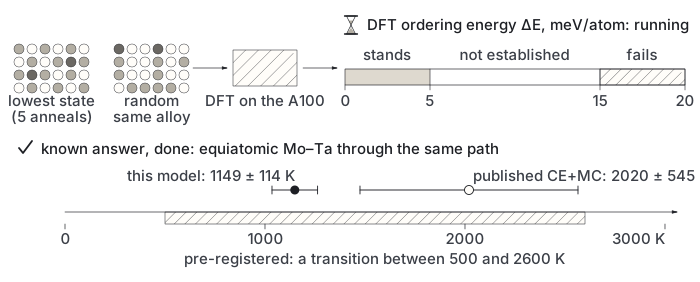
Does the chosen alloy really stay disordered when checked with DFT?
No. It orders: on cells with identical atom counts, DFT puts the model's arrangement 25.6 meV/atom below a random one, past the 15 meV/atom fail bar. The model had predicted +22.6 ± 8.8; the old ordering rung let it through.
In the log: the survivor at DFT: does Mo₅₁Ti₃₈W₃Ta₃ order? (pre-registered 2026-09-23 22:0x)
falsifiedDate 2026-09-23 22:0x, as written in the logrung 4 · DFT4 predictions · 5 result paragraphsEXPERIMENTS.md lines 16291–16308, line 16309, lines 16311–16320, lines 16376–16393, lines 16395–16435, lines 16584–16590, lines 16653–16679, lines 17268–17276
What E242 did and how it came out, drawn from this record and the files it names (book/assets/diagrams/exp/E242.svg).
Pre-registration
(1)
e6's
own ΔE_order on these two cells is < 5 meV/atom (its rung 1 finds no transition down to 60 K; by
E222's Bragg–Williams scaling ~20–30 K per meV).
falsifiede6's ΔE_order is 17–33, not < 5; …
(2)
Decisive: DFT ΔE_order ≤ 5 meV/atom → e6's
ordering energetics confirmed at this composition and the find stands as the ladder's first
full pass; 5–15 → not established (a transition could sit at ~100–400 K), reported as such; > 15 →
e6 is wrong here and the find FAILS. The e6 ground state is the lowest state the MODEL finds, so a
small DFT ΔE_order is a lower bound that cannot rule out a different DFT-preferred order — stated,
not hidden.
fails, ΔE_order 25 …
(3)
The random cell's DFT formation energy is within 15 meV/atom of e6's (with E239's
open Ti-reference caveat: the old-label frame may carry ~x_Ti·30 meV).
falsifiedas written: e6 − DFT is −21 …
(4)
Known answer for e6's
rung 1 (runs in parallel on the Mac): equiatomic Mo–Ta through the production path (ECEVerifier,
e6 ensemble mean, exact evaluator) must show a transition inside the sweep between 500 and 2600 K
(published CE+MC 2020 ± 545 K; v5 985 K on the same sampler); "no transition" there would void E240.
no verdict written against it
The pre-registration, as written
E242 — the survivor at DFT: does Mo₅₁Ti₃₈W₃Ta₃ order? (pre-registered 2026-09-23 22:0x)
E222's design on E241's survivor. The e6 model (seed 0; the ensemble re-evaluates) is annealed from
five starts to its 54-atom ground state at the survivor's composition (ground_state.py), and a
seed-fixed random decoration of the same composition is written (random_cell.py); both at ideal
bcc sites and the Vegard constant, QE at the rung-4 standard (60/720 Ry, k 4³, MV 0.02), on the A100
through the spin-aware ladder. ΔE_order = E(random) − E(ground), per atom. Predictions. (1) e6's
own ΔE_order on these two cells is < 5 meV/atom (its rung 1 finds no transition down to 60 K; by
E222's Bragg–Williams scaling ~20–30 K per meV). (2) Decisive: DFT ΔE_order ≤ 5 meV/atom → e6's
ordering energetics confirmed at this composition and the find stands as the ladder's first
full pass; 5–15 → not established (a transition could sit at ~100–400 K), reported as such; > 15 →
e6 is wrong here and the find FAILS. The e6 ground state is the lowest state the MODEL finds, so a
small DFT ΔE_order is a lower bound that cannot rule out a different DFT-preferred order — stated,
not hidden. (3) The random cell's DFT formation energy is within 15 meV/atom of e6's (with E239's
open Ti-reference caveat: the old-label frame may carry ~x_Ti·30 meV). (4) Known answer for e6's
rung 1 (runs in parallel on the Mac): equiatomic Mo–Ta through the production path (ECEVerifier,
e6 ensemble mean, exact evaluator) must show a transition inside the sweep between 500 and 2600 K
(published CE+MC 2020 ± 545 K; v5 985 K on the same sampler); "no transition" there would void E240.
E242 — the two DFT cells are not the same composition; fixed before scoring (2026-09-24 01:57). Both
cells reached JOB DONE on the A100 (runs/e242_dft.log: ordered −235006.117 eV, random
−235777.395 eV). Their totals differ by 771 eV because the cells differ by one atom. The ordered
cell is Mo₂₇Ti₂₁Ta₂W₂Zr₂: the anneal keeps whatever counts pyeCE's sampler produced
(ground_state.json). The random cell is Mo₂₈Ti₂₁Ta₂W₂Zr₁: random_cell.py rounds x by largest
remainder. This is the same defect the site check found in E222 (Cr₁₄Ta₁₃Ti₁₄W₁₃ vs Cr₁₄Ta₁₄Ti₁₃W₁₃).
The model-side "ΔE_order(v5) +21.7 meV/atom" printed by ground_state.py is no ordering energy
either. It sets the 54-atom ground state against the model's random mean at the continuous x,
which also carries 0.63 at.% each of Cr, Hf, Nb and V. Nothing is scored on these pairs. Fix,
under the pre-registration's own wording ("a seed-fixed random decoration of the same composition"):
random_cell.py gains --counts, which takes the ordered cell's exact counts.
A new random cell is drawn at Mo₂₇Ti₂₁Ta₂W₂Zr₂ with seed 0, at the same Vegard constant (3.2448 Å),
and computed at the same rung-4 standard.
e6's own ΔE_order for (1) is taken on the two 54-atom cells of that composition, with the random
side as the mean over decorations of the same 54 atoms.
The Mo₂₈ random cell already computed is kept for prediction (3), which needs only a random cell
and its own e6 value.
Predictions unchanged.
E242 correction (2026-09-27 00:05): the Mo–Ta reference. This entry and its pre-registration quote "published
CE+MC 2020 ± 545 K". Kim & Widom (Phys. Rev. Materials7, 063803, 2023) give 2020 K with no
uncertainty: the susceptibility peak of an unrelaxed 1024-atom lattice under a four-site cluster
model with a 21 meV/atom error. The ±545 K is published_error_K: this project's rule, 2020 × √2 × 21 / 110,
where 110 meV/atom is the ordering energy a nearest-neighbour bcc Ising model needs to order at 2020 K,
inferred here, not given in the paper. It was written correctly on 2026-09-21 ("by this project's own
rule") and lost the qualifier in later copies. No other publication found reports it; other estimates
cited in a 2026 paper range from 800 ± 200 to 1770 K (not yet read in the originals). The known-answer
bar (500–2600 K) never used the ±545 K, so the E242 (4) verdict is unchanged.
Results
EXPERIMENTS.md · line 16309
E242 addendum (2026-09-24 00:08, before any DFT result) — the cells' actual composition. Both 54-atom cells round the survivor's nine-element x to whole atoms: Mo₂₈Ti₂₁Ta₂W₂Zr₁ (runs/e242_random/Mo51Ti38W3Ta3_random/random_cell.json), i.e. Mo 51.9, Ti 38.9, Ta 3.7, W 3.7, Zr 1.9 at.%. Cr, Hf, Nb and V (0.63 at.% each in x, 0.34 atoms each) are absent. The name Mo₅₁Ti₃₈W₃Ta₃ is x's four largest shares; ΔE_order is measured on the rounded cell, and the verdict applies to that composition. Predictions unchanged.
EXPERIMENTS.md · line 16311
E242 (4) RESULT (22:4x) — e6's rung 1 passes the Mo–Ta known answer. Equiatomic Mo–Ta through the
production path (ECEVerifier, three-member e6 mean, exact evaluator): T = 1149 ± 114 K by the
energy-slope channel, α₁(Mo–Ta) = −1.00 on cooling (perfect B2) — inside the pre-registered 500–2600 K
(published CE+MC 2020 ± 545 K; v5 985 K). E240 is not void. Caveat it exposes: the fluctuation
channel peaks at 80 K here — a spurious low-temperature peak from energy still drifting where
the sampler freezes, while the true transition sits at 1149 K. Both channels therefore have cold-end
artefacts. The 2026-09-23 fix uses the fluctuation channel only when the slope channel found no peak,
and the five finds it failed had mid-range fluctuation peaks (331–575 K), not cold-end ones; failing an
ambiguous find is the safe direction, but those five are "not established", not proven to order.
runs/e242_mota_known_answer.json.
EXPERIMENTS.md · line 16395
E242 (1) and (3) RESULTS (2026-09-24 02:01); (2), the decisive one, waits for the matched random cell.
(1) Falsified, on every seed.runs/e242_model_side.json (scripts/ordering/e242_model_side.py).
Each seed is evaluated on the anneal's 54-atom ground state and on the mean of 32 seed-fixed shuffles
of the same 54 atoms:
e6 seed
ordering energy ΔE_order, meV/atom
0
+32.8
1
+17.3
2
+17.7
ensemble
+22.6 ± 8.8 (seed sd)
The prediction was < 5. The model's own energetics say this composition orders. By the
Bragg–Williams scaling this entry used (~20–30 K per meV), that puts ordering at roughly 450–680 K,
inside the window. So e6 contradicts its own rung 1, which read "no transition down to 60 K".
The rung-1 record shows why the two disagree (runs/e240_walk/15_Mo51Ti38W3Ta3.json):
its energy at the 60 K floor is −106.5 meV/atom, against rung 0's random-solution −83.7;
the sampler did order, by 23 meV/atom, the size of ΔE_order above;
neither transition channel found a peak on the 227 K grid.
A gradual ordering with no sharp peak is being read as "no transition", and so as a pass.
scripts/ordering/e242_rung1_curve.py re-runs the same rung on a 60 K grid to show where the
energy falls (runs/e242_rung1_curve.json). Until that lands, the survivor's rung-1 pass is not
established, and E240/E241's "silent to 60 K" verdicts share the doubt.
(3) Falsified as written.runs/e242_formation.json, the same references and ensemble as
E223's scoring:
cell
DFT E_form, meV/atom
e6, meV/atom
e6 − DFT
random Mo₂₈Ti₂₁Ta₂W₂Zr₁
−59.0
−80.3 ± 5.2
−21.3 (bar ±15)
ordered Mo₂₇Ti₂₁Ta₂W₂Zr₂
−64.6
−93.5 ± 11.0
−28.9
The pre-registered caveat (the old-label frame may carry ~x_Ti·30 ≈ 12 meV/atom of Ti reference)
could account for about half of the random cell's miss; E239 measures it. Either way e6 binds
this Mo–Ti composition too deeply.
The ordered and random totals above are NOT an ordering energy: the cells differ by one atom
(addendum above). (2) is scored only on the matched pair (runs/e242b_dft_chain.sh, queued
behind E221's W cell).
EXPERIMENTS.md · line 16584
E242 diagnostic RESULT: the survivor orders inside the window.runs/e242_rung1_curve.json uses
the same e6 ensemble, cell and sweeps as E240's rung 1, but a 60 K grid (floor 80 K). The EXISTING
peak reader finds a transition inside the sweep: dE/dT at 320 ± 180 K, the fluctuation channel at
492 K. The energy falls from −84.0 (740 K) to −106.9 meV/atom (80 K), and α₁(Mo–Ta) reaches −0.53.
The survivor fails rung 1. The blind spot that passed it was mainly E240's 227 K grid, on which no
peak resolved and "no peak" read as a pass. The survivor fails whatever E242's DFT (2) says about
the ordering energy's size. E241 must re-choose from finds re-read on a fine grid.
EXPERIMENTS.md · line 16653
E242 (2) RESULT (2026-09-24 03:46): the survivor FAILS. It orders, and the model knew it. The matched cells
hold the same 54 atoms (Mo₂₇Ti₂₁Ta₂W₂Zr₂) at the same Vegard constant and rung-4 standard; both are
non-magnetic and converged (26 and 28 SCF iterations):
ordered −235006.117 eV;
random −235004.736 eV (runs/e242b_dft.log).
DFT ΔE_order = +25.6 meV/atom. The bar was > 15 → the find fails.
The pre-registration's wording, "e6 is wrong here", assumed e6's own ΔE_order was small, and (1)
showed it was not. e6's energetics are right:
e6 estimate of ΔE_order
meV/atom
this exact cell pair (ensemble)
+32.2
mean over 32 decorations of the same atoms
+22.6 ± 8.8
DFT
+25.6
So the failure was never the model's. Rung 1's coarse-grid reading turned an ordering it had actually
sampled into a pass (E242 diagnostic: peak 320 ± 180 K on the fine grid). Final E242 scorecard:
(1) falsified: e6's ΔE_order is 17–33, not < 5;
(2) fails, ΔE_order 25.6 by DFT;
(3) falsified as written: e6 − DFT is −21.3 on the random cell, about half of it possibly the Ti
reference;
(4) passed: Mo–Ta at 1149 K.
The ladder's first full walk ends with no survivor. Rung 1 as corrected (E244's fine grid)
would have stopped this composition before DFT.
The full record
This entry is written in 8 separate places in the log, shown here in log order.
EXPERIMENTS.md · lines 16291–16308
E242 — the survivor at DFT: does Mo₅₁Ti₃₈W₃Ta₃ order? (pre-registered 2026-09-23 22:0x)
E222's design on E241's survivor. The e6 model (seed 0; the ensemble re-evaluates) is annealed from
five starts to its 54-atom ground state at the survivor's composition (ground_state.py), and a
seed-fixed random decoration of the same composition is written (random_cell.py); both at ideal
bcc sites and the Vegard constant, QE at the rung-4 standard (60/720 Ry, k 4³, MV 0.02), on the A100
through the spin-aware ladder. ΔE_order = E(random) − E(ground), per atom. Predictions. (1) e6's
own ΔE_order on these two cells is < 5 meV/atom (its rung 1 finds no transition down to 60 K; by
E222's Bragg–Williams scaling ~20–30 K per meV). (2) Decisive: DFT ΔE_order ≤ 5 meV/atom → e6's
ordering energetics confirmed at this composition and the find stands as the ladder's first
full pass; 5–15 → not established (a transition could sit at ~100–400 K), reported as such; > 15 →
e6 is wrong here and the find FAILS. The e6 ground state is the lowest state the MODEL finds, so a
small DFT ΔE_order is a lower bound that cannot rule out a different DFT-preferred order — stated,
not hidden. (3) The random cell's DFT formation energy is within 15 meV/atom of e6's (with E239's
open Ti-reference caveat: the old-label frame may carry ~x_Ti·30 meV). (4) Known answer for e6's
rung 1 (runs in parallel on the Mac): equiatomic Mo–Ta through the production path (ECEVerifier,
e6 ensemble mean, exact evaluator) must show a transition inside the sweep between 500 and 2600 K
(published CE+MC 2020 ± 545 K; v5 985 K on the same sampler); "no transition" there would void E240.
EXPERIMENTS.md · line 16309
E242 addendum (2026-09-24 00:08, before any DFT result) — the cells' actual composition. Both 54-atom cells round the survivor's nine-element x to whole atoms: Mo₂₈Ti₂₁Ta₂W₂Zr₁ (runs/e242_random/Mo51Ti38W3Ta3_random/random_cell.json), i.e. Mo 51.9, Ti 38.9, Ta 3.7, W 3.7, Zr 1.9 at.%. Cr, Hf, Nb and V (0.63 at.% each in x, 0.34 atoms each) are absent. The name Mo₅₁Ti₃₈W₃Ta₃ is x's four largest shares; ΔE_order is measured on the rounded cell, and the verdict applies to that composition. Predictions unchanged.
EXPERIMENTS.md · lines 16311–16320
E242 (4) RESULT (22:4x) — e6's rung 1 passes the Mo–Ta known answer. Equiatomic Mo–Ta through the
production path (ECEVerifier, three-member e6 mean, exact evaluator): T = 1149 ± 114 K by the
energy-slope channel, α₁(Mo–Ta) = −1.00 on cooling (perfect B2) — inside the pre-registered 500–2600 K
(published CE+MC 2020 ± 545 K; v5 985 K). E240 is not void. Caveat it exposes: the fluctuation
channel peaks at 80 K here — a spurious low-temperature peak from energy still drifting where
the sampler freezes, while the true transition sits at 1149 K. Both channels therefore have cold-end
artefacts. The 2026-09-23 fix uses the fluctuation channel only when the slope channel found no peak,
and the five finds it failed had mid-range fluctuation peaks (331–575 K), not cold-end ones; failing an
ambiguous find is the safe direction, but those five are "not established", not proven to order.
runs/e242_mota_known_answer.json.
EXPERIMENTS.md · lines 16376–16393
E242 — the two DFT cells are not the same composition; fixed before scoring (2026-09-24 01:57). Both
cells reached JOB DONE on the A100 (runs/e242_dft.log: ordered −235006.117 eV, random
−235777.395 eV). Their totals differ by 771 eV because the cells differ by one atom. The ordered
cell is Mo₂₇Ti₂₁Ta₂W₂Zr₂: the anneal keeps whatever counts pyeCE's sampler produced
(ground_state.json). The random cell is Mo₂₈Ti₂₁Ta₂W₂Zr₁: random_cell.py rounds x by largest
remainder. This is the same defect the site check found in E222 (Cr₁₄Ta₁₃Ti₁₄W₁₃ vs Cr₁₄Ta₁₄Ti₁₃W₁₃).
The model-side "ΔE_order(v5) +21.7 meV/atom" printed by ground_state.py is no ordering energy
either. It sets the 54-atom ground state against the model's random mean at the continuous x,
which also carries 0.63 at.% each of Cr, Hf, Nb and V. Nothing is scored on these pairs. Fix,
under the pre-registration's own wording ("a seed-fixed random decoration of the same composition"):
random_cell.py gains --counts, which takes the ordered cell's exact counts.
A new random cell is drawn at Mo₂₇Ti₂₁Ta₂W₂Zr₂ with seed 0, at the same Vegard constant (3.2448 Å),
and computed at the same rung-4 standard.
e6's own ΔE_order for (1) is taken on the two 54-atom cells of that composition, with the random
side as the mean over decorations of the same 54 atoms.
The Mo₂₈ random cell already computed is kept for prediction (3), which needs only a random cell
and its own e6 value.
Predictions unchanged.
EXPERIMENTS.md · lines 16395–16435
E242 (1) and (3) RESULTS (2026-09-24 02:01); (2), the decisive one, waits for the matched random cell.
(1) Falsified, on every seed.runs/e242_model_side.json (scripts/ordering/e242_model_side.py).
Each seed is evaluated on the anneal's 54-atom ground state and on the mean of 32 seed-fixed shuffles
of the same 54 atoms:
e6 seed
ordering energy ΔE_order, meV/atom
0
+32.8
1
+17.3
2
+17.7
ensemble
+22.6 ± 8.8 (seed sd)
The prediction was < 5. The model's own energetics say this composition orders. By the
Bragg–Williams scaling this entry used (~20–30 K per meV), that puts ordering at roughly 450–680 K,
inside the window. So e6 contradicts its own rung 1, which read "no transition down to 60 K".
The rung-1 record shows why the two disagree (runs/e240_walk/15_Mo51Ti38W3Ta3.json):
its energy at the 60 K floor is −106.5 meV/atom, against rung 0's random-solution −83.7;
the sampler did order, by 23 meV/atom, the size of ΔE_order above;
neither transition channel found a peak on the 227 K grid.
A gradual ordering with no sharp peak is being read as "no transition", and so as a pass.
scripts/ordering/e242_rung1_curve.py re-runs the same rung on a 60 K grid to show where the
energy falls (runs/e242_rung1_curve.json). Until that lands, the survivor's rung-1 pass is not
established, and E240/E241's "silent to 60 K" verdicts share the doubt.
(3) Falsified as written.runs/e242_formation.json, the same references and ensemble as
E223's scoring:
cell
DFT E_form, meV/atom
e6, meV/atom
e6 − DFT
random Mo₂₈Ti₂₁Ta₂W₂Zr₁
−59.0
−80.3 ± 5.2
−21.3 (bar ±15)
ordered Mo₂₇Ti₂₁Ta₂W₂Zr₂
−64.6
−93.5 ± 11.0
−28.9
The pre-registered caveat (the old-label frame may carry ~x_Ti·30 ≈ 12 meV/atom of Ti reference)
could account for about half of the random cell's miss; E239 measures it. Either way e6 binds
this Mo–Ti composition too deeply.
The ordered and random totals above are NOT an ordering energy: the cells differ by one atom
(addendum above). (2) is scored only on the matched pair (runs/e242b_dft_chain.sh, queued
behind E221's W cell).
EXPERIMENTS.md · lines 16584–16590
E242 diagnostic RESULT: the survivor orders inside the window.runs/e242_rung1_curve.json uses
the same e6 ensemble, cell and sweeps as E240's rung 1, but a 60 K grid (floor 80 K). The EXISTING
peak reader finds a transition inside the sweep: dE/dT at 320 ± 180 K, the fluctuation channel at
492 K. The energy falls from −84.0 (740 K) to −106.9 meV/atom (80 K), and α₁(Mo–Ta) reaches −0.53.
The survivor fails rung 1. The blind spot that passed it was mainly E240's 227 K grid, on which no
peak resolved and "no peak" read as a pass. The survivor fails whatever E242's DFT (2) says about
the ordering energy's size. E241 must re-choose from finds re-read on a fine grid.
EXPERIMENTS.md · lines 16653–16679
E242 (2) RESULT (2026-09-24 03:46): the survivor FAILS. It orders, and the model knew it. The matched cells
hold the same 54 atoms (Mo₂₇Ti₂₁Ta₂W₂Zr₂) at the same Vegard constant and rung-4 standard; both are
non-magnetic and converged (26 and 28 SCF iterations):
ordered −235006.117 eV;
random −235004.736 eV (runs/e242b_dft.log).
DFT ΔE_order = +25.6 meV/atom. The bar was > 15 → the find fails.
The pre-registration's wording, "e6 is wrong here", assumed e6's own ΔE_order was small, and (1)
showed it was not. e6's energetics are right:
e6 estimate of ΔE_order
meV/atom
this exact cell pair (ensemble)
+32.2
mean over 32 decorations of the same atoms
+22.6 ± 8.8
DFT
+25.6
So the failure was never the model's. Rung 1's coarse-grid reading turned an ordering it had actually
sampled into a pass (E242 diagnostic: peak 320 ± 180 K on the fine grid). Final E242 scorecard:
(1) falsified: e6's ΔE_order is 17–33, not < 5;
(2) fails, ΔE_order 25.6 by DFT;
(3) falsified as written: e6 − DFT is −21.3 on the random cell, about half of it possibly the Ti
reference;
(4) passed: Mo–Ta at 1149 K.
The ladder's first full walk ends with no survivor. Rung 1 as corrected (E244's fine grid)
would have stopped this composition before DFT.
EXPERIMENTS.md · lines 17268–17276
E242 correction (2026-09-27 00:05): the Mo–Ta reference. This entry and its pre-registration quote "published
CE+MC 2020 ± 545 K". Kim & Widom (Phys. Rev. Materials7, 063803, 2023) give 2020 K with no
uncertainty: the susceptibility peak of an unrelaxed 1024-atom lattice under a four-site cluster
model with a 21 meV/atom error. The ±545 K is published_error_K: this project's rule, 2020 × √2 × 21 / 110,
where 110 meV/atom is the ordering energy a nearest-neighbour bcc Ising model needs to order at 2020 K,
inferred here, not given in the paper. It was written correctly on 2026-09-21 ("by this project's own
rule") and lost the qualifier in later copies. No other publication found reports it; other estimates
cited in a 2026 paper range from 800 ± 200 to 1770 K (not yet read in the originals). The known-answer
bar (500–2600 K) never used the ±545 K, so the E242 (4) verdict is unchanged.