Does the machine-learned potential overestimate the energy of a vacancy in molybdenum?
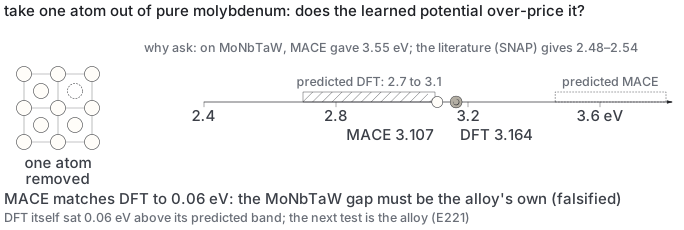
No. It matched DFT to 0.06 eV (3.107 against 3.164 eV), where an error above 0.3 eV was predicted.
In the log: E216–E219 — pre-registered before any of them runs (2026-09-21 16:2x)
falsifiedDate 2026-09-21 16:2x, as written in the logrung 4 · DFT2 predictions · 1 result paragraphEXPERIMENTS.md lines 14103–14106, lines 14140–14149, lines 15006–15020
What E219 did and how it came out, drawn from this record and the files it names (book/assets/diagrams/exp/E219.svg).
Pre-registration
(15)
− (15/16)·E
no verdict written against it
(16)
. MACE on the identical cells with the identical relaxation. This
is the cheapest direct test of the discrepancy that rung 3's first run exposed: MACE gives
E_f_eff = 3.55 eV on MoNbTaW where SNAP literature says 2.48–2.54 — a +1 eV error in the
"too frozen" direction would dominate every kinetics verdict. Predictions: DFT E_f
2.7–3.1 eV (larger cells give 2.9–3.0; 16 atoms carries ±0.15 finite-size error);
MACE − DFT > +0.3 eV (the MoNbTaW number is not a fluke), which would keep
trust_kinetics off and set the correction the rung needs. If MACE lands within ±0.2 of DFT
here, the MoNbTaW discrepancy is alloy-specific and needs an alloy anchor next.
no verdict written against it
The pre-registration, as written
E216–E219 — pre-registered before any of them runs (2026-09-21 16:2x)
Queued as one pw.x-at-a-time chain behind the fcc references (runs/e216_e219_chain.sh),
cheapest first. Each is the first number of its kind in this project.
E219 — a DFT anchor for rung 3. Vacancy formation energy of pure bcc Mo in a 2×2×2
(16-atom) cell: perfect cell, and the 15-atom cell relaxed at fixed volume;
E_f = E(15) − (15/16)·E(16). MACE on the identical cells with the identical relaxation. This
is the cheapest direct test of the discrepancy that rung 3's first run exposed: MACE gives
E_f_eff = 3.55 eV on MoNbTaW where SNAP literature says 2.48–2.54 — a +1 eV error in the
"too frozen" direction would dominate every kinetics verdict. Predictions: DFT E_f
2.7–3.1 eV (larger cells give 2.9–3.0; 16 atoms carries ±0.15 finite-size error);
MACE − DFT > +0.3 eV (the MoNbTaW number is not a fluke), which would keep
trust_kinetics off and set the correction the rung needs. If MACE lands within ±0.2 of DFT
here, the MoNbTaW discrepancy is alloy-specific and needs an alloy anchor next.
Results
EXPERIMENTS.md · line 15006
E219 RESULT — the pure-Mo vacancy anchor: MACE is right where it was expected to be wrong (2026-09-21 21:0x)
2×2×2 bcc Mo, a₀ 3.167 Å, k 7³, 60/720 Ry; 15-atom cell relaxed at fixed volume (BFGS, 4
steps). DFT E_f = 3.164 eV; MACE-MPA-0 on the identical cells 3.107 eV; residual −0.057 eV.
Scored against the pre-registration: DFT was predicted at 2.7–3.1 eV — 3.16 misses the top
of the bar by 0.06 (a 16-atom cell at fixed volume sits high; the bar's own ±0.15 finite-
size allowance covers it, the bar did not); MACE − DFT was predicted > +0.3 eV (the
MoNbTaW 3.55 eV against SNAP's 2.48–2.54 "not a fluke") — falsified: −0.06 eV. The
pre-registered consequence of this branch applies: the MoNbTaW discrepancy is alloy-specific
and needs an alloy anchor next.trust_kinetics stays off — this result licenses nothing
about alloys; it removes "MACE's vacancy energies are generically 1 eV high" as an
explanation. MACE ran in float32 (its default; ~0.01 eV noise on a difference of two cells).
Next: E221, the same measurement on a 16-atom MoNbTaW cell, one vacancy per species,
against the same MACE on identical cells and against SNAP's 2.5 — the number the kinetics
rung actually uses. The separate E219 re-run chain is stopped as redundant.
The full record
This entry is written in 3 separate places in the log, shown here in log order.
EXPERIMENTS.md · lines 14103–14106
E216–E219 — pre-registered before any of them runs (2026-09-21 16:2x)
Queued as one pw.x-at-a-time chain behind the fcc references (runs/e216_e219_chain.sh),
cheapest first. Each is the first number of its kind in this project.
EXPERIMENTS.md · lines 14140–14149
E219 — a DFT anchor for rung 3. Vacancy formation energy of pure bcc Mo in a 2×2×2
(16-atom) cell: perfect cell, and the 15-atom cell relaxed at fixed volume;
E_f = E(15) − (15/16)·E(16). MACE on the identical cells with the identical relaxation. This
is the cheapest direct test of the discrepancy that rung 3's first run exposed: MACE gives
E_f_eff = 3.55 eV on MoNbTaW where SNAP literature says 2.48–2.54 — a +1 eV error in the
"too frozen" direction would dominate every kinetics verdict. Predictions: DFT E_f
2.7–3.1 eV (larger cells give 2.9–3.0; 16 atoms carries ±0.15 finite-size error);
MACE − DFT > +0.3 eV (the MoNbTaW number is not a fluke), which would keep
trust_kinetics off and set the correction the rung needs. If MACE lands within ±0.2 of DFT
here, the MoNbTaW discrepancy is alloy-specific and needs an alloy anchor next.
EXPERIMENTS.md · lines 15006–15020
E219 RESULT — the pure-Mo vacancy anchor: MACE is right where it was expected to be wrong (2026-09-21 21:0x)
2×2×2 bcc Mo, a₀ 3.167 Å, k 7³, 60/720 Ry; 15-atom cell relaxed at fixed volume (BFGS, 4
steps). DFT E_f = 3.164 eV; MACE-MPA-0 on the identical cells 3.107 eV; residual −0.057 eV.
Scored against the pre-registration: DFT was predicted at 2.7–3.1 eV — 3.16 misses the top
of the bar by 0.06 (a 16-atom cell at fixed volume sits high; the bar's own ±0.15 finite-
size allowance covers it, the bar did not); MACE − DFT was predicted > +0.3 eV (the
MoNbTaW 3.55 eV against SNAP's 2.48–2.54 "not a fluke") — falsified: −0.06 eV. The
pre-registered consequence of this branch applies: the MoNbTaW discrepancy is alloy-specific
and needs an alloy anchor next.trust_kinetics stays off — this result licenses nothing
about alloys; it removes "MACE's vacancy energies are generically 1 eV high" as an
explanation. MACE ran in float32 (its default; ~0.01 eV noise on a difference of two cells).
Next: E221, the same measurement on a 16-atom MoNbTaW cell, one vacancy per species,
against the same MACE on identical cells and against SNAP's 2.5 — the number the kinetics
rung actually uses. The separate E219 re-run chain is stopped as redundant.
Related entries
E216 — E219 — pre-registered before any of them runs (2026-09-21 16:2x)
E221 — the alloy vacancy anchor, pre-registered (2026-09-21 21:1x; queued after E217 and the…