Is the energy model reliable for a chromium-containing alloy when checked against DFT?
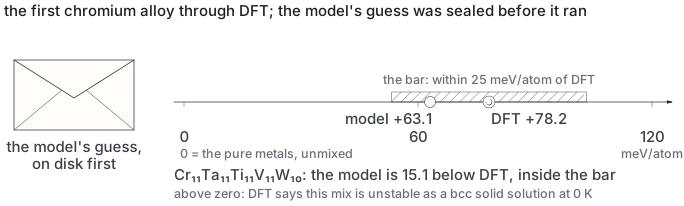
Yes. For Cr-Ta-Ti-V-W it was within 15.1 meV/atom of DFT, inside the 25 meV/atom bar.
In the log: E216–E219 — pre-registered before any of them runs (2026-09-21 16:2x)
confirmedDate 2026-09-21 16:2x, as written in the logrung 4 · DFT0 predictions · 1 result paragraphEXPERIMENTS.md lines 14103–14106, lines 14119–14128, lines 15116–15141
What E217 did and how it came out, drawn from this record and the files it names (book/assets/diagrams/exp/E217.svg).
Pre-registration
The pre-registration, as written
E216–E219 — pre-registered before any of them runs (2026-09-21 16:2x)
Queued as one pw.x-at-a-time chain behind the fcc references (runs/e216_e219_chain.sh),
cheapest first. Each is the first number of its kind in this project.
E217 — the first chromium-bearing alloy through rung 4. Cr₂₀Ta₂₀Ti₂₀V₂₀W₂₀ (SOB20's
scorecard quinary; published T_c 900–1000 K), one random 54-site decoration at Vegard
a = 3.1362 Å, the standard settings. v5's rung-0 prediction is on disk before pw.x
runs (runs/e217_cr_alloy/prediction.json): cell +63.1 meV/atom, random
+84.2 ± 13.2 (n = 8) — a positive formation energy against the bcc pure elements,
i.e. v5 says this scorecard system is unstable as a bcc solid solution. Prediction:
|v5 − DFT| < 25 meV/atom (Cr has 1576 training rows, it is not an edge like Hf/Zr were
in E172). If the residual exceeds 40, v5's Cr corner is as unreliable as its Hf/Zr corner
was and every Cr-bearing scorecard number from E210 inherits that. No sign prediction —
the record has both signs on hand (Mo–Ta +32, MoNbTaW −4).
Results
EXPERIMENTS.md · line 15116
E217 RESULT — the first chromium alloy through rung 4 (2026-09-22 00:3x)
Cr₁₁Ta₁₁Ti₁₁V₁₁W₁₀, 54 atoms at Vegard a = 3.1362 Å, 60/720 Ry, k 4³, converged in 26
iterations (3 h 16 min wall on six ranks). DFT E_form = +78.2 meV/atom against the bcc
pure elements (data/dft/E217_Cr11Ta11Ti11V11W10.extxyz). v5, written before pw.x ran:
this cell +63.1, random mean +84.2 ± 13.2. Residual v5 − DFT = −15.1 meV/atom: inside the
pre-registered 25 meV bar — v5's Cr corner is as reliable as its Mo–Ta interior (+32 there,
−4 on MoNbTaW), not another Hf/Zr corner. The sign agrees too: SOB20's scorecard quinary
Cr–Ta–Ti–V–W is unstable as a bcc solid solution at 0 K by DFT (+78 meV/atom), which is
worth stating beside its published 900–1000 K ordering temperature — that number was computed
on the ideal bcc lattice of a phase DFT does not want to form, and E210b's 747–830 K for the
same system (first system, 2026-09-21) inherits the same caveat. The row enters the store and
the v7 refit. E216's magnetic blind spot applies: this frame does not see bcc Cr's
antiferromagnetism (−12.4 meV/atom on pure Cr), so the +78 is the non-spin number.
Two reference runs that "finished" without running (2026-09-22 00:5x). The Fe fcc
lower-bracket scan and the 80-Ry Ni/Cu/Fe fcc references both died on the first line of
refs_fcc.py — a tag computed from SCALES before SCALES existed, introduced with the
--scales option on 2026-09-21 — and both chains wrote their done markers anyway, because
the marker followed the fit step's exit status (refs_fcc_fit.py happily re-fitted the
old 60-Ry cells) and not the scan's. Fe fcc is therefore still inside: False (a₀ 3.433
against a 3.446–3.662 bracket) and no 80-Ry reference exists; E218's Ni₃Al formation energy
will be read against a 60-Ry Ni reference until the redo lands. Fixed: tag after the
scales; runs/fcc_refs_redo_chain.sh runs both scans after the E218 finish chain and writes
its marker only if every scan exits 0; E221 waits for it. Same lesson as E217's truncated
output on 2026-09-21: a done marker must follow the thing that can fail.
The full record
This entry is written in 3 separate places in the log, shown here in log order.
EXPERIMENTS.md · lines 14103–14106
E216–E219 — pre-registered before any of them runs (2026-09-21 16:2x)
Queued as one pw.x-at-a-time chain behind the fcc references (runs/e216_e219_chain.sh),
cheapest first. Each is the first number of its kind in this project.
EXPERIMENTS.md · lines 14119–14128
E217 — the first chromium-bearing alloy through rung 4. Cr₂₀Ta₂₀Ti₂₀V₂₀W₂₀ (SOB20's
scorecard quinary; published T_c 900–1000 K), one random 54-site decoration at Vegard
a = 3.1362 Å, the standard settings. v5's rung-0 prediction is on disk before pw.x
runs (runs/e217_cr_alloy/prediction.json): cell +63.1 meV/atom, random
+84.2 ± 13.2 (n = 8) — a positive formation energy against the bcc pure elements,
i.e. v5 says this scorecard system is unstable as a bcc solid solution. Prediction:
|v5 − DFT| < 25 meV/atom (Cr has 1576 training rows, it is not an edge like Hf/Zr were
in E172). If the residual exceeds 40, v5's Cr corner is as unreliable as its Hf/Zr corner
was and every Cr-bearing scorecard number from E210 inherits that. No sign prediction —
the record has both signs on hand (Mo–Ta +32, MoNbTaW −4).
EXPERIMENTS.md · lines 15116–15141
E217 RESULT — the first chromium alloy through rung 4 (2026-09-22 00:3x)
Cr₁₁Ta₁₁Ti₁₁V₁₁W₁₀, 54 atoms at Vegard a = 3.1362 Å, 60/720 Ry, k 4³, converged in 26
iterations (3 h 16 min wall on six ranks). DFT E_form = +78.2 meV/atom against the bcc
pure elements (data/dft/E217_Cr11Ta11Ti11V11W10.extxyz). v5, written before pw.x ran:
this cell +63.1, random mean +84.2 ± 13.2. Residual v5 − DFT = −15.1 meV/atom: inside the
pre-registered 25 meV bar — v5's Cr corner is as reliable as its Mo–Ta interior (+32 there,
−4 on MoNbTaW), not another Hf/Zr corner. The sign agrees too: SOB20's scorecard quinary
Cr–Ta–Ti–V–W is unstable as a bcc solid solution at 0 K by DFT (+78 meV/atom), which is
worth stating beside its published 900–1000 K ordering temperature — that number was computed
on the ideal bcc lattice of a phase DFT does not want to form, and E210b's 747–830 K for the
same system (first system, 2026-09-21) inherits the same caveat. The row enters the store and
the v7 refit. E216's magnetic blind spot applies: this frame does not see bcc Cr's
antiferromagnetism (−12.4 meV/atom on pure Cr), so the +78 is the non-spin number.
Two reference runs that "finished" without running (2026-09-22 00:5x). The Fe fcc
lower-bracket scan and the 80-Ry Ni/Cu/Fe fcc references both died on the first line of
refs_fcc.py — a tag computed from SCALES before SCALES existed, introduced with the
--scales option on 2026-09-21 — and both chains wrote their done markers anyway, because
the marker followed the fit step's exit status (refs_fcc_fit.py happily re-fitted the
old 60-Ry cells) and not the scan's. Fe fcc is therefore still inside: False (a₀ 3.433
against a 3.446–3.662 bracket) and no 80-Ry reference exists; E218's Ni₃Al formation energy
will be read against a 60-Ry Ni reference until the redo lands. Fixed: tag after the
scales; runs/fcc_refs_redo_chain.sh runs both scans after the E218 finish chain and writes
its marker only if every scan exits 0; E221 waits for it. Same lesson as E217's truncated
output on 2026-09-21: a done marker must follow the thing that can fail.
Related entries
E216 — E219 — pre-registered before any of them runs (2026-09-21 16:2x)
E219 — E216–E219 — pre-registered before any of them runs (2026-09-21 16:2x)
E172 — the first rung-4 verdict: DFT vs the cheap rung on one 54-atom cell
E210 — the reversible protocol on every scorecard system (2026-09-20 23:39; queued behind E207)
E210b — the nine-system scorecard by the second sampler, pre-registered (2026-09-21 19:1x)
E218 — E216–E219 — pre-registered before any of them runs (2026-09-21 16:2x)
E221 — the alloy vacancy anchor, pre-registered (2026-09-21 21:1x; queued after E217 and the…