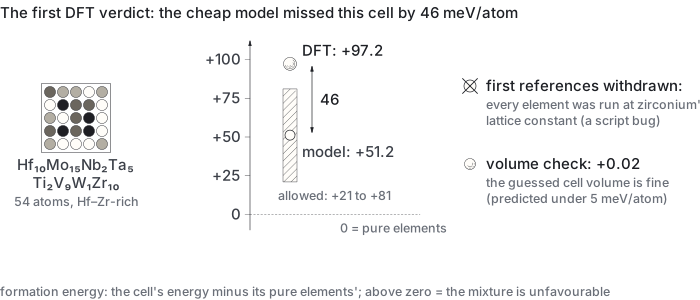
Does the cheap energy model agree with full DFT on a first 54-atom test cell?
No. DFT gave +97.2 meV/atom against the model's +51.2, a 46 meV/atom miss, well outside the allowed band.
In the log: the first rung-4 verdict: DFT vs the cheap rung on one 54-atom cell
falsifiedDate not stated in the log; it was written between the commit of 2026-09-16 19:06 and the first commit that contains it, 2026-09-19 08:35rung 4 · DFT0 predictions · 2 result paragraphsEXPERIMENTS.md lines 11152–11200, lines 11223–11229, lines 11255–11274
What E172 did and how it came out, drawn from this record and the files it names (book/assets/diagrams/exp/E172.svg).
Results
EXPERIMENTS.md · line 11223
E172 prediction 2 — confirmed. Alloy cell at 0.98 / 1.00 / 1.02: V/atom 16.812 / 17.863
/ 18.956 ų, E/atom −5757.30961 / −5757.33751 / −5757.30417 eV. Quadratic minimum at
V₀ = 17.836 ų/atom, a₀ = 3.2919 Å (inside the bracket) against the driver's Vegard
3.2935 Å: E(Vegard) − E(min) = +0.02 meV/atom (predicted < 5). The Vegard lattice
constant is a convention the cheap rung can be compared under; rung-4 cells need no volume
scan from here on — a single SCF at Vegard is within 0.1 meV/atom of the relaxed-volume
energy for a random decoration of this kind. Predictions 1 and 3 wait on refs_v2/.
EXPERIMENTS.md · line 11255
E172 verdict — prediction 1 FALSIFIED: the cheap rung is 46 meV/atom off on this cell.refs_v2/ (24 cells, matched settings, one k-mesh per element), each element's E(V)
minimum by quadratic through three points:
el   E_min (eV/atom)   a0 (Å)   RHEA a   bracket
Hf   -9472.34384      3.5368   3.600    inside
Mo   -4951.28756      3.1678   3.167    inside
Nb   -4547.88389      3.3169   3.340    inside
Ta   -9893.18864      3.3215   3.325    inside
Ti   -2499.17687      3.2626   3.300    inside
V    -2911.93430      3.0091   3.001    inside
W   -10343.86807      3.1862   3.190    inside
Zr   -4179.73760      3.5552   3.689    OUTSIDE (below 0.97 x 3.689 = 3.578) → re-run
Zr   -4179.73822      3.5792   3.689    inside, on 0.93/0.96/0.99 (refs_v2_zr.py)
E_form(DFT) = +97.2 meV/atom; eCE = +51.2; difference +46.0 — outside [21, 81] by 16
and 4× the eCE's holdout MAE. Prediction 3 confirmed after the Zr re-bracket (the first
scan's Zr minimum fell below its bracket; re-run three points lower, it sits inside at
a₀ = 3.579 Å and moves E_min by 0.6 meV — E_form by 0.1). The falsification did not hinge
on it.
The full record
This entry is written in 3 separate places in the log, shown here in log order.
EXPERIMENTS.md · lines 11152–11200
E172 — the first rung-4 verdict: DFT vs the cheap rung on one 54-atom cell
Conventions before differencing. The DFT cell is at ideal sites and at a Vegard lattice
constant — not its relaxed volume. The cheap rung's labels (E_lattice) are at ideal sites
and relaxed volume, referenced to corrected pure cells at their own relaxed volumes. So
the DFT number cannot be differenced as it stands. Launched (runs/rung4_n54_k3/refs_chain.sh,
resume-safe per unit): the eight pure bcc elements at 0.97 / 1.00 / 1.03 of their reference
lattice constant, two-atom cells, identical settings (50/400 Ry, MV 0.02 Ry, same psl
PAW, k-spacing 0.212 Å⁻¹ = this cell's 3×3×3), and the 54-atom cell again at 0.98 and 1.02.
Each E(V) is fitted (quadratic in V through three points; Birch not needed for ±3%) and
both sides are taken at their own minimum. The Δ-anchor references (60/480 Ry, MP1) are
not used — different convention.
The cheap rung's number, obtained before any DFT reference exists. The cell mapped onto
the eCE (ece data → ece predict, mapping cost 4e-20 — exact ideal sites):
E_lattice(eCE) = +51.2 meV/atom for Hf₁₀Mo₁₅Nb₂Ta₅Ti₂V₉W₁Zr₁₀. Positive: a Hf/Zr-rich
decoration with Mo and V is not a favourable mixture on the bcc lattice, and the eCE says so.
The eCE's own error on its composition-wise holdout (159 cells): MAE 11.4, RMSE 14.9, bias
+3.7 meV/atom.
Predictions, before the references finish.
E_mix(DFT, both sides at their own relaxed volume, QE-vs-QE) is positive and within
2 × RMSE = 30 meV/atom of +51.2, i.e. in [21, 81]. Outside that, the eCE is wrong on
this cell by more than its stated error and the cell joins training as a correction
(that is the flywheel's first turn, and the eCE's holdout error is then re-measured).
The volume correction on the alloy cell (E at Vegard a vs at its own minimum) is
< 5 meV/atom — a 54-atom random cell's Vegard constant is within ~1% of its relaxed
one, and ½·B·V·(ΔV/V)² at B ≈ 150 GPa gives ~1–3 meV/atom. If > 10, the driver's Vegard
volume is not a convention the cheap rung can be compared under, and every rung-4 cell
gets a three-volume fit as standard.
The pure references at 0.97/1.00/1.03 bracket each element's minimum (the middle point
lowest, or the fitted minimum inside the bracket) for all eight — the Δ-anchor lattice
constants were RHEA's, and QE's PBE minimum should sit within 1% of them. An element
whose minimum falls outside the bracket gets a wider scan before it is used.
Cross-code residual: both sides here are QE, so no Δ-gauge term enters; the eCE's labels
are VASP-referenced-to-VASP. The comparison is therefore formation energy vs formation
energy, each code against its own elements — the ACWF-clean quantity — with the measured
VW 6.7 meV/atom carried as the V-related uncertainty (E164), not corrected for.
The first 24 references are WITHDRAWN — an input fault, mine. Their E(a) fell
monotonically with expansion for every element while pw.x reported P from −74 to −511
kbar: a slope that says "expand" beside a stress that says "contract" cannot both be true
of one cell, so I read an input. The Mo input carried a = 3.689 Å and mass 91.224 — Zr's
values. macOS /bin/bash is 3.2 and has no declare -A; the "associative" lookups
evaluated to index 0, the last value assigned, and every element was run at Zr's lattice
constant and mass, scaled. The runs converged; the inputs were wrong. refs/ stays on disk
as the record. Rewritten in Python (refs_v2.py) with a printed (element, a, mass, UPF, k)
plan that is checked before any job, queued behind the alloy ±2% cells (whose scaling is
Python and is unaffected). Prediction 3 is evaluated on refs_v2/, not on refs/.
EXPERIMENTS.md · lines 11223–11229
E172 prediction 2 — confirmed. Alloy cell at 0.98 / 1.00 / 1.02: V/atom 16.812 / 17.863
/ 18.956 ų, E/atom −5757.30961 / −5757.33751 / −5757.30417 eV. Quadratic minimum at
V₀ = 17.836 ų/atom, a₀ = 3.2919 Å (inside the bracket) against the driver's Vegard
3.2935 Å: E(Vegard) − E(min) = +0.02 meV/atom (predicted < 5). The Vegard lattice
constant is a convention the cheap rung can be compared under; rung-4 cells need no volume
scan from here on — a single SCF at Vegard is within 0.1 meV/atom of the relaxed-volume
energy for a random decoration of this kind. Predictions 1 and 3 wait on refs_v2/.
EXPERIMENTS.md · lines 11255–11274
E172 verdict — prediction 1 FALSIFIED: the cheap rung is 46 meV/atom off on this cell.refs_v2/ (24 cells, matched settings, one k-mesh per element), each element's E(V)
minimum by quadratic through three points:
el   E_min (eV/atom)   a0 (Å)   RHEA a   bracket
Hf   -9472.34384      3.5368   3.600    inside
Mo   -4951.28756      3.1678   3.167    inside
Nb   -4547.88389      3.3169   3.340    inside
Ta   -9893.18864      3.3215   3.325    inside
Ti   -2499.17687      3.2626   3.300    inside
V    -2911.93430      3.0091   3.001    inside
W   -10343.86807      3.1862   3.190    inside
Zr   -4179.73760      3.5552   3.689    OUTSIDE (below 0.97 x 3.689 = 3.578) → re-run
Zr   -4179.73822      3.5792   3.689    inside, on 0.93/0.96/0.99 (refs_v2_zr.py)
E_form(DFT) = +97.2 meV/atom; eCE = +51.2; difference +46.0 — outside [21, 81] by 16
and 4× the eCE's holdout MAE. Prediction 3 confirmed after the Zr re-bracket (the first
scan's Zr minimum fell below its bracket; re-run three points lower, it sits inside at
a₀ = 3.579 Å and moves E_min by 0.6 meV — E_form by 0.1). The falsification did not hinge
on it.
Related entries
E164 — Mixing VASP and Quantum ESPRESSO data: the prior art, and the mechanism it fixes