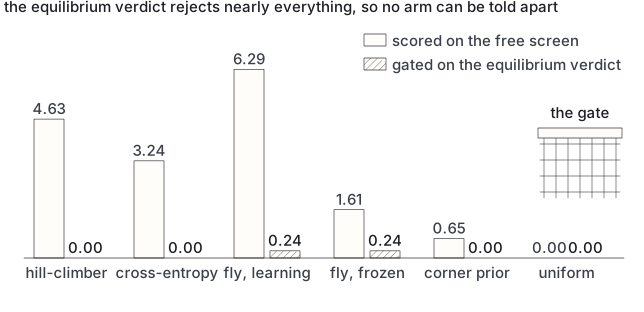
Can the generators be compared on the full requirement instead of the quick check?
No. On equilibrium alone nearly every composition orders inside 90–1000 K, so every generator scores zero or near zero; kinetics must decide.
In the log: Gating on the equilibrium terms sends every generator to zero, and that is the specification talking
recordedDate not stated in the log; it was written between the commit of 2026-09-13 08:16 and the first commit that contains it, 2026-09-16 02:04unclassified0 predictions · 0 result paragraphsEXPERIMENTS.md lines 3430–3476
What E63 did and how it came out, drawn from this record and the files it names (book/assets/diagrams/exp/E63.svg).
Results
No result paragraph for this entry was found in the log.
The full record
EXPERIMENTS.md · lines 3430–3476
E63 — Gating on the equilibrium terms sends every generator to zero, and that is the specification talking
E60 scored the generators on the free rung alone, which answers one of the three things
that can break the requirement. The obvious repair is to keep the cheap reward and let the
dear rungs decide what counts as a find - trial.run takes a confirm argument for
exactly this. Gating on the two equilibrium terms, off-lattice stability and no ordering
inside the window:
arm
screen only
gated on equilibrium
elitist
4.63
0.00
cem
3.24
0.00
fly
6.29
0.24 +/- 0.24
fly-frozen
1.61
0.24 +/- 0.24
sparse
0.65
0.00
uniform
0.00
0.00
paired fly minus frozen +0.00, one seed of four. No arm can be told from another.
This is not the arms failing. Of 348 compositions measured - 343 across the sampled box
and all five later examined outside it, up to Ta 0.44 - every one has an ordering
transition inside 90 to 1000 K. The gate is the equilibrium criterion and the equilibrium
criterion is empty, so it rejects everything by construction, including the alloy with a
five-week experiment behind it (E58).
The harness said so in advance. test_the_harness_is_blind_when_the_target_is_too_narrow
asserts that where qualifiers are isolated every arm scores the same and a comparison
measures luck rather than learning. Gated this way, the real problem is that regime.
What follows for the design. The kinetic term is not a refinement of the verdict, it is
the verdict; and it costs twenty minutes a composition. That leaves three options and no
free one:
score on the screen and accept that the comparison covers one term of three (E61, which
is where the learning result comes from);
gate on all three and pay twenty minutes per candidate, which no arm-versus-arm
comparison in this project can currently afford;
build a cheap kinetic proxy. A rule of mixtures over pure-element migration barriers
reaches r = +0.77 against measured E_m on five compositions, with a residual of 0.25 eV -
a factor of four in diffusion distance at 1000 K, and five points cannot validate
anything. Settling it needs the activation energy computed across the Mo-Nb-Ta-W corner.
The working pattern meanwhile is the ladder as designed and as used by hand in E60 and
E62: the generator optimises the screen, the few compositions it likes best are carried up,
and the survivors are reported with the rung that confirmed them. That produced a candidate
that survives all three. It is not the same thing as a generator comparison on the full
verdict, and this entry exists so the two are not confused later.
Related entries
E60 — The generators, compared on a real target; and a composition better than the one everyone…
E58 — With kinetics the requirement has an answer, and it is the alloy the survey rejected
E61 — The circuit does learn; the Kenyon-cell code had been starved to three cells
E62 — The candidates through all three rungs: tungsten is what freezes the alloy