No result paragraph for this entry was found in the log.
EXPERIMENTS.md · lines 3060–3127E58 — With kinetics the requirement has an answer, and it is the alloy the survey rejected
E56 left the equilibrium verdict rejecting everything in this system, MoNbTaW included: its
bcc ordering sits at 631 K, inside the service window. That cannot be the criterion, because
MoNbTaW has been held at 500 C for five weeks with no superlattice reflection. A free energy
says what an alloy would rather be, not what it becomes.
So each transformation is discounted by whether atoms can travel far enough to accomplish
it, P(it happens) = P(favoured) x P(reachable), with the reach being sqrt(D t) at the top
of the window over the life of the part. Ordering is a local shuffle and needs about a
lattice spacing; decomposition has to gather a species into a nucleus and needs nanometres.
The result, over the whole plausible range of the activation energy rather than a point
estimate (1000 hours at 1000 K):
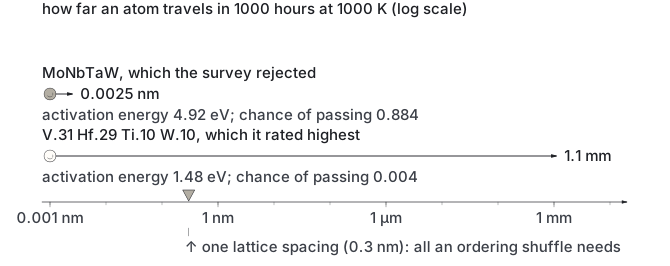
MoNbTaW's atoms travel less than one lattice spacing in a thousand hours. The other two
travel tens of micrometres - they go wherever they like, and they do: the five-week
experiment and the ten-hour decomposition both fall out of computed quantities.
A twenty to hundredfold separation that holds at every plausible Q. The absolute
probability for MoNbTaW is uncertain; which alloy wins is not.
The same thing again with every number computed here rather than taken from the
literature, using the rate-weighted effective barrier rather than the arithmetic mean,
because a hopping rate is a sum of exponentials and the easy paths carry the transformation:
A factor of five hundred million in how far an atom travels, and a two hundredfold
separation in the verdict. MoNbTaW cannot move an atom a hundredth of a lattice spacing in
a thousand hours at the top of the window; the composition the expansion rated highest can
move one a millimetre. The expansion, alone, preferred the second: 1225 K against 631 K.
The ratio shortcut does not hold. Rung 3 was first built to cost only a formation
energy, with the migration half carried as a ratio calibrated on MoNbTaW (E_m/E_f = 0.44).
The V-Hf alloy gives 0.29. The ladder makes the honest version affordable instead: rung 3 is
reached only by what survives rung 2, which is almost nothing.
Our own numbers. Migration barriers, validated first on the pure elements against DFT
(W 1.85 against 1.7-1.8, Mo 1.39 against 1.3-1.6, Nb 0.52 against 0.6-0.9, Ta 0.85 against
0.7-1.0): equiatomic MoNbTaW gives E_m = 1.58 +/- 0.28 eV over eight bands, lowest 1.26,
by element Mo 1.37, Nb 1.40, W 1.90. Published for the same alloy: Nb 1.05, Ta 1.13, Mo
1.44, W 1.50 - ours run 0.2 to 0.4 eV high, in the same order.
A correction to E57. The formation energy was reported there as convention-dependent,
and the 1 eV gap against the published 2.48-2.54 eV was attributed to that. It is not a
convention. A convention is a constant shift in the chemical potential, and these offsets
have opposite signs: against the weighted mean of its own pure elements MoNbTaW sits
+0.62 eV and the two mobile alloys -0.81 and -0.96 eV. The code path was checked by
running pure W through the alloy function, which returns 3.403 eV against a direct 3.40.
The numbers are real. What remains unexplained is why ours sit above a published value for
the low-mismatch alloy and below it for the high-mismatch ones; with three compositions
there is no trend to claim, only a 2 eV gap between the corners that is far larger than any
of the disagreements inside it.
An earlier robustness claim in this session was also wrong and is withdrawn. The verdict
was called "not robust" on the strength of a sweep from Q = 2.5 to 5.0 eV. Q = 2.5 is not
available to MoNbTaW: its migration barrier alone is 1.26 to 1.90 eV, so no accounting puts
its total below about 3.7. Swept over what is actually reachable, the verdict holds.