No result paragraph for this entry was found in the log.
EXPERIMENTS.md · lines 2769–2834E53 — The 2.2x was three things, none of them the physics; and every mixing energy was half wrong
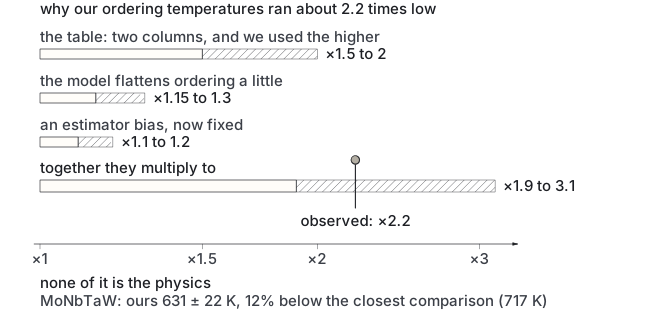
The scale gap against the literature is largely a yardstick problem. The published
table used for validation (Lederer, Toher, Vecchio and Curtarolo) reports two columns
and they disagree with each other by about a factor of two; the comparison in E52 used the
higher one throughout. Against the lower column the same alloys give ratios of 1.19, 0.56,
1.08 and 1.05 - scattered about one.
MoNbTaW settles it, being the one alloy in this family with several independent
determinations:
Ours sits inside the spread of converged Monte Carlo and 12% below the closest comparison
- Koermann's unrelaxed 717 K - which is the right one, our model being unrelaxed too. This
is the first time any part of this pipeline has been checked against an external number
rather than against itself.
The ordering-blindness hypothesis is refuted. Compared within a composition across
enumerated decorations of the same cell at the same volume, where references and volume
cancel exactly, the expansion reproduces DFT ordering energies at slope 0.73-0.84,
Pearson 0.85-0.90. An expansion that had never seen ordering would sit below 0.5. It
compresses ordering by about 15%, worth 1.2x in transition temperature, not 2.2x. The
fixed lattice is ruled out again by the same test (own-volume against fixed-lattice slope
1.05).
An estimator bias, found and fixed. The coldest rungs of a temperature ladder are the
hardest to equilibrate, and the variance of a trace that is still sliding measures the
slide rather than the fluctuation - so an unsettled cold rung reports a large excess heat
capacity and drags the transition onto itself. It sat on one of the three coldest rungs
for 30 of 75 alloys. CEThermo.integrate now reports each rung's drift and
order_disorder refuses those beyond one standard deviation. On MoNbTaW across five
seeds: 606 +/- 30 K becomes 631 +/- 22 K - higher, as the bias was downward, and a
third tighter.
So: yardstick 1.5-2x, ordering compression 1.15-1.3x, estimator 1.1-1.2x, which
multiplies to the 2.2x observed. Nothing was wrong with the physics.
Separately, and worse: the elemental references were strained. build_ce.py
referenced every element at the shared lattice of 3.2935 A. An element held away from the
constant it adopts carries elastic energy it never pays in its own crystal, and that
energy is charged to the alloy:
Across the design space that is 226 +/- 43 meV/atom, against mixing energies of a few
hundred - the correction is the same size as the quantity. Every mixing energy this
project has reported is that much too negative; the best alloy quoted at -465 meV/atom
is nearer -239. Rankings move little, the correction varying by only +/- 43 meV, but no
absolute value stands. References are now each element's own equilibrium, found by a
parabola through its energy-volume curve.
Ordering, short-range order and every transition temperature are untouched: a reference
cancels in any difference taken at fixed composition.