Did the fix to the pure-element reference energies actually reach the model in use?
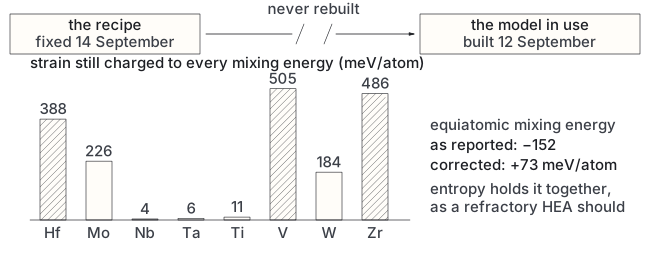
No. The model in use was never rebuilt; corrected at load, the equiatomic mixing energy moves from −152 to +73 meV/atom.
In the log: The reference fix reached the source and never reached the data
recordedDate not stated in the log; it was written between the commit of 2026-09-13 08:16 and the first commit that contains it, 2026-09-16 02:04unclassified0 predictions · 0 result paragraphsEXPERIMENTS.md lines 2890–2931
What E55 did and how it came out, drawn from this record and the files it names (book/assets/diagrams/exp/E55.svg).
Results
No result paragraph for this entry was found in the log.
The full record
EXPERIMENTS.md · lines 2890–2931
E55 — The reference fix reached the source and never reached the data
E53 found that every element had been referenced at one shared lattice constant, 3.2935 A,
charging the alloy for elastic energy no element pays in its own crystal - 505 meV/atom for
V, 486 for Zr, 388 for Hf - and concluded: "References are now each element's own
equilibrium." scripts/build_ce.py was indeed corrected, and it wrote
data/references_equilibrium.npz on 14 September.
The expansion in use, data/ce_8element.npz, is dated 12 September. It was never rebuilt.
Element by element, its stored references match the shared-lattice column exactly and the
equilibrium column not at all:
Hf
Mo
Nb
Ta
Ti
V
W
Zr
stored minus equilibrium (meV/atom)
388
226
4
6
11
505
184
486
which is E53's own table of what the strain charged, reproduced to the last digit. The fix
was written down and the artefact kept the bug. Every mixing energy the pipeline has
produced since is still too negative by 226 +/- 43 meV/atom.
Found by accident, and that is the point. It surfaced only because the off-lattice hull
(E54) needed absolute energies and the elemental bcc cells were relaxed with MACE, giving
an independent measurement of the same eight numbers. Nothing in the pipeline compares its
stored references against anything, so nothing could have noticed.
A refit is not needed. Changing a reference shifts every fit target by a function
linear in composition, and the singlet terms of a cluster expansion are themselves linear
in composition, so the shift is absorbed exactly by the singlets and no pair or higher term
moves. CEThermo.correct_references adds it back at load. Measured at equiatomic the
correction is 224.8 meV/atom, against E53's predicted 226 +/- 43.
What moves, and what does not. Transition temperatures are untouched, for the same
reason the correction is exact: they come from the energy variance at fixed composition,
where any reference is a constant and cancels. The survey stands. E54 stands, since it
never routes through the expansion's references at all - the solid solution there is
relaxed directly with MACE.
What moves is the sign of the answer. The equiatomic mixing energy goes from -152
meV/atom to +73 meV/atom: not a favourable mixture at all, but one that would rather
separate or order at zero temperature and is held together by entropy. That is the
accepted picture of a refractory high-entropy alloy, and the number the pipeline had been
reporting contradicted it.
Related entries
E53 — The 2.2x was three things, none of them the physics; and every mixing energy was half…
E54 — The three qualifiers are on the wrong lattice; the expansion cannot see what beats them