No result paragraph for this entry was found in the log.
EXPERIMENTS.md · lines 3002–3056E57 — A vacancy formation energy in an alloy is a convention, and the convention was doing the physics
E56 left the thermodynamics rejecting everything, including the one alloy in this system
with a five-week experiment behind it. The missing quantity is whether an atom can move at
all, so the first attempt computed the vacancy formation energy, the cheap half of the
activation energy Q = E_f + E_m.
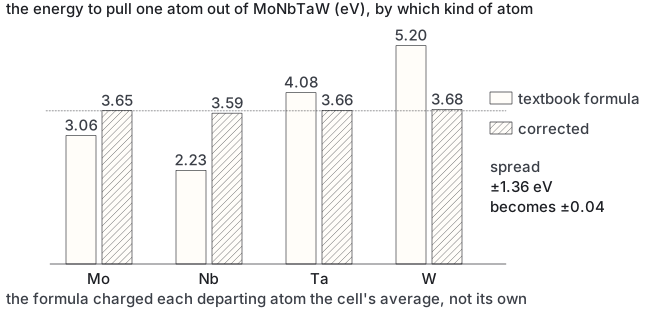
The first result looked like chemistry and was arithmetic. Equiatomic MoNbTaW gave
3.31 +/- 1.36 eV, with W at 5.20 and Nb at 2.23 - a three-electron-volt spread across
species, which is exactly the sort of local-environment effect a random alloy is supposed
to show, and which would have been reported as one.
It came from the textbook formula:
E_f = E(N-1, vacancy) - (N-1)/N * E(N)
which is correct only for a monatomic crystal, where every atom carries the average energy
by definition. In an alloy it charges the departing atom the cell's average instead of its
own, taxing a tightly bound species and subsidising a loose one. The correction is exactly
mu_X - mean(mu), and applying it collapses the spread:
+/- 1.36 eV becomes +/- 0.04. The species dependence was the reference.
It was caught by validating the pure elements first, where the formula is exact and the
answers are known: W 3.40, Mo 2.93, Nb 2.61, Ta 2.76, all at or near the published DFT
range. A method that works on the simple case and not on the real one is pointing at the
difference between them.
The corrected numbers still fail their own validation, and that is the finding.
The published value for NbMoTaW is 2.48 to 2.54 eV and this gives 3.57. The ratio between
the two corners, 2.7, matches the literature ratio of 2.4 - but the absolute value does
not, and the reason is not a bug to be found. In an alloy the vacancy formation energy
depends on where the removed atom is imagined to go: to its own elemental reservoir, or
to a kink site on the alloy's own surface, where the chemical potential is the alloy's, not
the element's. The two conventions differ by more than an electron volt here, which is the
entire effect being measured. The ratio survives the choice; no absolute number does.
So the formation energy is not the rung. A migration barrier is: a saddle point at
fixed composition and fixed atom count, with no chemical potential anywhere in it, which is
why the published values for NbMoTaW are quoted without qualification. Validated on the
pure elements against DFT: W 1.85 (literature 1.7-1.8), Mo 1.39 (1.3-1.6).