Tuned properly, does the whole brain steer the search better than a small matrix?
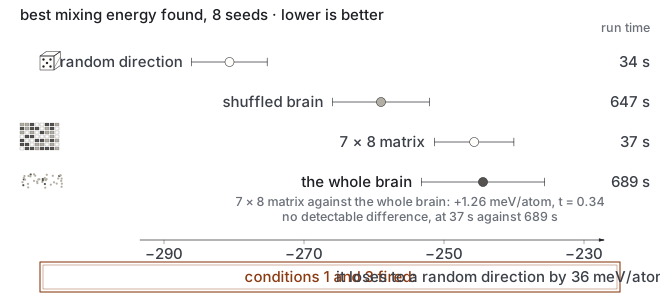
No. It matched a 7 × 8 matrix to within 1.26 meV/atom and lost to random directions by 36 meV/atom; two pre-registered failure conditions fired.
In the log: The connectome does not generate the search: a 7x8 matrix does the same job
falsifiedDate not stated in the log; it was written between the commit of 2026-09-13 08:16 and the first commit that contains it, 2026-09-16 02:04rung 1 · ordering0 predictions · 0 result paragraphsEXPERIMENTS.md lines 2521–2565
What E49 did and how it came out, drawn from this record and the files it names (book/assets/diagrams/exp/E49.svg).
Pre-registration
The pre-registration, as written
E49 — The connectome does not generate the search: a 7x8 matrix does the same job
The comparison PREREGISTER_wholebrain.md asks for, at the corrected operating point of
E48 (thresholds solved to a fixed point, 94.6% of neurons switching, membrane state
persisted between moves). Identical objective, budget, starting compositions, step size,
restart rule, readout projection and search seeds; every brain calibrates its own
thresholds and its own common mode from the same objective-free reference compositions.
arm
best mixing energy
wall time
random heading
-280.65 +/- 5.39 meV/atom
34 s
shuffled brain
-259.00 +/- 6.92 meV/atom
647 s
affine surrogate
-245.69 +/- 5.68 meV/atom
37 s
measured brain
-244.43 +/- 8.81 meV/atom
689 s
comparison
difference
t over 8 seeds
measured vs random
+36.22 meV/atom
+9.92
measured vs shuffled
+14.57 meV/atom
+3.68
measured vs affine surrogate
+1.26 meV/atom
+0.34
Two pre-registered failure conditions have fired.
Condition 1: the measured brain loses end-to-end, by 36 meV/atom against a direction drawn
from a generator and by 15 against a degree-preserving shuffle of itself. The practical
superiority hypothesis fails for this protocol, and is reported as a failure.
Condition 3: the affine surrogate - the measured brain's own headings reduced to nine rows
by eight columns, fitted on objective-free compositions - searches with no detectable
difference from the whole brain (+1.26 meV/atom, t = 0.34 over 8 seeds - an absence of
evidence for a difference, not evidence of equivalence), at 37 seconds against 689. The claim that
whole-brain complexity is necessary is retired.
What is established, and what is not. Not that a connectome cannot generate a search:
the sensory encoding, the motor readout and the objective are all particular, and Astra's
identity shows that a uniformly random orthonormal readout gives an isotropic heading at
any fixed composition whatever the wiring, so this interface can only expose the wiring
through how headings correlate across compositions and time. What is established is that
this composite algorithm does not beat a random direction, and that its brain contributes
nothing a 7x8 matrix does not.
Where the connectome still earns its place. As a scorer, not a generator: E8-E11
established the measured wiring in the causal path of the ranking, and nothing here touches
that. The cluster expansion, the short-range order and the order-disorder transitions never
depended on the circuit proposing anything.
Results
No result paragraph for this entry was found in the log.
The full record
EXPERIMENTS.md · lines 2521–2565
E49 — The connectome does not generate the search: a 7x8 matrix does the same job
The comparison PREREGISTER_wholebrain.md asks for, at the corrected operating point of
E48 (thresholds solved to a fixed point, 94.6% of neurons switching, membrane state
persisted between moves). Identical objective, budget, starting compositions, step size,
restart rule, readout projection and search seeds; every brain calibrates its own
thresholds and its own common mode from the same objective-free reference compositions.
arm
best mixing energy
wall time
random heading
-280.65 +/- 5.39 meV/atom
34 s
shuffled brain
-259.00 +/- 6.92 meV/atom
647 s
affine surrogate
-245.69 +/- 5.68 meV/atom
37 s
measured brain
-244.43 +/- 8.81 meV/atom
689 s
comparison
difference
t over 8 seeds
measured vs random
+36.22 meV/atom
+9.92
measured vs shuffled
+14.57 meV/atom
+3.68
measured vs affine surrogate
+1.26 meV/atom
+0.34
Two pre-registered failure conditions have fired.
Condition 1: the measured brain loses end-to-end, by 36 meV/atom against a direction drawn
from a generator and by 15 against a degree-preserving shuffle of itself. The practical
superiority hypothesis fails for this protocol, and is reported as a failure.
Condition 3: the affine surrogate - the measured brain's own headings reduced to nine rows
by eight columns, fitted on objective-free compositions - searches with no detectable
difference from the whole brain (+1.26 meV/atom, t = 0.34 over 8 seeds - an absence of
evidence for a difference, not evidence of equivalence), at 37 seconds against 689. The claim that
whole-brain complexity is necessary is retired.
What is established, and what is not. Not that a connectome cannot generate a search:
the sensory encoding, the motor readout and the objective are all particular, and Astra's
identity shows that a uniformly random orthonormal readout gives an isotropic heading at
any fixed composition whatever the wiring, so this interface can only expose the wiring
through how headings correlate across compositions and time. What is established is that
this composite algorithm does not beat a random direction, and that its brain contributes
nothing a 7x8 matrix does not.
Where the connectome still earns its place. As a scorer, not a generator: E8-E11
established the measured wiring in the causal path of the ranking, and nothing here touches
that. The cluster expansion, the short-range order and the order-disorder transitions never
depended on the circuit proposing anything.
Related entries
E48 — Rectifying at zero makes the network scale-symmetric, and it measures as nearly affine
E8 — What a named readout fixes, and what it does not
E11 — Is the measured wiring better, or only different?