Does the real wiring rank alloys closer to the target than rewired copies do?
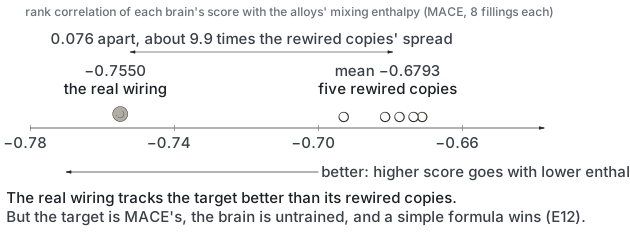
Yes. The real wiring scores −0.755 against −0.679 for rewired copies, though a simple formula later did far better.
In the log: Is the measured wiring better, or only different?
recordedDate 2026-09-12, as written in the logrung 4 · DFT0 predictions · 1 result paragraphEXPERIMENTS.md lines 360–401
What E11 did and how it came out, drawn from this record and the files it names (book/assets/diagrams/exp/E11.svg).
Pre-registration
The pre-registration, as written
E11 — Is the measured wiring better, or only different?
Date 2026-09-12 · Question Does the measured wiring rank candidates closer to
the actual objective than a rewired control? · Provenance…/objective_test.py
Method. Objective is the MACE mixing enthalpy of each of the 64 candidates,
averaged over 8 random occupancies so the target is not itself occupancy noise
(range -245.5 to +269.5 meV/atom). Each circuit's score is correlated against it.
Controls as E10, five rewirings.
Result.
Spearman(score, objective)
measured wiring
-0.7550
rewired, five seeds
-0.6711, -0.6774, -0.6735, -0.6929, -0.6814
rewired mean
-0.6793 +/- 0.0077
Measured minus rewired mean = -0.0758, about 9.9 sd of the control spread.
The sign is favourable: a higher score corresponds to a lower mixing enthalpy.
Interpretation. The measured KC->MBON wiring ranks candidates closer to the
objective than a degree-preserving rewiring does. This is real, and it is the first
positive evidence in the project that the measured connectivity carries useful
structure - but see E12, which shows the comparison is against the wrong
opponent.
Caveats, all load-bearing.
The objective is MACE's mixing enthalpy, itself miscalibrated against DFT
(slope 0.28, sign disagreement on 5 of 10 relaxed alloys). This is agreement with
the screening model, not with DFT.
The circuit is untrained. Nothing here involves learning.
Five controls give a crude sd; "9.9 sd" means large, not precise.
Much of |rho| = 0.755 is probably composition alone - element identity largely
determines the mixing enthalpy, and the circuit is a function of element fractions.
A composition-only baseline (for instance ridge regression on the eight
concentrations) has not been run and is the obvious next control.
Several readouts and encoders were tried before this configuration. That is a
forking-paths risk. This is a signal that warrants a pre-registered repeat with
more seeds, more controls, and the composition-only baseline - not a finished
result.
Results
EXPERIMENTS.md · line 371
Result.
The full record
EXPERIMENTS.md · lines 360–401
E11 — Is the measured wiring better, or only different?
Date 2026-09-12 · Question Does the measured wiring rank candidates closer to
the actual objective than a rewired control? · Provenance…/objective_test.py
Method. Objective is the MACE mixing enthalpy of each of the 64 candidates,
averaged over 8 random occupancies so the target is not itself occupancy noise
(range -245.5 to +269.5 meV/atom). Each circuit's score is correlated against it.
Controls as E10, five rewirings.
Result.
Spearman(score, objective)
measured wiring
-0.7550
rewired, five seeds
-0.6711, -0.6774, -0.6735, -0.6929, -0.6814
rewired mean
-0.6793 +/- 0.0077
Measured minus rewired mean = -0.0758, about 9.9 sd of the control spread.
The sign is favourable: a higher score corresponds to a lower mixing enthalpy.
Interpretation. The measured KC->MBON wiring ranks candidates closer to the
objective than a degree-preserving rewiring does. This is real, and it is the first
positive evidence in the project that the measured connectivity carries useful
structure - but see E12, which shows the comparison is against the wrong
opponent.
Caveats, all load-bearing.
The objective is MACE's mixing enthalpy, itself miscalibrated against DFT
(slope 0.28, sign disagreement on 5 of 10 relaxed alloys). This is agreement with
the screening model, not with DFT.
The circuit is untrained. Nothing here involves learning.
Five controls give a crude sd; "9.9 sd" means large, not precise.
Much of |rho| = 0.755 is probably composition alone - element identity largely
determines the mixing enthalpy, and the circuit is a function of element fractions.
A composition-only baseline (for instance ridge regression on the eight
concentrations) has not been run and is the obvious next control.
Several readouts and encoders were tried before this configuration. That is a
forking-paths risk. This is a signal that warrants a pre-registered repeat with
more seeds, more controls, and the composition-only baseline - not a finished
result.