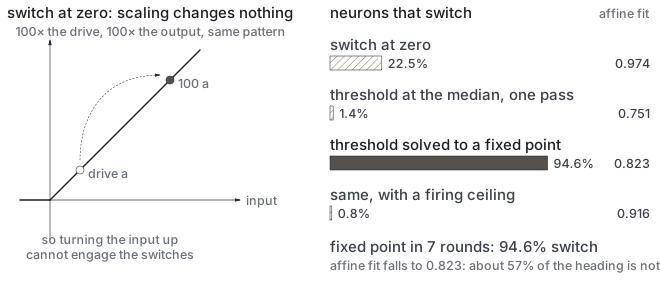
Can turning up the input make the brain model use its on-off switching?
No. Switches set at zero scale exactly with the input; only thresholds solved neuron by neuron raised switching to 94.6% of neurons.
In the log: Rectifying at zero makes the network scale-symmetric, and it measures as nearly affine
recordedDate not stated in the log; it was written between the commit of 2026-09-13 08:16 and the first commit that contains it, 2026-09-16 02:04generator · fly brain0 predictions · 0 result paragraphsEXPERIMENTS.md lines 2462–2516
What E48 did and how it came out, drawn from this record and the files it names (book/assets/diagrams/exp/E48.svg).
Pre-registration
The pre-registration, as written
E48 — Rectifying at zero makes the network scale-symmetric, and it measures as nearly affine
The whole brain reduced to a 7x8 matrix (E47). Sweeping the operating point shows why, and
the demonstration is exact rather than statistical. Driving the same compositions through
the same brain at two input scales:
gain
sensory drive
tonic
switching
affine fidelity
descending rate
0.90
1
0
22.5%
+0.9739
2.743e-06
0.90
100
0
22.5%
+0.9739
2.743e-04
0.90
1
0.01
0.1%
+0.9814
1.115e-02
0.99
1
0
22.6%
+0.9711
3.541e-06
0.99
100
0
22.6%
+0.9711
3.541e-04
A hundred times the input gives exactly a hundred times the output, the same firing
pattern, and the same affine fidelity to four decimals. relu(a v) = a relu(v) for positive
a, so a rectifying rate network integrated from rest with no per-neuron threshold is
positively homogeneous of degree one, and its response to a I is exactly a times its
response to I. Turning the drive up therefore cannot engage the nonlinearity - which
is why sweeping the input scale was wasted effort.
This does not say the network cannot compute nonlinear functions, and an earlier draft of
this entry wrongly said it did. Positive homogeneity is a symmetry under scaling, not
linearity: max(a - b, 0) is positively homogeneous and nonlinear, because changing inputs
relative to each other crosses a rectification boundary even though scaling them together
never does. The evidence that this network is close to affine is the measured affine
fidelity below, not the scaling argument. The log-concentration encoding is itself nonlinear
in composition.
A uniform tonic current is worse, not better: it lifts 99% of cells above zero so nothing
rectifies at all and switching falls to 0.1%.
The threshold has to be per neuron, and it has to be solved rather than set. Giving
each cell a threshold at the median of the membrane state it reaches breaks the
homogeneity. Set in one pass it fails - imposing the threshold changes the rates, which
changes the recurrent drive, which moves the very states the threshold was read from, and
the population falls to 1.4% switching. Iterated to a fixed point, reached in 7 rounds
with 92.2% of neurons alive:
transfer function
switching
affine fidelity
rectify at zero
22.5%
+0.9739
threshold at the median, one pass
1.4%
+0.7512
threshold at the median, iterated
94.6%
+0.8228
threshold iterated, with a firing ceiling
0.8%
+0.9160
This is the same fixed point the mushroom body's gain needed (2.2, 2.6) and the same class
of fault as every earlier one in this project: the circuit was never wrong, the operating
point was. The firing ceiling as parameterised clips almost everything and is dropped
rather than tuned.
At 94.6% switching the affine map still reproduces the heading at cosine 0.823, so about
57% of the heading magnitude is not affine. Whether that residue is worth 163,972 neurons
is not a question the geometry answers, and the pre-registered condition asks for the
search, not the cosine.
Results
No result paragraph for this entry was found in the log.
The full record
EXPERIMENTS.md · lines 2462–2516
E48 — Rectifying at zero makes the network scale-symmetric, and it measures as nearly affine
The whole brain reduced to a 7x8 matrix (E47). Sweeping the operating point shows why, and
the demonstration is exact rather than statistical. Driving the same compositions through
the same brain at two input scales:
gain
sensory drive
tonic
switching
affine fidelity
descending rate
0.90
1
0
22.5%
+0.9739
2.743e-06
0.90
100
0
22.5%
+0.9739
2.743e-04
0.90
1
0.01
0.1%
+0.9814
1.115e-02
0.99
1
0
22.6%
+0.9711
3.541e-06
0.99
100
0
22.6%
+0.9711
3.541e-04
A hundred times the input gives exactly a hundred times the output, the same firing
pattern, and the same affine fidelity to four decimals. relu(a v) = a relu(v) for positive
a, so a rectifying rate network integrated from rest with no per-neuron threshold is
positively homogeneous of degree one, and its response to a I is exactly a times its
response to I. Turning the drive up therefore cannot engage the nonlinearity - which
is why sweeping the input scale was wasted effort.
This does not say the network cannot compute nonlinear functions, and an earlier draft of
this entry wrongly said it did. Positive homogeneity is a symmetry under scaling, not
linearity: max(a - b, 0) is positively homogeneous and nonlinear, because changing inputs
relative to each other crosses a rectification boundary even though scaling them together
never does. The evidence that this network is close to affine is the measured affine
fidelity below, not the scaling argument. The log-concentration encoding is itself nonlinear
in composition.
A uniform tonic current is worse, not better: it lifts 99% of cells above zero so nothing
rectifies at all and switching falls to 0.1%.
The threshold has to be per neuron, and it has to be solved rather than set. Giving
each cell a threshold at the median of the membrane state it reaches breaks the
homogeneity. Set in one pass it fails - imposing the threshold changes the rates, which
changes the recurrent drive, which moves the very states the threshold was read from, and
the population falls to 1.4% switching. Iterated to a fixed point, reached in 7 rounds
with 92.2% of neurons alive:
transfer function
switching
affine fidelity
rectify at zero
22.5%
+0.9739
threshold at the median, one pass
1.4%
+0.7512
threshold at the median, iterated
94.6%
+0.8228
threshold iterated, with a firing ceiling
0.8%
+0.9160
This is the same fixed point the mushroom body's gain needed (2.2, 2.6) and the same class
of fault as every earlier one in this project: the circuit was never wrong, the operating
point was. The firing ceiling as parameterised clips almost everything and is dropped
rather than tuned.
At 94.6% switching the affine map still reproduces the heading at cosine 0.823, so about
57% of the heading magnitude is not affine. Whether that residue is worth 163,972 neurons
is not a question the geometry answers, and the pre-registered condition asks for the
search, not the cosine.
Related entries
E47 — The whole brain is a 7x8 matrix at this operating point, and the shuffle wins by a…