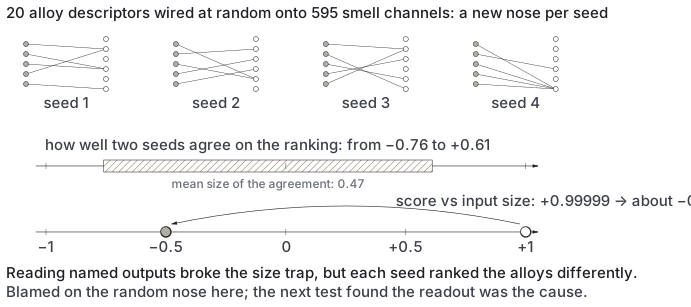
Does reading a named group of output neurons give a stable ranking of alloys?
Partly. It removed a size artefact, but different random seeds still ranked the alloys differently, correlations from −0.76 to +0.61.
In the log: What a named readout fixes, and what it does not
recordedDate 2026-09-12, as written in the logunclassified0 predictions · 1 result paragraphEXPERIMENTS.md lines 234–270
What E8 did and how it came out, drawn from this record and the files it names (book/assets/diagrams/exp/E8.svg).
Results
EXPERIMENTS.md · line 248
Result.
The full record
EXPERIMENTS.md · lines 234–270
E8 — What a named readout fixes, and what it does not
Date 2026-09-12 · Question Does reading a named population instead of the
mean over all neurons recover a usable policy? · Provenanceforager/mushroom.py, …/stability.py
Method.MushroomBody drives the full 166,700-neuron graph at the olfactory
projection neurons, weights by contact count, signs by consensus transmitter, and
scores by a signed fixed projection over the 97 MBONs. Compared against LocalFF's
mean of h^2 over all neurons on the same graph, seed and 64 real RHEA descriptors.
Populations resolved: KC 4,064, MBON 97, PAM 316, PPL 24, APL 2, PN 595
(family-matched, correctly excluding 213 non-olfactory wedge neurons); plastic edges
61,210; inhibitory fraction 0.356; KC sparsity ~0.10.
Result.
Part of the null is a units artifact. The softmax applies a fixed temperature
to a score of arbitrary scale. Standardising scores across candidates first gives
a best/worst policy ratio of 27x (mean h^2) and 21x (MBON), against a
uniform 1/64 — from a policy previously confined to [0.013, 0.019].
The MBON readout breaks the norm degeneracy: r(score, ‖x‖) moves from
+0.99999 to about -0.5.
But the ranking is not yet a circuit property. Across four seeds, pairwise
Spearman between rankings spans -0.76 to +0.61 (mean |rho| 0.47), and one seed
flips r(score,‖x‖) to +0.09.
Normalisation was not the cause: per-row, global-percentile and spectral-radius
scaling all give the same result. Spectral scaling is kept because it bounds a
recurrent network with a single constant and so preserves measured ratios, where a
per-row budget divides a fixed sum across every input and erases them.
Interpretation. The readout was a real defect and fixing it removed the ‖x‖
degeneracy, but what replaces it is encoder noise routed through the circuit. The
encoder is now the binding constraint: twenty abstract descriptors are mapped onto
595 projection neurons at random, so each seed is a different nose, where in a fly a
PN is a specific glomerulus for a specific chemical class. No claim about the wiring
is testable until that mapping carries meaning.