Does the whole fly brain compute anything a small table of 56 numbers cannot?
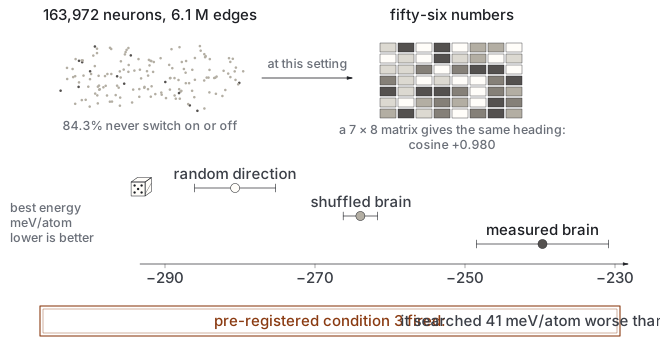
No. At this setting a 7 × 8 matrix reproduced its steering almost exactly (similarity 0.980), and it searched 41 meV/atom worse than random directions.
In the log: The whole brain is a 7x8 matrix at this operating point, and the shuffle wins by a shortcut
falsifiedDate not stated in the log; it was written between the commit of 2026-09-13 08:16 and the first commit that contains it, 2026-09-16 02:04generator · fly brain0 predictions · 0 result paragraphsEXPERIMENTS.md lines 2402–2457
What E47 did and how it came out, drawn from this record and the files it names (book/assets/diagrams/exp/E47.svg).
Pre-registration
The pre-registration, as written
E47 — The whole brain is a 7x8 matrix at this operating point, and the shuffle wins by a shortcut
Three checks, each able to retire the architecture on its own. Two of them fire.
Settling. Row-normalisation bounds the row sums at one, so for gain below one the
dynamics are contractive with a conservative decay time of tau_max/(1-g) - 200 ms at
gain 0.9, four times the 50 ms the readout was taken at. Measured against an 800 ms
reference, the descending direction is already there: cosine 0.976 at 25 ms, 0.990 at
50 ms, 0.999 at 100 ms. The magnitude is not - the mean rate is 1.45e-06 at 50 ms
against 3.14e-06 converged. Since the heading is normalised, 50 ms costs about 1% of
direction. Starting from a settled state rather than from rest also moves the direction by
cosine 0.990, so the persisted state and the remaining settling are the same size.
The shuffle takes a shortcut. Receptors reach the descending neurons in a median of
3 hops through the measured wiring and 2 hops through the shuffle (1325 of 1326
descending neurons reached in both). A shorter route mixes the signal less, so part of the
shuffle's decoding advantage in E46 is route length rather than wiring. The E46 comparison
stands as a measurement; its interpretation does not, and must be stated as route length
plus wiring rather than wiring alone.
The whole brain collapses to a 7x8 matrix. Fitting d(x) = A log1p(x/0.05) + b on 160
calibration compositions and testing on 80 held out, the affine map reproduces the
descending-neuron heading at cosine +0.980 mean, +0.989 median. The reason is in the
rectification: 84.3% of neurons never change their active/inactive state across
compositions, and the descending population idles at a mean rate of 3e-06. At this
operating point the network is not using its nonlinearity, so 163,972 neurons and 6.1M
edges are computing what fifty-six numbers compute.
Pre-registered failure condition 3 has fired (PREREGISTER_wholebrain.md): the claim
that whole-brain complexity is necessary is retired, whatever the search numbers say.
The end-to-end search, at this operating point. Cluster-expansion mixing energy at the
random limit, 16 walkers x 60 steps, 8 seeds, identical objective, budget, starts and
readout projection:
arm
best mixing energy
evaluations/run
random heading
-280.65 +/- 5.39 meV/atom
1014
shuffled brain
-263.95 +/- 2.29 meV/atom
1045
measured brain
-239.67 +/- 8.80 meV/atom
1080
The brain searches 41 meV/atom worse than a random direction, and 24 worse than its
own shuffle. The spreads are over eight search seeds, which is the right denominator for
search noise; the shuffled arm is a single graph, so graph-to-graph variation is not in
that figure and no significance is quoted for the measured-against-shuffled difference. This arm resets the
membrane state between moves, which makes the heading a fixed function of composition, so
a walker that has just failed proposes the identical step until the restart rescues it;
that degeneracy is real and is corrected by persisting state, but it cannot explain an
affine map fitting the headings at cosine 0.98.
What this establishes. Not that a connectome cannot generate a search. That the
architecture as built operates the brain in a nearly linear, nearly silent regime where
its wiring cannot express anything a small matrix could not, and that in that regime it
searches worse than chance. The diagnosis names the fix - an operating point where the
rectification pattern actually moves - and the fix is testable against the same
pre-registered conditions.
Results
No result paragraph for this entry was found in the log.
The full record
EXPERIMENTS.md · lines 2402–2457
E47 — The whole brain is a 7x8 matrix at this operating point, and the shuffle wins by a shortcut
Three checks, each able to retire the architecture on its own. Two of them fire.
Settling. Row-normalisation bounds the row sums at one, so for gain below one the
dynamics are contractive with a conservative decay time of tau_max/(1-g) - 200 ms at
gain 0.9, four times the 50 ms the readout was taken at. Measured against an 800 ms
reference, the descending direction is already there: cosine 0.976 at 25 ms, 0.990 at
50 ms, 0.999 at 100 ms. The magnitude is not - the mean rate is 1.45e-06 at 50 ms
against 3.14e-06 converged. Since the heading is normalised, 50 ms costs about 1% of
direction. Starting from a settled state rather than from rest also moves the direction by
cosine 0.990, so the persisted state and the remaining settling are the same size.
The shuffle takes a shortcut. Receptors reach the descending neurons in a median of
3 hops through the measured wiring and 2 hops through the shuffle (1325 of 1326
descending neurons reached in both). A shorter route mixes the signal less, so part of the
shuffle's decoding advantage in E46 is route length rather than wiring. The E46 comparison
stands as a measurement; its interpretation does not, and must be stated as route length
plus wiring rather than wiring alone.
The whole brain collapses to a 7x8 matrix. Fitting d(x) = A log1p(x/0.05) + b on 160
calibration compositions and testing on 80 held out, the affine map reproduces the
descending-neuron heading at cosine +0.980 mean, +0.989 median. The reason is in the
rectification: 84.3% of neurons never change their active/inactive state across
compositions, and the descending population idles at a mean rate of 3e-06. At this
operating point the network is not using its nonlinearity, so 163,972 neurons and 6.1M
edges are computing what fifty-six numbers compute.
Pre-registered failure condition 3 has fired (PREREGISTER_wholebrain.md): the claim
that whole-brain complexity is necessary is retired, whatever the search numbers say.
The end-to-end search, at this operating point. Cluster-expansion mixing energy at the
random limit, 16 walkers x 60 steps, 8 seeds, identical objective, budget, starts and
readout projection:
arm
best mixing energy
evaluations/run
random heading
-280.65 +/- 5.39 meV/atom
1014
shuffled brain
-263.95 +/- 2.29 meV/atom
1045
measured brain
-239.67 +/- 8.80 meV/atom
1080
The brain searches 41 meV/atom worse than a random direction, and 24 worse than its
own shuffle. The spreads are over eight search seeds, which is the right denominator for
search noise; the shuffled arm is a single graph, so graph-to-graph variation is not in
that figure and no significance is quoted for the measured-against-shuffled difference. This arm resets the
membrane state between moves, which makes the heading a fixed function of composition, so
a walker that has just failed proposes the identical step until the restart rescues it;
that degeneracy is real and is corrected by persisting state, but it cannot explain an
affine map fitting the headings at cosine 0.98.
What this establishes. Not that a connectome cannot generate a search. That the
architecture as built operates the brain in a nearly linear, nearly silent regime where
its wiring cannot express anything a small matrix could not, and that in that regime it
searches worse than chance. The diagnosis names the fix - an operating point where the
rectification pattern actually moves - and the fix is testable against the same
pre-registered conditions.
Related entries
E46 — The whole brain is wired in, and a shuffled graph beats it at carrying composition