EXPERIMENTS.md · lines 2012–2069E40 — Calibrated uncertainty, by not assuming the error is a variance
Date 2026-09-12 · Question (operator) The circuit has to learn uncertainty
properly - with it, it is interchangeable with any other network in a Bayesian
optimisation or active-learning loop. · Provenance forager/uncertainty.py,
…/uq_test.py
Why three previous attempts failed, in one sentence. A bootstrap ensemble, the spread
across compartments and a raw novelty score all measure variance - how far an answer
would move under resampling - and E29 established this circuit's error is reproducible to
99.8% across runs on identical data. A quantity identical under every resampling is
invisible to every method that resamples.
The method that does not care. Conformal prediction is distribution-free and gives a
finite-sample coverage guarantee for any model and any heuristic: calibrate on held-out
residuals, take the empirical quantile at level ceil((n+1)(1-alpha))/n, and the interval
covers at least 1-alpha of the time. The model may be biased, badly calibrated or plainly
wrong; the heuristic only decides how sharp the interval is, never whether it is honest.
Following Hu, Musielewicz, Ulissi and Kitchin, Mach. Learn.: Sci. Technol. 4, 015031
(2023), who pair it with latent-space distance for machine-learned interatomic potentials.
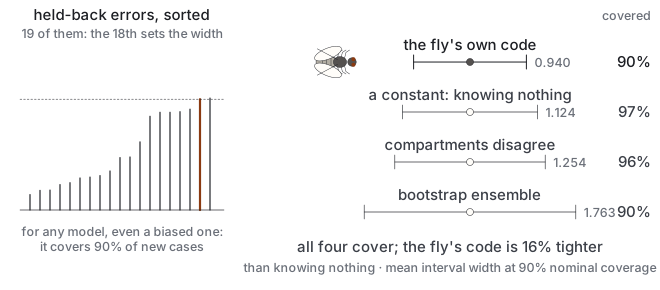
Result, 160 training / 100 calibration / 100 held out, nominal coverage 90%:
Coverage is achieved by every row, which is the guarantee doing its work and is the
first honest uncertainty this circuit has had. Wrapping the failed signals in conformal
prediction makes them all truthful, so what separates them is sharpness alone - which turns
"whose uncertainty is real" from an argument into a measurement.
The circuit's own sparse code is the best signal available: sharpest at nominal
coverage, 16% tighter than knowing nothing. So the Kenyon expansion does carry information
about where the readout is unreliable - the earlier novelty attempt was not wrong in kind,
only raw and uncalibrated.
The margin is modest and is reported as such. 0.940 against 1.124 is useful, not
decisive, and the width tracks the actual error at only +0.071. This is an uncertainty that
is honest and mildly informative, not one that is sharp.
The bootstrap ensemble is worse than knowing nothing - 1.763 against 1.124, and
anti-correlated with the error. Exactly what E29 predicts for an error that is bias, and
consistent with the literature finding ensembles overconfident on neural potentials, their
"magnitude of uncertainty lower than the error by orders of magnitude" (npj Comput. Mater.
2025).
What this unlocks. An acquisition function needs a calibrated interval, not a correct
one. With coverage guaranteed the circuit can be dropped into a Bayesian-optimisation or
active-learning loop on the same footing as any other surrogate - and swapped for one.
Also corrected here: the first test of this asserted nominal coverage on a single
calibration split. Conformal's guarantee is marginal - in expectation over splits - and one
split of 500 points missed by 8% purely because its halves differed in spread. The
implementation was right and the test was wrong; it now averages over forty splits.