No result paragraph for this entry was found in the log.
EXPERIMENTS.md · lines 2632–2695E51 — The learning rule was inverted, and the objective's labels are not yet trustworthy
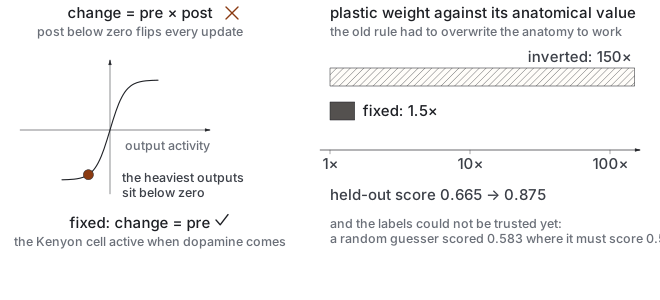
The rule. learn_head and train gated plasticity on the product of the presynaptic
Kenyon cell and the postsynaptic output neuron, elig = pre[src] * h[dst]. The output
neuron's activity is a signed tanh, and the heaviest appetitive output neurons sit at
negative activity, so the sign of every update through them was wrong. In the animal
this synapse is gated by the Kenyon cell being active when dopamine arrives; the output
neuron's own firing does not license a change to its inputs, and writing it as a product
also closes a loop - a synapse onto an already active output is changed more, which makes
that output more active.
The circuit still scored +0.665 with the inverted rule, by accident: at a learning rate of
one, the plastic weights were driven to 0.35, about 150x their anatomical value, which
eventually flipped the output neurons positive and made the rule correct again. Every
number this project reported before the fix rests on that accident. Corrected:
The last row is the one that matters for the scientific claim: with the sign right, the
rule no longer has to overwrite the anatomy to work.
Seven further defects, all fixed. A zero ratchet (np.sign(0) differs from every
later sign, so a synapse that once reached zero was re-zeroed for ever); per-cell
thresholds with no floor, which let 200 cells with no input fire on 5e-7 of numerical
noise; alphabetical allotment of projection neurons to channels, which gave one channel
29,657 Kenyon contacts and another none, leaving two of the eight elements
inaudible; a place code with no guard rungs, whose bank total varied 0.90 to 2.14 across
the range and so smuggled a rate code back in; a gain override that ignored a caller's
number; a term in the Kenyon input that is identically zero; and feature centring, which
measured harmful (+0.837 uncentred against +0.766) and is now off by default.
The objective, measured for the first time. 150 compositions, annealed by Monte Carlo,
transition located from the heat-capacity peak: transition temperature 418 +/- 256 K, and
33 of 150 cross a transition inside a 90-1000 K service window. A well balanced
question.
No conclusion is drawn from this table, and none may be. The random arm returned
+0.583 where it must return 0.500, which is the sample telling us it is too small: 33
failures across five folds is six or seven per fold. The target is also not locally
coherent - a composition's five nearest neighbours share its verdict 69% of the time
against 78% for guessing the majority class - and a target whose near neighbours disagree
more often than chance is one whose labels are dominated by noise.
The labels, not the learner, are what is wrong. Sixty-nine of the 150 peaks fell at
the edge of the scanned temperature range, so those transitions are bounded rather than
located, and the determination itself carries the +/- 173 K scatter of E41 - which makes
any alloy whose transition lies near the window's edge a coin toss. A trustworthy map is
the prerequisite for testing anything against it: a wider temperature range so peaks are
found rather than clipped, more compositions, and repeated determinations so the label
noise is measured rather than assumed.