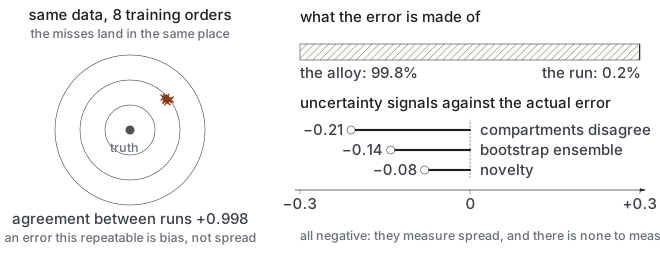
Can any of the fly's own signals tell where its predictions are wrong?
No. Its error is 99.8% repeatable bias, so all three spread-based signals correlated negatively with it (−0.08 to −0.21).
In the log: The fly's error is bias, so no variance-based uncertainty can see it
recordedDate 2026-09-12, as written in the loggenerator · fly brain0 predictions · 0 result paragraphsEXPERIMENTS.md lines 1394–1457
What E29 did and how it came out, drawn from this record and the files it names (book/assets/diagrams/exp/E29.svg).
Results
No result paragraph for this entry was found in the log.
The full record
EXPERIMENTS.md · lines 1394–1457
E29 — The fly's error is bias, so no variance-based uncertainty can see it
Date 2026-09-12 · Question Bayesian optimisation needs an uncertainty. Does the
circuit have one? · Provenance…/{novelty_test,uncertainty_chain, uc2,uc3,uc4,uc5}.py, forager/mushroom.py
All three negative, which is worse than useless: an exploration bonus built on any of
them sends the search where the circuit is already right. It also explains why
fly+explore scored identically to fly in the search benchmark, to the decimal.
Two false trails, both corrected.
A first test found error uncorrelated with distance from the training data (+0.007) and
concluded there was nothing to predict. That test had no power: in eight dimensions
100 random points sit at nearly equal nearest-neighbour distance (spread/median 0.25).
Restricting the training region widened it to 0.42 and the correlation rose to +0.215.
The effect was real; the measurement could not see it.
An earlier attempt compared two regions with different reward distributions while
standardising across both, so a distribution shift entered the residual and the trained
region appeared harder than the untrained one. Standardising on training statistics
only removes it.
The shared-confound hypothesis was tested and rejected. All three signals grow with
prediction magnitude, and a model can be most accurate where it predicts most strongly,
which would give every one of them the same spurious sign. Controlling for |prediction|
changes almost nothing (-0.137 to -0.177, -0.213 to -0.204, -0.077 to -0.068). Not it.
What it actually is. Train the same circuit on the same 100 observations eight times,
varying only the order they arrive in:
agreement between runs on which compositions are hard: +0.998
variance of the error explained by the composition: 99.8%
variance left to the run itself: 0.2%
The error is bias, not variance. The circuit is wrong in the same places every time,
whatever path its learning takes. Novelty, disagreement and bootstrap ensembles all
measure variance - how much the answer would move if the data or the fit were resampled
and a quantity that is identical across every resampling is invisible to all of them by
construction. Three failures, one cause, and it was not a shortage of ideas for signals.
Consequences.
No variance-based uncertainty can work here. Not a limitation of the three tried;
a statement about what they measure.
Exploration is not the fly's problem. Its 99.8%-reproducible error is the gap
between what its local plasticity rule converges to and what its own code can support -
ridge regression on that same code reaches rank 0.6 where the rule reaches 14 (E28).
The lever is the rule, not the acquisition function.
Bayesian optimisation over this environment should take its uncertainty from the
cluster expansion, whose bootstrap ensemble is measured, unbiased and covers every
held-out point (E24). Using a validated uncertainty rather than inventing one that
correlates at -0.1 is the honest construction.
Caveat. This concerns the error of a trained readout at fixed sparsity 0.12 on one
problem. It does not show that connectome circuits have no usable uncertainty in general;
it shows this one's error, here, is reproducible to 99.8% and therefore not a variance.
Related entries
E27 — The fly could not learn, because its odour code was not sparse
E28 — The fly beats the baseline once dopamine reports a prediction error
E24 — The short-range-order correction was regressed on the wrong variable