No result paragraph for this entry was found in the log.
PREREGISTER_acquisition.md · lines 1–106Pre-registration: the fly as the thing that decides what to evaluate next
The scarce resource in materials discovery is the expensive evaluation, not the candidate.
Whatever decides where that budget goes is what discovers the material. This tests whether
the mushroom body can be that decider. Written before the benchmark exists.
The claim, stated so it can fail
Scoring candidates with the measured mushroom body - learned value from dopamine plus a
familiarity bonus from the Kenyon-cell code - finds better alloys per oracle call than
conventional Bayesian optimisation, and does so because of the measured wiring.
Two hypotheses, deliberately separated, because one can hold without the other:
- Useful optimiser. Better candidates per unit budget than standard acquisition.
- Connectome contribution. The measured wiring beats matched rewirings of itself.
What this is not
Value plus novelty is not an upper confidence bound. A Kenyon-cell familiarity score
records exposure; it is not an estimate of what an observation would teach. A Gaussian
process supplies a function prior, an observation model and a posterior covariance, and
none of those exist here. The algebraic resemblance between value + beta * novelty and
UCB carries no guarantee, and the word is not used.
Three things are kept distinct and are never used as synonyms: the Kenyon-cell code (a
similarity-preserving feature map), familiarity memory (a record of what has been
observed), and epistemic uncertainty (what could still be learned).
The trap this design is built around
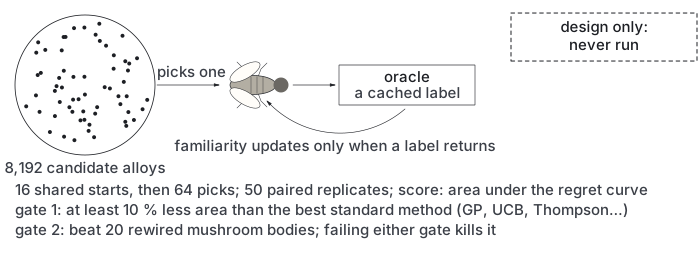
Scoring a candidate must not teach the circuit that it has evaluated one. Habituation
in the animal fires on exposure, and a pool of 8,192 candidates scanned once would leave
every one of them familiar and the novelty term dead. Therefore: plasticity is frozen
while scoring, transient state is reset between candidates, ranking is invariant to the
order candidates are enumerated in, and familiarity updates only when an oracle
observation actually returns.
Separately: a cheap evaluation must not discharge the uncertainty attached to an expensive
one through a shared familiarity memory.
Protocol, frozen before any run
Arms
The fly: measured mushroom body, value from MBON output learned by dopamine
reward-prediction error, plus a familiarity bonus from the Kenyon-cell code.
Conventional: Gaussian process with LogEI, UCB and Thompson sampling; random; maximum
composition-distance coverage.
The controls that decide attribution:
Rewirings preserve connection blocks, cell classes, compartment membership, signs, weight
distributions, learning masks and the number of adjustable parameters, and are checked for
comparable sparsity and non-saturation - a shuffle that is silent or unstable is not a
control. Encoder, thresholds, reward scaling and exploration schedule are frozen before
evaluation and are identical for every arm, and development tuning is given comparable
effort across arms.
The build gate
Continue only if simultaneous 95% confidence bounds establish both:
- at least 10% lower
A than the strongest conventional comparator chosen on
development runs; and
- a positive advantage over the rewired ensemble, accounting for graph-to-graph
variation.
Ten percent is an engineering threshold chosen in advance, not a biological constant.
Failing either gate kills this implementation. An inconclusive result is not permission
to add machinery. Passing only the practical gate supports a generic acquisition method
with no anatomical claim; passing only the wiring gate supports an anatomical effect with
no demonstrated usefulness; passing both earns a higher-fidelity replay.
What may not be claimed
Fifty starts on one cluster-expansion landscape establish robustness to initialisation on
that landscape, and nothing about materials discovery in general. A single DFT energy is
not an observation of short-range order or of a transition temperature; those need a stated
configurational and thermal protocol, and the whole protocol is charged. Multi-fidelity
allocation is a separate problem and is not attempted here: fifteen dopaminergic
compartments provide capacity, not cross-fidelity correlations, and assigning compartments
to fidelities would be an architectural choice needing its own controls.
MaleCNS supplies aggregate neurotransmitter predictions; synapse counts are not
measured physiological gains. This is a connectome-constrained model with engineered
dynamics, and is described as one.
Paths in the Forager repository, as the log wrote them.