Can a model that also predicts magnetism replace the main energy model?
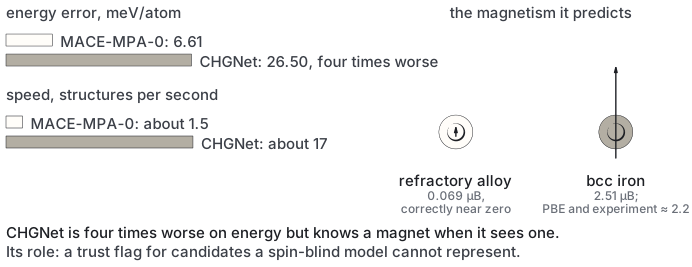
No. It is four times worse on energy (26.50 meV/atom), but it spots magnetic systems, so it serves as a warning flag.
In the log: CHGNet: worse energies, but it knows when a system is magnetic
recordedDate 2026-09-12, as written in the logrung 2 · hull, MACE0 predictions · 1 result paragraphEXPERIMENTS.md lines 875–915
What E20 did and how it came out, drawn from this record and the files it names (book/assets/diagrams/exp/E20.svg).
Results
EXPERIMENTS.md · line 890
Result.
The full record
EXPERIMENTS.md · lines 875–915
E20 — CHGNet: worse energies, but it knows when a system is magnetic
Date 2026-09-12 · Question Is there a surrogate that handles spin, and should it
replace or join MACE-MPA-0? · Provenance…/chgnet_compare.py
Why it was asked. MACE-MP-0 and MACE-MPA-0 do not predict spin. Nickel superalloys
involve Ni, Co, Fe and Cr, all magnetic, so extending the environment there raises the
question of whether a charge- or spin-aware model is needed. CHGNet predicts magnetic
moments per atom as a fourth output alongside energy, forces and stress, having been
trained on MPtrj's magmom labels.
Method. CHGNet 0.3.0 (via chgnet 0.4.2) on the same 200 near-equilibrium
(|strain| <= 5%) RHEA bcc solid solutions used in E18, per-element referencing as
before.
Result.
energy MAE
RMSE
max
throughput
spin
parameters
MACE-MPA-0
6.61
8.30
-
~1.5/s
no
9,060,000
CHGNet 0.3.0
26.50
32.48
108.13
~17/s
yes
412,525
meV/atom. CHGNet is four times worse on energy and about ten times faster,
which is what 22x fewer parameters buys.
The magnetism sanity check passes. On these non-magnetic refractories CHGNet
predicts mean |magmom| 0.069 and max 0.217 uB/atom - correctly near zero - while
returning 2.51 uB/atom on bcc Fe against a PBE and experimental value near 2.2. It
distinguishes magnetic from non-magnetic systems.
Interpretation. CHGNet should not replace MACE-MPA-0 for energies. Its useful
role is as a trust flag: run its magmom prediction on each candidate, and where it
returns significant spin, the candidate sits in a regime a non-spin-aware model cannot
represent, so it should be marked untrusted rather than silently screened. That does
not fix the energy, but it marks the boundary of the envelope, which is what E19 showed
an environment needs.
Not tested. Neither model has been evaluated on actually magnetic alloys - RHEA
contains no Fe, Co or Ni. CHGNet's energy accuracy on ferromagnetic systems, where
its charge-informed training is supposed to pay off, is unmeasured here and is the
thing that would decide its role for superalloys.
Related entries
E18 — MACE-MPA-0 validated on 300 independent DFT structures
E19 — The accuracy envelope: where MACE-MPA-0 is trustworthy and where it is not