Can existing public quantum datasets support a move to nickel superalloys?
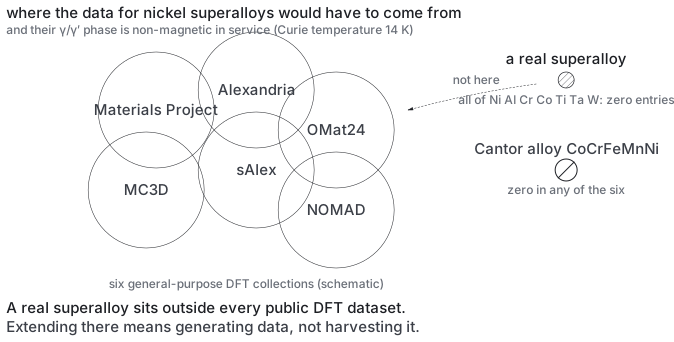
No. Not one public dataset holds a nickel–aluminium–chromium–cobalt structure; that data would have to be generated.
In the log: Superalloys are outside the support of every public DFT dataset
recordedDate 2026-09-12, as written in the logrung 4 · DFT0 predictions · 1 result paragraphEXPERIMENTS.md lines 977–1022
What E22 did and how it came out, drawn from this record and the files it names (book/assets/diagrams/exp/E22.svg).
Results
EXPERIMENTS.md · line 982
Result — measured across Materials Project, Alexandria, OMat24, sAlex, MC3D and
NOMAD:
The full record
EXPERIMENTS.md · lines 977–1022
E22 — Superalloys are outside the support of every public DFT dataset
Date 2026-09-12 · Question Can the environment be extended to nickel superalloys
using existing open data? · Provenance literature and database review
Result — measured across Materials Project, Alexandria, OMat24, sAlex, MC3D and
NOMAD:
Ni + Al + Cr + Co: zero structures in any of them
Cantor alloy (CoCrFeMnNi): zero in any of them
Zero entries anywhere contain all of Ni-Al-Cr-Co-Ti-Ta-W
NOMAD holds 1,307 Ni-Al-Cr-Co entries and none are FCC
No disordered solid-solution sampling in any general corpus; they are ordered
prototypes on small cells
A real superalloy is outside the support of every general-purpose DFT dataset.
Extending there requires generating data, not harvesting it - the opposite of the
refractory case, where RHEA already had exactly the right distribution.
Correction to the magnetism framing of E20. The concern was stated as a ~500
meV/atom ferromagnetic effect. For gamma/gamma-prime specifically that is wrong: its
Curie temperature is 14 K, so it is paramagnetic across the whole 300-1200 K
operating range. The real problem is not whether the alloy is magnetic at temperature
but that reference DFT is computed with ferromagnetic initialisation, which may
describe the wrong magnetic state entirely. CHGNet's role as a trust flag (E20) still
holds, but the reason is different from the one given there.
Licence constraints relevant to an aerospace context.
Meta FAIR checkpoints (eSEN, EquiformerV2-OMat24, UMA) carry an acceptable-use
policy barring ITAR-subject and "transportation technologies" use. Worth legal
review before any ESA-adjacent deployment.
GNoME data: CC BY-NC 4.0.AFLOW: "free for scientific, academic and
non-commercial purposes. Any other use is prohibited."
FitSNAP training data is GPL-2.0 - software copyleft on data - and is
incompatible with CC-BY-SA-4.0, so those sources can never be merged.
Nitol CoCrFeNi and Wang Ni-Al datasets carry no licence at all.
Recommended path for superalloys: pretrain on OMat24 (CC BY 4.0), fine-tune on
MatPES (BSD-3-Clause, spin-polarised PBE, no +U, metal-tuned smearing), then generate
gamma/gamma-prime SQS and MC data directly using the Cao-Freitas and Sheriff recipes,
both MIT-licensed with data.
Unverified. The exact FCC fraction of LeMat-Traj (112,932,152 rows) could not be
computed - HuggingFace's filter index will not build over 419 GB. It is the only
corpus carrying space group and n-ary as queryable columns alongside forces, so that
number remains open.
Related entries
E20 — CHGNet: worse energies, but it knows when a system is magnetic