Experiments · E21
Is the usual assumption of perfectly random mixing good enough for the entropy?
No. At 1500 K the real entropy is 3.4% lower, about 6 meV/atom, and at 300 K it is only half.
In the log: Configurational entropy computed, not assumed
Experiments · E21
No. At 1500 K the real entropy is 3.4% lower, about 6 meV/atom, and at 300 K it is only half.
In the log: Configurational entropy computed, not assumed
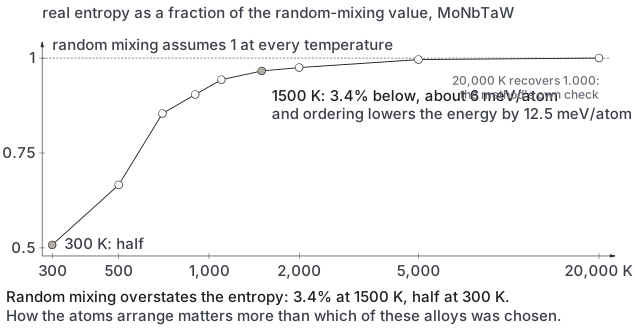
book/assets/diagrams/exp/E21.svg).Result.
Date 2026-09-12 · Question Replace the ideal-mixing entropy that makes the
1500 K ranking a count of components. · Provenance …/ce_mc.py,
icet + mchammer canonical Monte Carlo on the 8-element CE
Method. Canonical Monte Carlo (atom swaps, fixed composition) on the cluster expansion of E16b, MoNbTaW at 128 sites, down a temperature ladder from 20,000 K to 300 K, annealing continuously. Free energy by thermodynamic integration from the random limit:
beta*F(beta) = -S_ideal/k_B + integral_0^beta <E> dbeta'
At beta = 0 the alloy is random and F = -T*S_ideal exactly, so the integration starts
from a known point rather than a fitted one. <E> at beta = 0 measured directly by
sampling 400 random occupancies: -135.961 meV/atom, sd 4.234.
Result.
| T (K) | <E> meV/atom |
F meV/atom | S real | S ideal | S/S_ideal |
|---|---|---|---|---|---|
| 20000 | -137.500 | -2525.962 | 0.11942 | 0.11946 | 1.000 |
| 5000 | -141.077 | -736.208 | 0.11903 | 0.11946 | 0.996 |
| 2000 | -148.302 | -381.213 | 0.11646 | 0.11946 | 0.975 |
| 1500 | -150.010 | -323.145 | 0.11542 | 0.11946 | 0.966 |
| 1100 | -153.695 | -277.596 | 0.11264 | 0.11946 | 0.943 |
| 900 | -158.305 | -255.488 | 0.10798 | 0.11946 | 0.904 |
| 700 | -162.990 | -234.412 | 0.10203 | 0.11946 | 0.854 |
| 500 | -176.119 | -215.881 | 0.07953 | 0.11946 | 0.666 |
| 300 | -183.167 | -201.386 | 0.06073 | 0.11946 | 0.508 |
Entropies in meV/K/atom. Ideal value 0.11946 = k_B ln 4, confirmed independently.
Validation. At 20,000 K the integration returns S/S_ideal = 1.000. That is the known limit the integration begins from, and recovering it is the method's internal correctness check.
Two findings at the operating point.
At 300 K entropy falls to 50.8% of ideal: the ideal-mixing approximation fails outright in that regime.
Caveats. One composition, one supercell size (128 sites), one CE. Finite-size effects on the ordering transition are not assessed, and the temperature ladder is coarse below 700 K where the entropy is changing fastest. The CE is fitted to MACE-MPA-0, so this is the potential's thermodynamics, inheriting its 6.61 meV/atom error against DFT.
 Built with PRISMWebsite and visualizations made using Claude