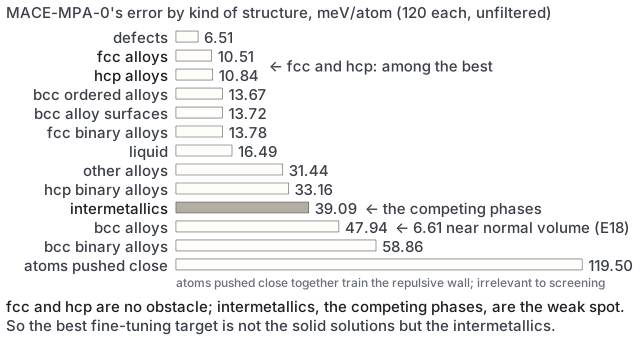
Is the screening model equally reliable for every kind of atomic structure?
No. Errors range from 6.51 to 119.50 meV/atom; intermetallic compounds, the key competing phases, are a weak spot at 39.09.
In the log: The accuracy envelope: where MACE-MPA-0 is trustworthy and where it is not
recordedDate 2026-09-12, as written in the logrung 2 · hull, MACE0 predictions · 0 result paragraphsEXPERIMENTS.md lines 825–871
What E19 did and how it came out, drawn from this record and the files it names (book/assets/diagrams/exp/E19.svg).
Results
No result paragraph for this entry was found in the log.
The full record
EXPERIMENTS.md · lines 825–871
E19 — The accuracy envelope: where MACE-MPA-0 is trustworthy and where it is not
Date 2026-09-12 · Question An environment is only usable if its error is known
per regime, not as one global number. · Provenance…/rhea_envelope.py
Method. 120 random structures from each RHEA config_type, per-element referencing
fitted within each group separately, MACE-MPA-0. Unfiltered: each group mixes near- and
far-from-equilibrium sampling as RHEA generated it.
config_type
n
atoms
MAE
RMSE
max
defects
120
126
6.51
9.23
36.4
fcc_alloys
120
32
10.51
13.74
49.9
hcp_alloys
120
48
10.84
14.19
46.5
bcc_alloys_ordered
120
16
13.67
19.95
79.1
bcc_alloys_surface
120
48
13.72
19.09
89.7
fcc_binary_alloys
120
32
13.78
18.55
46.7
liquid
120
128
16.49
25.25
177.6
misc_alloys
120
54
31.44
53.39
287.8
hcp_binary_alloys
120
54
33.16
41.54
118.8
intermetallics
120
24
39.09
52.43
170.7
bcc_alloys
120
54
47.94
69.27
330.8
bcc_binary_alloys
120
54
58.86
85.05
365.2
short_range
120
16
119.50
160.92
581.2
meV/atom.
Two findings that change priorities.
FCC and HCP are among the best regimes (10.5 and 10.8). The lattice is not an
obstacle to extending this work to face-centred systems, which is encouraging for
nickel superalloys. Magnetism remains untested - RHEA contains no Fe, Co or Ni,
so nothing here speaks to ferromagnetic alloys.
Intermetallics are the weak regime at 39.09 meV/atom, and that is precisely where
the convex hull lives. Laves, sigma and mu phases are the competing phases that
decide whether a solid solution is actually stable (see 4c). So the highest-value
fine-tuning target is not the solid solutions but the intermetallics - the
opposite of the obvious choice.
short_range at 119.50 is structures with atoms pushed close together to train the
repulsive wall; irrelevant to screening and expected to be poor.
Caveat. These are unfiltered. bcc_alloys reads 47.94 here but 6.61 when
restricted to within 5% of the Vegard volume (E18), so the ordering partly reflects how
aggressively RHEA sampled each group rather than intrinsic difficulty. The same
near-equilibrium filter has not been applied group by group.
Related entries
E18 — MACE-MPA-0 validated on 300 independent DFT structures