Does the gain still help if each walker keeps following one other walker's live signal?
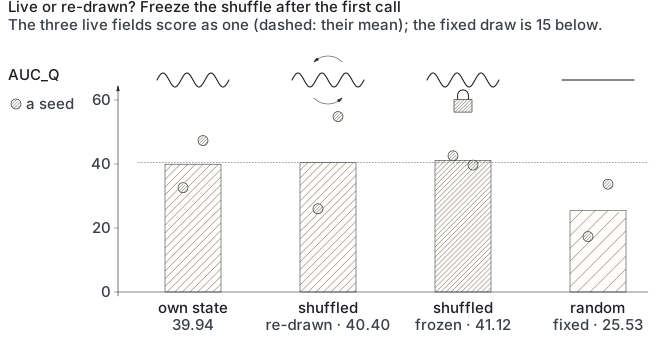
Yes. On the old reward, freezing the pairing scored 41.1, level with the other live signals and 15 above a fixed random gain.
In the log: live or re-drawn? Shuffled gains with the permutation frozen after the first call
confirmedDate not stated in the log; it was written between the commit of 2026-09-16 19:06 and the first commit that contains it, 2026-09-19 08:35unclassified0 predictions · 1 result paragraphEXPERIMENTS.md lines 11963–11975, lines 12056–12072
What E189 did and how it came out, drawn from this record and the files it names (book/assets/diagrams/exp/E189.svg).
Pre-registration
The pre-registration, as written
E189 — live or re-drawn? Shuffled gains with the permutation frozen after the first call
E185 left two readings of "shuffled ≈ own ≫ fixed-random": either what pays is that the gain
moves in time with the head (any walker's state, reassigned once), or that it is
re-drawn on every call (a fresh reassignment each move — a source of noise a fixed draw
lacks). FORAGER_MODULATE=shuffle_frozen: the permutation is drawn once and kept, so each
walker follows one other walker's live state for the whole run. Same MPS family as E185,
tag e189, 200 × 4 × 2.
Predictions. 1. E189 ≈ shuffle (mean within 7 of 40.4 and above 33): what matters is a
live, composition-dependent gain — the head's state is doing work even when it is not the
walker's own. 2. E189 ≈ random (mean below 30): the per-call re-drawing was the ingredient,
and "the head's state" is not the active part; the modulator then reduces to a noise
injector and is described as one. 3. Between 30 and 33: undecidable at two seeds.
Results
EXPERIMENTS.md · line 12056
E189 result (15:31) — prediction 1 confirmed: live, not re-drawn. Shuffled gains with
the permutation frozen after the first call (each walker follows one other walker's live
state all run): AUC_Q 41.12 ± 1.44 (seeds 39.7 / 42.6), 88 ± 8 finds, best −138. The MPS
family now reads:
own-state gains          39.94    live, own
shuffled, re-drawn       40.40    live, someone else's, reassigned every call
shuffled, frozen         41.12    live, someone else's, reassigned once
fixed random draw        25.53    not live
The three live arms are one number; the dead one is 15 below. So the ingredient is a gain
that moves with the head's state as the swarm moves — a composition-dependent, time-
varying signal — and it does not need to be the walker's own. E170's "heterogeneity, not
the head" becomes: the head's live state is the heterogeneity that pays; which walker
reads which cell does not matter. That is a statement about the head as a shared field,
not as a per-walker controller — and it is the first result in which removing the head
(fixed draw) costs the search something on every seed. Task 21 closed.
The full record
This entry is written in 2 separate places in the log, shown here in log order.
EXPERIMENTS.md · lines 11963–11975
E189 — live or re-drawn? Shuffled gains with the permutation frozen after the first call
E185 left two readings of "shuffled ≈ own ≫ fixed-random": either what pays is that the gain
moves in time with the head (any walker's state, reassigned once), or that it is
re-drawn on every call (a fresh reassignment each move — a source of noise a fixed draw
lacks). FORAGER_MODULATE=shuffle_frozen: the permutation is drawn once and kept, so each
walker follows one other walker's live state for the whole run. Same MPS family as E185,
tag e189, 200 × 4 × 2.
Predictions. 1. E189 ≈ shuffle (mean within 7 of 40.4 and above 33): what matters is a
live, composition-dependent gain — the head's state is doing work even when it is not the
walker's own. 2. E189 ≈ random (mean below 30): the per-call re-drawing was the ingredient,
and "the head's state" is not the active part; the modulator then reduces to a noise
injector and is described as one. 3. Between 30 and 33: undecidable at two seeds.
EXPERIMENTS.md · lines 12056–12072
E189 result (15:31) — prediction 1 confirmed: live, not re-drawn. Shuffled gains with
the permutation frozen after the first call (each walker follows one other walker's live
state all run): AUC_Q 41.12 ± 1.44 (seeds 39.7 / 42.6), 88 ± 8 finds, best −138. The MPS
family now reads:
own-state gains          39.94    live, own
shuffled, re-drawn       40.40    live, someone else's, reassigned every call
shuffled, frozen         41.12    live, someone else's, reassigned once
fixed random draw        25.53    not live
The three live arms are one number; the dead one is 15 below. So the ingredient is a gain
that moves with the head's state as the swarm moves — a composition-dependent, time-
varying signal — and it does not need to be the walker's own. E170's "heterogeneity, not
the head" becomes: the head's live state is the heterogeneity that pays; which walker
reads which cell does not matter. That is a statement about the head as a shared field,
not as a per-walker controller — and it is the first result in which removing the head
(fixed draw) costs the search something on every seed. Task 21 closed.
Related entries
E185 — the heterogeneity question as one MPS family (E167 / E170 / E174, same device)