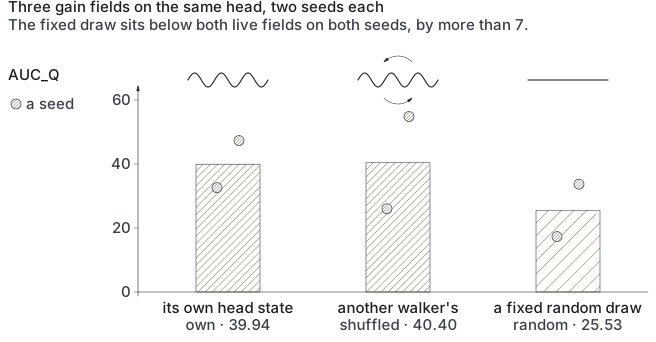
Is a gain that follows a live brain signal better than a fixed random one?
Yes. On the old reward the fixed gain scored 25.5 against about 40 for live signals; on the real reward this later reversed.
In the log: the heterogeneity question as one MPS family (E167 / E170 / E174, same device)
falsifiedDate not stated in the log; it was written between the commit of 2026-09-16 19:06 and the first commit that contains it, 2026-09-19 08:35unclassified1 prediction · 1 result paragraphEXPERIMENTS.md lines 11791–11809, lines 11852–11859, lines 11941–11961
What E185 did and how it came out, drawn from this record and the files it names (book/assets/diagrams/exp/E185.svg).
Pre-registration
(7)
stays the unit
any claim is measured in. Shuffle and
random arms pending.
no verdict written against it
The pre-registration, as written
E185 — the heterogeneity question as one MPS family (E167 / E170 / E174, same device)
E170 answered "head or heterogeneity?" with heterogeneity, but E174 (gains from a fixed
random vector, the head never read) was never run, and by the E184b rule an MPS E174 could
not be set beside scipy E167/E170. So the three arms are re-run as one family on MPS,
E171b's head otherwise (steps 4, fb+oa+5ht, no --confirm), 200 × 4 × 2 each, tags
e185_own / e185_shuffle / e185_random (FORAGER_MODULATE=1 | shuffle | random). ~1.7 h.
Predictions.
All three means within one seed-spread (7 AUC_Q) of each other, and none below 30:
the E170 reading — per-walker heterogeneity is what pays — stands, and the head's
state is not needed for it. This is the null and the expected result.
Falsified if random is below both own and shuffle by > 7 on both seeds: then a head
state — anyone's — carries something a fixed draw does not (it varies with where the
walker is, in time), and E170's "not the head" was too strong: not the walker's own
state, but a live state.
Falsified the other way if own is above both by > 7 on both seeds: E170's shuffled
arm was an unlucky pair and the own-state reading returns, on the same device this time.
Wall time ≤ 25 min per seed (E184b: 17–18); the family's six seeds fit before E173 ends.
Runs after E183's JOB DONE (core budget), with the full test suite in the same chain first.
E185 interim (13:51) — own-state arm: AUC_Q 39.94 ± 7.33, finds 87 ± 4 (per-seed file now
written: see runs/odt_map/stage_b_e185_own.json). Same protocol, seeds and device as
E184b (32.610625 / 45.346): seed 0 is bit-identical across the two MPS runs; seed 1 differs
by 1.9 — MPS sparse reductions are reproducible until a walker's greedy comparison lands
within float32 of a tie, after which the trajectories part; an MPS seed is therefore a
replicate most of the time and a sample sometimes, and the seed spread (7) stays the unit
any claim is measured in. Shuffle and
random arms pending.
Results
EXPERIMENTS.md · line 11941
E185 result (14:58) — prediction 1 (the null) FALSIFIED; prediction 2 fires: a live head
state matters, anyone's. One MPS family, E171b's head, 200 × 4 × 2 each:
arm                              seed 0   seed 1   mean ± s.e.      finds
own-state gains  (E167's rule)    32.6     47.3    39.94 ± 7.33    83, 91
shuffled gains   (E170's rule)    26.0     54.8    40.40 ± 14.43   61, 95
fixed random gains (E174)         17.3     33.7    25.53 ± 8.20    60, 71
random − own      −15.3  −13.5 ;  random − shuffle  −8.6  −21.1   (bar: > 7 on both seeds)
The fixed-draw arm is below both live arms on both seeds by more than the 7-point bar.
So the reading E170 left — "per-walker heterogeneity is what pays; the head's state is not
needed" — was too strong, and is amended: heterogeneity that is live (a gain that moves
as the head's state moves, even when it is another walker's state) beats heterogeneity that
is fixed at the start. The walker's own state is still not shown to matter (own ≈
shuffle), so the head is not steering each walker; it is supplying a time-varying,
composition-dependent gain field that a static draw cannot. What that field carries is the
next question, and it has a cheap test: shuffled gains with the permutation frozen after
round 1 (a fixed reassignment of a live signal) separates "live" from "re-drawn every
call". Not launched tonight; written as task 21. Finds and best follow the same order
(random 65.5 vs 78–87; −120 vs −136). Prediction 4 (≤ 25 min per seed) confirmed
throughout.
The full record
This entry is written in 3 separate places in the log, shown here in log order.
EXPERIMENTS.md · lines 11791–11809
E185 — the heterogeneity question as one MPS family (E167 / E170 / E174, same device)
E170 answered "head or heterogeneity?" with heterogeneity, but E174 (gains from a fixed
random vector, the head never read) was never run, and by the E184b rule an MPS E174 could
not be set beside scipy E167/E170. So the three arms are re-run as one family on MPS,
E171b's head otherwise (steps 4, fb+oa+5ht, no --confirm), 200 × 4 × 2 each, tags
e185_own / e185_shuffle / e185_random (FORAGER_MODULATE=1 | shuffle | random). ~1.7 h.
Predictions.
All three means within one seed-spread (7 AUC_Q) of each other, and none below 30:
the E170 reading — per-walker heterogeneity is what pays — stands, and the head's
state is not needed for it. This is the null and the expected result.
Falsified if random is below both own and shuffle by > 7 on both seeds: then a head
state — anyone's — carries something a fixed draw does not (it varies with where the
walker is, in time), and E170's "not the head" was too strong: not the walker's own
state, but a live state.
Falsified the other way if own is above both by > 7 on both seeds: E170's shuffled
arm was an unlucky pair and the own-state reading returns, on the same device this time.
Wall time ≤ 25 min per seed (E184b: 17–18); the family's six seeds fit before E173 ends.
Runs after E183's JOB DONE (core budget), with the full test suite in the same chain first.
EXPERIMENTS.md · lines 11852–11859
E185 interim (13:51) — own-state arm: AUC_Q 39.94 ± 7.33, finds 87 ± 4 (per-seed file now
written: see runs/odt_map/stage_b_e185_own.json). Same protocol, seeds and device as
E184b (32.610625 / 45.346): seed 0 is bit-identical across the two MPS runs; seed 1 differs
by 1.9 — MPS sparse reductions are reproducible until a walker's greedy comparison lands
within float32 of a tie, after which the trajectories part; an MPS seed is therefore a
replicate most of the time and a sample sometimes, and the seed spread (7) stays the unit
any claim is measured in. Shuffle and
random arms pending.
EXPERIMENTS.md · lines 11941–11961
E185 result (14:58) — prediction 1 (the null) FALSIFIED; prediction 2 fires: a live head
state matters, anyone's. One MPS family, E171b's head, 200 × 4 × 2 each:
arm                              seed 0   seed 1   mean ± s.e.      finds
own-state gains  (E167's rule)    32.6     47.3    39.94 ± 7.33    83, 91
shuffled gains   (E170's rule)    26.0     54.8    40.40 ± 14.43   61, 95
fixed random gains (E174)         17.3     33.7    25.53 ± 8.20    60, 71
random − own      −15.3  −13.5 ;  random − shuffle  −8.6  −21.1   (bar: > 7 on both seeds)
The fixed-draw arm is below both live arms on both seeds by more than the 7-point bar.
So the reading E170 left — "per-walker heterogeneity is what pays; the head's state is not
needed" — was too strong, and is amended: heterogeneity that is live (a gain that moves
as the head's state moves, even when it is another walker's state) beats heterogeneity that
is fixed at the start. The walker's own state is still not shown to matter (own ≈
shuffle), so the head is not steering each walker; it is supplying a time-varying,
composition-dependent gain field that a static draw cannot. What that field carries is the
next question, and it has a cheap test: shuffled gains with the permutation frozen after
round 1 (a fixed reassignment of a live signal) separates "live" from "re-drawn every
call". Not launched tonight; written as task 21. Finds and best follow the same order
(random 65.5 vs 78–87; −120 vs −136). Prediction 4 (≤ 25 min per seed) confirmed
throughout.
Related entries
E167 — octopamine gain and serotonin persistence read from the head (task 0 step 4)