Must each walker's stride come from the brain's reading at that walker's own spot?
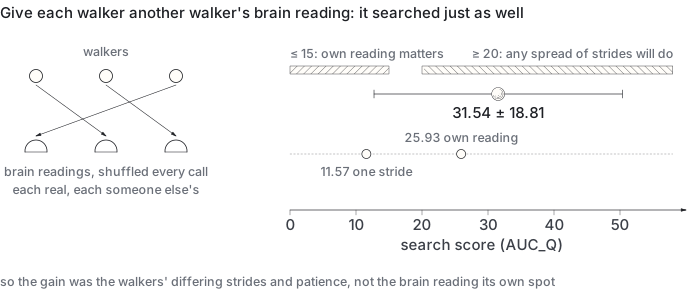
No. Handing each walker another walker's reading scored as well (31.5 against 25.9); the spread of strides helped, not the brain.
In the log: the shuffled control for E167
falsifiedDate not stated in the log; it was written between the commit of 2026-09-16 19:06 and the first commit that contains it, 2026-09-19 08:35generator · fly brain0 predictions · 1 result paragraphEXPERIMENTS.md lines 11061–11080, lines 11231–11253
What E170 did and how it came out, drawn from this record and the files it names (book/assets/diagrams/exp/E170.svg).
Results
EXPERIMENTS.md · line 11231
E170 result — prediction 2 fires: "read from the head" is withdrawn. Shuffled gains
(each walker given another walker's LAL/DN state), everything else E167:
arm                                       AUC_Q            finds         best
E163  constant step / patience            11.57 +- 8.87    29 +- 17      -111
E167  gains from the head, own walker     25.93 +- 11.44   71 +- 15      -136
E170  gains from the head, WRONG walker   31.54 +- 18.81   68 +- 24      -137
The control is not below E167 — it is nominally above it, with seeds at ≈ 12.7 and 50.4.
By the bar I set before the run (mean ≥ 20 → heterogeneity), the improvement is
per-walker heterogeneity of step and patience, not the head's state at the walker's own
composition. A swarm whose walkers stall and relocate on different clocks and take
different strides searches better than one in lockstep; where those differences come from
does not matter at this resolution. Withdrawn: every sentence in E167 and in its OVERNIGHT
mark that reads the gain as "the head setting the walk". Kept: the mechanism, as a
heterogeneity generator, and the numbers — a fly arm 2.3× the CEM. Prediction 4 confirmed
(spans 0.048 / 0.044). Sites: fb 583 / 595 lessons, |Δw| 18.3 / 14.7; oa 799 / 799; 5ht 0.
Branch this opens: the cheapest possible control — E167's protocol with the gains drawn
from a fixed random per-walker vector (no head read at all, FORAGER_MODULATE=random). If
that too matches, "modulation" reduces to "give each walker its own step and patience",
and the whole-brain claim must rest on something the shuffled control does not preserve:
the readout, or the plastic sites once they can act (E171b). That control is E174, after
E173, and its prediction goes in before launch.
The full record
This entry is written in 2 separate places in the log, shown here in log order.
E167 changed two things against E163: walkers got individual steps and patiences, and those
came from the head's state at each walker's own composition. E170 keeps the first and
removes the second: FORAGER_MODULATE=shuffle permutes the standardised LAL and DN states
across the 24 walkers on every call, so each walker receives a real head state — another
walker's. Same multiset of gains, wrong walkers. Everything else is E167 (fb+oa+5ht sites,
no --confirm, so it is E167's protocol exactly), 200 × 4 × 2, tag e170, run beside E169.
Predictions, before the run.
E170 falls between E163 and E167: mean AUC_Q below 25.9 and above 11.6. Heterogeneity
alone buys something (a swarm with one patience relocates in lockstep), but the head's
own state at the walker's composition carries more.
Falsification of "read from the head": if E170's mean AUC_Q ≥ 20 (within one seed-sd
of E167's 25.9), the gain is heterogeneity and the interpretation is withdrawn — the
mechanism stays as a heterogeneity generator, and "the head sets the walk" is struck.
Confirmation: if E170's mean AUC_Q ≤ 15, the head's state at the walker's own
composition carries the improvement, and E167's claim stands with this control cited.
Gains span the same range as E167 (step ≥ 0.01 across walkers) — a check that the
shuffle did not silently collapse the modulation.
EXPERIMENTS.md · lines 11231–11253
E170 result — prediction 2 fires: "read from the head" is withdrawn. Shuffled gains
(each walker given another walker's LAL/DN state), everything else E167:
arm                                       AUC_Q            finds         best
E163  constant step / patience            11.57 +- 8.87    29 +- 17      -111
E167  gains from the head, own walker     25.93 +- 11.44   71 +- 15      -136
E170  gains from the head, WRONG walker   31.54 +- 18.81   68 +- 24      -137
The control is not below E167 — it is nominally above it, with seeds at ≈ 12.7 and 50.4.
By the bar I set before the run (mean ≥ 20 → heterogeneity), the improvement is
per-walker heterogeneity of step and patience, not the head's state at the walker's own
composition. A swarm whose walkers stall and relocate on different clocks and take
different strides searches better than one in lockstep; where those differences come from
does not matter at this resolution. Withdrawn: every sentence in E167 and in its OVERNIGHT
mark that reads the gain as "the head setting the walk". Kept: the mechanism, as a
heterogeneity generator, and the numbers — a fly arm 2.3× the CEM. Prediction 4 confirmed
(spans 0.048 / 0.044). Sites: fb 583 / 595 lessons, |Δw| 18.3 / 14.7; oa 799 / 799; 5ht 0.
Branch this opens: the cheapest possible control — E167's protocol with the gains drawn
from a fixed random per-walker vector (no head read at all, FORAGER_MODULATE=random). If
that too matches, "modulation" reduces to "give each walker its own step and patience",
and the whole-brain claim must rest on something the shuffled control does not preserve:
the readout, or the plastic sites once they can act (E171b). That control is E174, after
E173, and its prediction goes in before launch.
Related entries
E167 — octopamine gain and serotonin persistence read from the head (task 0 step 4)
E163 — Task 0, step 2b: the afferent broadcast as the brain's input
E169 — the cast from the descending neurons (task 0 step 5)