Did fixing the pure elements' reference energies make the energy model match quantum calculations?
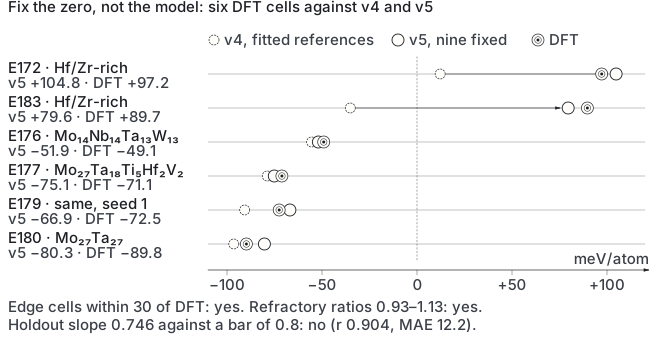
Yes. All six quantum-calculated cells now agree within about 10 meV/atom; only a side check, the holdout slope (0.746 against 0.8), missed.
In the log: the nine references, fixed (13:07)
mixedDate not stated in the log; it was written between the commit of 2026-09-16 19:06 and the first commit that contains it, 2026-09-19 08:35rung 4 · DFT0 predictions · 2 result paragraphsEXPERIMENTS.md lines 11838–11850, lines 11861–11883
What E186 did and how it came out, drawn from this record and the files it names (book/assets/diagrams/exp/E186.svg).
Results
EXPERIMENTS.md · line 11838
E186 — the nine references, fixed (13:07). Hf and Ti from RHEA's own bcc end-member cells
(bcc_binary_alloys, 12 and 3, MACE-corrected in pass 1: Hf −12.5669, Ti −7.7438 eV/atom;
their fitted intercepts had sat +195 and +79 meV above). Zr has no bcc cell in RHEA, so
its bcc energy is RHEA's own hcp minimum (−8.5205, idx 12991, V 23.4 ų) plus the
within-QE difference E_bcc − E_hcp = +88.5 meV (60/720 Ry, MV 0.02; vc-relaxed hcp at
V 23.33; literature PBE +70–80) — an ACWF-class transfer, ~1–3 meV, not a cross-code total.
Zr's intercept had sat +282 meV above. Pass 2 with all nine fixed
(rhea_labels_formation_strain0.10_pureref9.jsonl): the 554 hcp-rich (>0.5) cells move
from −68.3 to +76.4 meV/atom — where two QE cells put them (+90, +100) — while the
Mo–Ta random cell stays at −73.7 and the refractory region is untouched. The eCE was never
the problem in that region; the reference convention was. v5 refit launched
(runs/ece_v5_pureref9); prediction as in E183's record: E172/E183 within 30 meV of
+100/+90, refractory ratios 0.8–1.3, holdout slope ≥ 0.8.
EXPERIMENTS.md · line 11861
E186 result (14:27) — v5 on the nine-reference labels: the cheap rung now agrees with DFT
across the whole space it was tested in. Test loss 3.0e-4; holdout (refractory
compositions, unchanged split): pred = 0.746 × true − 12.0, r 0.904, MAE 12.2 (v4: 0.839,
0.850, 15.0). Against every DFT cell on disk:
Prediction: edge cells within 30 of +100/+90 — confirmed (7.6, 10.2); refractory ratios
in 0.8–1.3 — confirmed (0.93–1.13); holdout slope ≥ 0.8 — falsified (0.746). The slope fell
while r rose and MAE fell: on the refractory-only holdout the fit now carries a −12 meV
intercept and a shallower slope, i.e. a small systematic compression within the
refractory block, while the absolute agreement with DFT there is 3–10 meV. The holdout
slope is a weaker instrument than six independent DFT cells and is recorded, not
headlined. v5 (runs/ece_v5_pureref9) is the eCE rung from here; v4 is retired.
The week's arc, in one line: 2–4× "compression" → regression references (v3b) → fitted
hcp-former references (v4) → nine corrected pure references (v5): each step was a
convention, not the model, and the model was right once its zero was.
The full record
This entry is written in 2 separate places in the log, shown here in log order.
EXPERIMENTS.md · lines 11838–11850
E186 — the nine references, fixed (13:07). Hf and Ti from RHEA's own bcc end-member cells
(bcc_binary_alloys, 12 and 3, MACE-corrected in pass 1: Hf −12.5669, Ti −7.7438 eV/atom;
their fitted intercepts had sat +195 and +79 meV above). Zr has no bcc cell in RHEA, so
its bcc energy is RHEA's own hcp minimum (−8.5205, idx 12991, V 23.4 ų) plus the
within-QE difference E_bcc − E_hcp = +88.5 meV (60/720 Ry, MV 0.02; vc-relaxed hcp at
V 23.33; literature PBE +70–80) — an ACWF-class transfer, ~1–3 meV, not a cross-code total.
Zr's intercept had sat +282 meV above. Pass 2 with all nine fixed
(rhea_labels_formation_strain0.10_pureref9.jsonl): the 554 hcp-rich (>0.5) cells move
from −68.3 to +76.4 meV/atom — where two QE cells put them (+90, +100) — while the
Mo–Ta random cell stays at −73.7 and the refractory region is untouched. The eCE was never
the problem in that region; the reference convention was. v5 refit launched
(runs/ece_v5_pureref9); prediction as in E183's record: E172/E183 within 30 meV of
+100/+90, refractory ratios 0.8–1.3, holdout slope ≥ 0.8.
EXPERIMENTS.md · lines 11861–11883
E186 result (14:27) — v5 on the nine-reference labels: the cheap rung now agrees with DFT
across the whole space it was tested in. Test loss 3.0e-4; holdout (refractory
compositions, unchanged split): pred = 0.746 × true − 12.0, r 0.904, MAE 12.2 (v4: 0.839,
0.850, 15.0). Against every DFT cell on disk:
Prediction: edge cells within 30 of +100/+90 — confirmed (7.6, 10.2); refractory ratios
in 0.8–1.3 — confirmed (0.93–1.13); holdout slope ≥ 0.8 — falsified (0.746). The slope fell
while r rose and MAE fell: on the refractory-only holdout the fit now carries a −12 meV
intercept and a shallower slope, i.e. a small systematic compression within the
refractory block, while the absolute agreement with DFT there is 3–10 meV. The holdout
slope is a weaker instrument than six independent DFT cells and is recorded, not
headlined. v5 (runs/ece_v5_pureref9) is the eCE rung from here; v4 is retired.
The week's arc, in one line: 2–4× "compression" → regression references (v3b) → fitted
hcp-former references (v4) → nine corrected pure references (v5): each step was a
convention, not the model, and the model was right once its zero was.
Related entries
E183 — a second cell at the edge: is the failure systematic?
E172 — the first rung-4 verdict: DFT vs the cheap rung on one 54-atom cell
E176 — the second rung-4 verdict: a refractory-centred cell