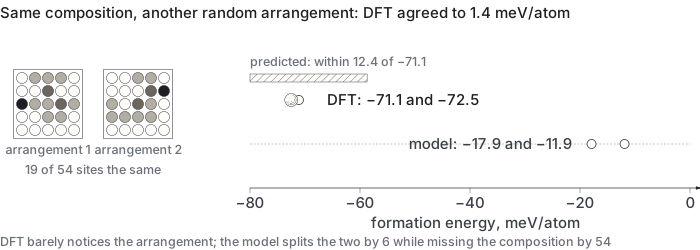
Does a different random arrangement of the same composition give the same DFT energy?
Yes. The second arrangement gave −72.5 meV/atom against −71.1, a 1.4 difference, well inside the 12.4 allowance.
In the log: result — prediction confirmed: the −71 is the composition's, not the decoration's
confirmedDate not stated in the log; it was written between the commit of 2026-09-16 19:06 and the first commit that contains it, 2026-09-19 08:35rung 4 · DFT0 predictions · 1 result paragraphEXPERIMENTS.md lines 11469–11479
What E179 did and how it came out, drawn from this record and the files it names (book/assets/diagrams/exp/E179.svg).
Results
EXPERIMENTS.md · line 11469
E179 result — prediction confirmed: the −71 is the composition's, not the decoration's.
Seed-1 decoration (19/54 sites shared), same Vegard a, JOB DONE in 23 iterations:
E/atom −6463.52808 eV, E_form(DFT) = −72.5 meV/atom vs E177's −71.1 — ΔE = 1.4, an
order of magnitude inside the 12.4 meV decoration floor. Two things follow. (i) The DFT
formation energy of a random 54-atom decoration at this composition is reproducible to
~1–2 meV/atom, so single-decoration rung-4 verdicts are sound at this cell size. (ii) The
eCE scored the two decorations 6 meV apart (−17.9 / −11.9) where DFT puts them 1.4 apart —
the model resolves decoration differences that are not there, at the same time as it misses
the composition's energy by 54. Both are what an embedding fitted to RHEA's rattled,
strain-cut labels would do at a composition 0.27 from its nearest training point. Four
QE cells now exist; six more before E175's refit.
The full record
EXPERIMENTS.md · lines 11469–11479
E179 result — prediction confirmed: the −71 is the composition's, not the decoration's.
Seed-1 decoration (19/54 sites shared), same Vegard a, JOB DONE in 23 iterations:
E/atom −6463.52808 eV, E_form(DFT) = −72.5 meV/atom vs E177's −71.1 — ΔE = 1.4, an
order of magnitude inside the 12.4 meV decoration floor. Two things follow. (i) The DFT
formation energy of a random 54-atom decoration at this composition is reproducible to
~1–2 meV/atom, so single-decoration rung-4 verdicts are sound at this cell size. (ii) The
eCE scored the two decorations 6 meV apart (−17.9 / −11.9) where DFT puts them 1.4 apart —
the model resolves decoration differences that are not there, at the same time as it misses
the composition's energy by 54. Both are what an embedding fitted to RHEA's rattled,
strain-cut labels would do at a composition 0.27 from its nearest training point. Four
QE cells now exist; six more before E175's refit.