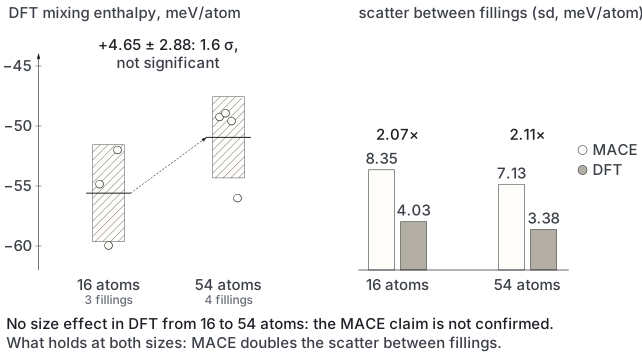
Does the quantum calculation confirm that small simulation boxes are biased?
No. The 16-to-54-atom shift is +4.65 ± 2.88 meV/atom, within noise. The screening model overstates the scatter about twofold.
In the log: The finite-size claim does not survive DFT; a different pattern does
recordedDate 2026-09-12, as written in the logrung 4 · DFT0 predictions · 1 result paragraphEXPERIMENTS.md lines 723–764
What E17 did and how it came out, drawn from this record and the files it names (book/assets/diagrams/exp/E17.svg).
Results
EXPERIMENTS.md · line 731
Result.
The full record
EXPERIMENTS.md · lines 723–764
E17 — The finite-size claim does not survive DFT; a different pattern does
Date 2026-09-12 · Question Complete E4/E5: what is the finite-size shift in
DFT, and does it match MACE? · Provenancescripts/dft_calibration.py, local
Method. As E4, with size-matched elemental references at each cell size, now with
three occupancies at 16 atoms and four at 54. Each 54-atom SCF took 3,158-3,931 s.
Result.
cell
composition
n
mean dH_mix
occupancy sd
16 atoms
4/4/4/4
3
-55.60
4.03
54 atoms
14/14/13/13
4
-50.95
3.38
Shift 16 -> 54 = +4.65 +/- 2.88 meV/atom, 1.6 sigma. Not significant, and
consistent with the +1.21 that MACE predicted for the same two points (E3).
The finite-size claim of E3 is therefore not confirmed in DFT. It was measured in
MACE, where 16-atom cells looked biased by up to 15 meV/atom. In DFT the 16-to-54
shift is within noise. The 128-atom point, which is where E3 saw the effect converge,
remains unmeasured in DFT because it needs 23.45 GB (E5). "128 atoms is the minimum"
stands only as a MACE result and must not be quoted as a DFT one.
A better-supported pattern, holding at two independent cell sizes:
16 atoms
54 atoms
ratio
MACE occupancy sd
8.35
7.13
DFT occupancy sd
4.03
3.38
MACE / DFT
2.07
2.11
MACE overstates configurational scatter by about 2.1x, and the two cell sizes agree
to within 2%. Still only 3 and 4 occupancies, so the individual standard deviations are
weakly determined; the consistency of the ratio across two independent cells is what
gives this more weight than E16's single-size version of the same observation.
This corrects E2 in the favourable direction. The 23.3% flip probability reported
there was computed from MACE's scatter. Using the DFT value of 4.03 meV/atom, the
closest pair's 8.5 meV gap sits at 1.49 sigma, so the single-occupancy flip risk is
about 7%, not 23%. The ranking problem is real and about a third the size first
stated.