Can a fast formula over neighbouring atoms stand in for the slow energy model?
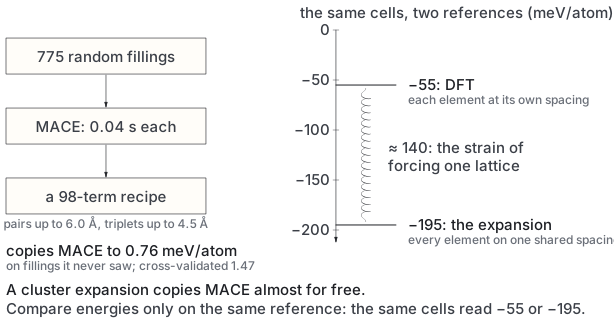
Yes. For four elements it matches the model to 0.76 meV/atom on unseen arrangements, at almost no cost.
In the log: A cluster expansion works, and it is nearly free
recordedDate 2026-09-12, as written in the logrung 0 · energy model0 predictions · 1 result paragraphEXPERIMENTS.md lines 612–678
What E16 did and how it came out, drawn from this record and the files it names (book/assets/diagrams/exp/E16.svg).
Results
EXPERIMENTS.md · line 649
Result.
The full record
EXPERIMENTS.md · lines 612–678
E16 — A cluster expansion works, and it is nearly free
Date 2026-09-12 · Question Can a cluster expansion be built from this data, and
would it address the occupancy and finite-size problems? · Provenance…/ce_pilot2.py, icet 4.0
Why CE. A cluster expansion writes the energy of any occupancy on a fixed lattice
as a sum over clusters with fitted interactions. Once fitted it evaluates any cell
instantly, which addresses four measured defects at once: occupancy noise (E2/E4)
becomes a Monte Carlo average rather than a 1-or-10 sample; the finite-size wall
(E3/E5) disappears because a fitted CE evaluates 1000-atom cells; the ideal-entropy
artefact that makes the 1500 K ranking a component count becomes a real
configurational entropy with short-range order; and the composition baseline of E12
is a crude CE, so a proper one is its principled form.
Parameter cost, measured with icet on bcc:
cutoffs (pair, triplet, quad)
parameters
structures needed at 5-10x
pairs only, 5.0
92
460 - 920
6.0, 4.5
344
1,720 - 3,440
6.0, 4.5, 4.0
750
3,750 - 7,500
four elements only (MoNbTaW), 6.0/4.5
52
260 - 520
five elements (MoNbTaVW), 6.0/4.5
95
475 - 950
A full eight-element CE therefore needs a few thousand structures - about 300-600
CPU-hours of DFT, which is not available. But MACE-MPA-0 produces one in 0.04 s,
so the standard route is to fit the CE to the potential and keep DFT as validation.
Method. Four elements (Mo, Ta, V, W), cutoffs 6.0/4.5, 98 parameters, 775 random
occupancies of a 16-site bcc cell at one fixed lattice parameter (3.1593 A, Vegard for
equiatomic MoTaVW). Fitted to the mixing energy, not the raw energy: raw energy per
atom spans ~7,000 eV across these compositions because V is -2911 and W is -10343
eV/atom, so a raw fit is dominated by which elements are present and reached only
74 meV/atom. Elemental references taken on the same fixed lattice, as a fixed-lattice
CE requires.
Result.
fit
CV RMSE
fit RMSE
non-zero
lasso
1.61
1.41
88/98
ardr
1.59
1.40
45/98
ridge
1.47
1.21
98/98
meV/atom. The CE reproduces MACE to 0.76 meV/atom mean absolute difference on
held-out occupancies. It is an accurate and essentially free surrogate.
Two findings.
A reference-convention trap. The CE gives dH of -195 where DFT gives -55 for the
same cells. This is not an error: a fixed-lattice CE references elements at the
common lattice, while the DFT here references them at their own equilibrium
lattice. The ~140 meV/atom difference is the elastic energy of straining each
element to the shared lattice. Only quantities on the same convention may be
compared, and occupancy-to-occupancy variation is convention-independent because
the reference cancels.
MACE-MPA-0 may still exaggerate configurational spread. Occupancy standard
deviation across the same three cells: DFT 4.03, CE 8.98, MACE 9.83
meV/atom. The CE tracks MACE closely, as it should, so the gap is MACE against DFT.
Caveat: the DFT sd comes from n=3, where a standard deviation is very weakly
determined. This is a lead worth more occupancies, not a measured factor.
Next for this thread. Extend to all eight elements (344 parameters, a few thousand
MACE structures, minutes), then Monte Carlo for configurational entropy and short-range
order - which is what would replace the ideal-mixing term that currently makes the
1500 K ranking a count of components.