Date 2026-09-12 · Question How large must the cell be before one occupancy is
a usable number? · Provenance…/cellsize.py
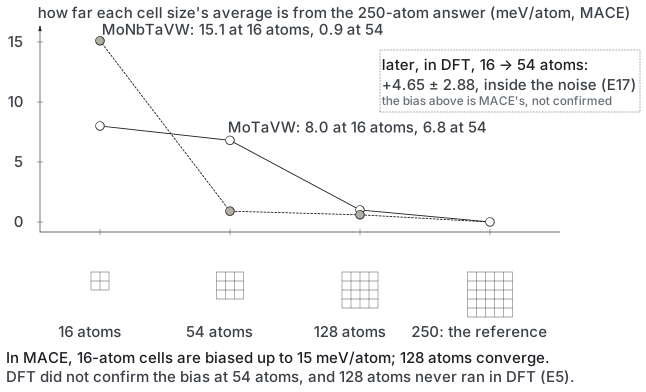
Method. As E2, at four supercell sizes (n x n x n conventional bcc, 2n^3 sites),
16 occupancies each, two compositions. Deviation measured against the 250-atom cell.
system
16
54
128
250 (ref)
MoTaVW mean dH
-120.84
-119.63
-113.86
-112.86
deviation
8.0
6.8
1.0
-
MoNbTaVW mean dH
-115.82
-99.88
-100.12
-100.75
deviation
15.1
0.9
0.6
-
sd, MoTaVW
8.35
7.13
4.53
2.82
sd, MoNbTaVW
11.17
6.55
4.21
3.60
Interpretation. The 16-atom cell is biased, not merely noisy — up to 15
meV/atom, larger than the gaps being ranked. 54 atoms is composition-dependent
(0.9 meV for one system, 6.8 for the other), and a composition-dependent error
reorders candidates rather than shifting them together. 128 atoms converges both to
~1 meV of the 250-atom reference.
Scatter falls more slowly than 1/sqrt(N) — 2.96x at 250 atoms where independent
averaging predicts 3.95x — because random occupancies share correlated local
environments. That is the argument for SQS over averaging.
Status of the claim. Measured in MACE only, and not confirmed - see E17, where
the DFT shift from 16 to 54 atoms is +4.65 +/- 2.88 meV/atom, within noise. The
128-atom DFT point remains unmeasured.