Does the quantum calculation also give different energies for different random arrangements?
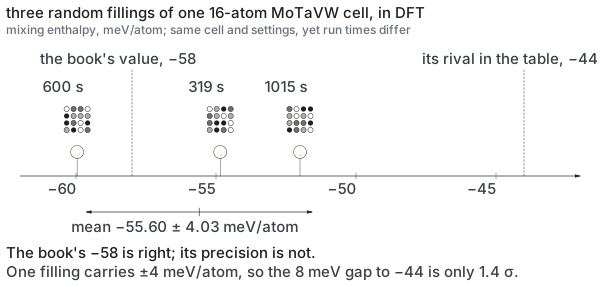
Yes. Three arrangements of one cell spread by 4 meV/atom; the book's −58 meV/atom lies inside that spread.
In the log: Occupancy scatter in DFT at 16 atoms
recordedDate 2026-09-12, as written in the logrung 4 · DFT0 predictions · 0 result paragraphsEXPERIMENTS.md lines 110–149
What E4 did and how it came out, drawn from this record and the files it names (book/assets/diagrams/exp/E4.svg).
Results
No result paragraph for this entry was found in the log.
The full record
EXPERIMENTS.md · lines 110–149
E4 — Occupancy scatter in DFT at 16 atoms
Date 2026-09-12 · Question Is E2's scatter a MACE artefact? ·
Provenancescripts/dft_calibration.py, run locally in forager-qe:latest
Method. Three independent random occupancies of one 16-site MoTaVW cell.
Quantum ESPRESSO 7.5, PBE, PSLibrary PAW, ecutwfc 50 Ry, ecutrho 400 Ry, 3x3x3
k-points, Marzari-Vanderbilt smearing 0.02 Ry, conv_thr 1e-7 Ry.
energy (eV/atom)
seconds
occ0
-7025.122403
319
occ1
-7025.127513
600
occ2
-7025.119557
1015
sd = 4.03 meV/atom, range = 7.96 meV/atom.
Completed with size-matched elemental references (Mo, Ta, V, W as bcc 2x2x2 at the
same k-mesh), so the comparable quantity is a mixing enthalpy rather than a raw total:
occupancy
dH_mix (meV/atom)
occ0
-54.85
occ1
-59.96
occ2
-52.00
mean
-55.60 +/- 4.03
The book's published QE value for MoTaVW is -58 meV/atom, which lies inside this
independently recomputed distribution. The published number is right; the precision
implied by ranking it against a -44 competitor is not — one occupancy draw carries
about +/- 4 meV/atom, and that is now measured in DFT rather than inferred from MACE.
Interpretation. Not an artefact. DFT scatter is about half MACE's 8.35 meV for
the same composition, consistent with MACE's inflated dynamic range partly carrying
over. Two single-occupancy samples differ with sd ~5.7 meV, so the 8 meV gap in the
published table sits at 1.4 sigma — roughly an 8% chance of inversion.
Note. Runtimes vary 319-1015 s for identical cells and k-meshes: SCF convergence
is occupancy-dependent. An earlier reading of these as an MPI-rank effect was not
supported and is withdrawn.