Can a database of known crystal structures tell whether a found alloy is new?
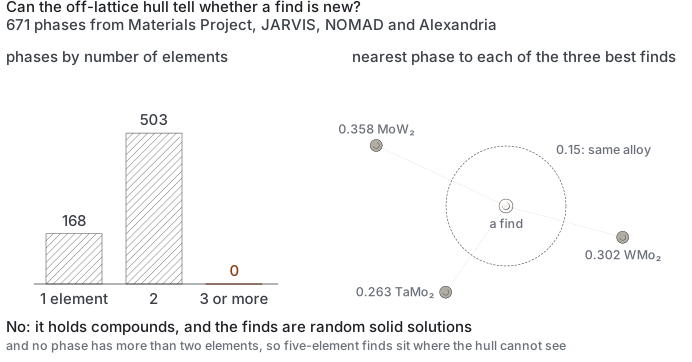
No. Its 671 phases are compounds with at most two elements; the nearest to any find sat 0.263 away, beyond the 0.15 tolerance.
In the log: Can a real database settle the novelty question? Probably not, and here is why.
confirmedDate not stated in the log; it was written between the commit of 2026-09-16 18:20 and the first commit that contains it, 2026-09-16 19:06rung 2 · hull, MACE0 predictions · 1 result paragraphEXPERIMENTS.md lines 8924–8951, lines 8953–8991
What E147 did and how it came out, drawn from this record and the files it names (book/assets/diagrams/exp/E147.svg).
Results
EXPERIMENTS.md · line 8953
E147 result: all three predictions confirmed, and the check found something larger than the
novelty question it was asked about.
671 hull phases, by element count:
  1 element   168
  2 elements  503
  3 or more     0

nearest hull phase to each in-class find:
  Mo0.522 W0.151 Ta0.135 Nb0.112 Ti0.080   d = 0.302   WMo2-C15
  W0.412 Mo0.238 Ta0.210 Nb0.077 Ti0.063   d = 0.358   MoW2-C15
  Mo0.589 Ta0.134 Ti0.098 Nb0.092 W0.079   d = 0.263   TaMo2-C15
Predictions 1 and 2 confirmed: nothing within 0.15, nearest 0.263, and every nearest
neighbour is a binary Laves prototype. Prediction 3 confirmed: the hull cannot answer the
novelty question. It is a database of ordered stoichiometric compounds and the finds are
disordered solid solutions — different categories, and absence from one says nothing about the
other. The novelty question remains open and needs a literature check, not a structure
database.
The larger finding is in the first table. The off-lattice hull — the thing every driving
force in this project is measured against — contains no phase with more than two elements.
Not one, out of 671.
A convex hull over unaries and binaries can still bound a five-element composition correctly,
because the bound comes from tie-planes between phases rather than from a phase at that
composition. But it is only correct if no ternary or higher compound is more stable than the
best binary mixture. Where one exists and is absent, the hull sits too high, the driving
force comes out too negative, and the composition looks more stable than it is.
That is the same failure mode as E54/E56, where C15 Laves phases missing from an earlier hull
put seven compositions 98 to 185 meV/atom wrong in the optimistic direction. The current
hull has the same blind spot for every ternary and higher intermetallic in this element set —
and the in-class finds are all five-element, so they sit squarely in the region it cannot see.
This does not withdraw the in-class finds, because no specific missing competitor has been
identified. It does mean their driving forces carry an unquantified one-signed risk, and it
should be recorded as a rung-0 blind spot in spec.py, which currently says only that bcc
superstructures are excluded.
The full record
This entry is written in 2 separate places in the log, shown here in log order.
EXPERIMENTS.md · lines 8924–8951
E147 — Can a real database settle the novelty question? Probably not, and here is why.
E136 flagged that scripts/search/novelty.py cannot support a discovery claim: its reference
list holds only equiatomic alloys, so any non-equiatomic composition reads novel by
construction. The queue says to check against a real database instead. One is already local —
data/offlattice_hull12.json, 671 phases pulled from Materials Project, JARVIS, NOMAD and
Alexandria (E120: 136 prototypes plus 193 alexandria, 167 mc3d, 132 mc3d-psol, 43 jarvis).
But there is a category error waiting here and it should be named before the measurement,
not after. That hull is a database of compounds — ordered stoichiometric phases with
definite structures. The finds are solid solutions: disordered arrangements on a bcc
lattice at arbitrary composition. A solid solution is not the kind of object that appears in a
structure database, so absence from the hull is not evidence of novelty. It is evidence of
the two being different categories.
Predicted:
No in-class find matches any hull phase within 0.15, and the nearest distances are
large — above 0.3 for most.
The nearest hull phases are binary or ternary compounds, not five-element ones, because
the databases are thin on high-order random solid solutions (E14 counted zero MPtrj
materials with four or more of these elements).
So the hull cannot answer the question. Confirming 1 and 2 establishes that this
database is the wrong instrument, not that the finds are new.
Falsified if a find sits within 0.15 of a hull phase, which would mean the databases do
carry comparable objects and the hull can serve as a novelty reference after all — a better
outcome, and one that would give the project a real check it currently lacks.
EXPERIMENTS.md · lines 8953–8991
E147 result: all three predictions confirmed, and the check found something larger than the
novelty question it was asked about.
671 hull phases, by element count:
  1 element   168
  2 elements  503
  3 or more     0

nearest hull phase to each in-class find:
  Mo0.522 W0.151 Ta0.135 Nb0.112 Ti0.080   d = 0.302   WMo2-C15
  W0.412 Mo0.238 Ta0.210 Nb0.077 Ti0.063   d = 0.358   MoW2-C15
  Mo0.589 Ta0.134 Ti0.098 Nb0.092 W0.079   d = 0.263   TaMo2-C15
Predictions 1 and 2 confirmed: nothing within 0.15, nearest 0.263, and every nearest
neighbour is a binary Laves prototype. Prediction 3 confirmed: the hull cannot answer the
novelty question. It is a database of ordered stoichiometric compounds and the finds are
disordered solid solutions — different categories, and absence from one says nothing about the
other. The novelty question remains open and needs a literature check, not a structure
database.
The larger finding is in the first table. The off-lattice hull — the thing every driving
force in this project is measured against — contains no phase with more than two elements.
Not one, out of 671.
A convex hull over unaries and binaries can still bound a five-element composition correctly,
because the bound comes from tie-planes between phases rather than from a phase at that
composition. But it is only correct if no ternary or higher compound is more stable than the
best binary mixture. Where one exists and is absent, the hull sits too high, the driving
force comes out too negative, and the composition looks more stable than it is.
That is the same failure mode as E54/E56, where C15 Laves phases missing from an earlier hull
put seven compositions 98 to 185 meV/atom wrong in the optimistic direction. The current
hull has the same blind spot for every ternary and higher intermetallic in this element set —
and the in-class finds are all five-element, so they sit squarely in the region it cannot see.
This does not withdraw the in-class finds, because no specific missing competitor has been
identified. It does mean their driving forces carry an unquantified one-signed risk, and it
should be recorded as a rung-0 blind spot in spec.py, which currently says only that bcc
superstructures are excluded.
Related entries
E136 — The fly has not been used, and nothing found so far is new
E120 — Reconciling the hull phase count, and what a fresh clone cannot do
E14 — Why the old model failed: a census, not a hypothesis
E54 — The three qualifiers are on the wrong lattice; the expansion cannot see what beats them
E56 — The survey inverts: every composition it rated highest is unstable off the lattice, and…