Had the old screening model ever seen an alloy like the ones it was judging?
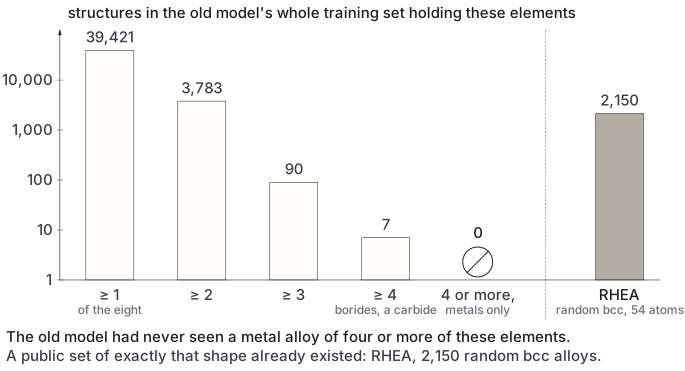
No. Its training data holds not one metal alloy of four or more of these elements; a public set of 2,150 exists.
In the log: Why the old model failed: a census, not a hypothesis
recordedDate 2026-09-12, as written in the logrung 2 · hull, MACE0 predictions · 2 result paragraphsEXPERIMENTS.md lines 506–562
What E14 did and how it came out, drawn from this record and the files it names (book/assets/diagrams/exp/E14.svg).
Results
EXPERIMENTS.md · line 506
E14 — Why the old model failed: a census, not a hypothesis
Date 2026-09-12 · Question Is chapter 7's distributional explanation correct? ·
Provenance literature and database review; Materials Project OPTIMADE census
Method. Exhaustive enumeration of the Materials Project OPTIMADE endpoint
(154,387 entries; MPtrj covers 145,923 materials, so this bounds it tightly), counting
structures by how many of {Mo, Nb, Ta, W, V, Ti, Zr, Hf} they contain. Plus a
measured census of 137,361 real OMat24 structures decoded from two validation
subsets generated by different routes.
Result — Materials Project / MPtrj, the entire MACE-MP-0 training set:
containing
count
>= 1 of the eight
39,421
>= 2
3,783
>= 3
90
>= 4
7 — all borides or a carbide, no metals
refractory-only, 4+ elements
0
The 65 refractory-only ternaries are 4-atom ordered prototypes (MoNbV2, Nb2TaW,
NbTaW, NbTiZr, …), not solid-solution supercells.
OMat24, extrapolated from the measured 137,361-structure sample: ~155,000 frames
containing 3+ of the eight (0.153%), ~4,400 refractory-only quaternary (0.004%), and
zero quinary observed (95% upper bound <2,200). Those that exist are rattled
decorations of Alexandria prototypes in triclinic and monoclinic settings — not
random near-equiatomic bcc supercells.
Interpretation. Chapter 7's explanation is confirmed with a number:
MACE-MP-0's training set contains not one quaternary or quinary metallic refractory
alloy, and not one random bcc solid-solution supercell in this chemistry. The model
had never seen anything resembling the cells it was being asked about.
The published name for the resulting symptom is systematic softening — Deng et al.,
npj Comput. Mater.11, 9 (2025), arXiv:2405.07105 — which documents energy and
force under-prediction in exactly these regimes, attributes it to "biased sampling of
near-equilibrium atomic arrangements in uMLIP pre-training datasets", and reports it
is "effectively rectified by fine-tuning with a single additional data point".
And the missing distribution already exists, computed. The Byggmästar RHEA
database (Zenodo 10.5281/zenodo.18863415, 1.9 GB, CC-BY-4.0, VASP-PBE):
2,150 bcc alloy structures of 54 atoms, 3 to 9 components, elements
Ti-Zr-Hf-V-Nb-Ta-Cr-Mo-W — a superset of ours — randomly ordered, randomly
displaced, three volumes per composition, with isolated-atom references included.
Plus binaries, liquids, defects, surfaces and intermetallics.
Cross-code compatibility is second-order: after element-wise referencing the
VASP-QE residual is ~5 meV/atom RMS for these transition metals, against the
70-114 meV/atom error being fixed. If sources are ever combined, switching QE from
PSLibrary to SSSP-precision closes most of the remaining gap (W 6.28 -> 1.43,
Ta 3.27 -> 1.02 meV/atom).
Licence note. MACE-OMAT-0, the MACE checkpoint trained on OMat24, is ASL —
academic non-commercial only, as are all GRACE models. MACE-MPA-0 is MIT.
GNoME's weights are not downloadable at all.
EXPERIMENTS.md · line 517
Result — Materials Project / MPtrj, the entire MACE-MP-0 training set:
The full record
EXPERIMENTS.md · lines 506–562
E14 — Why the old model failed: a census, not a hypothesis
Date 2026-09-12 · Question Is chapter 7's distributional explanation correct? ·
Provenance literature and database review; Materials Project OPTIMADE census
Method. Exhaustive enumeration of the Materials Project OPTIMADE endpoint
(154,387 entries; MPtrj covers 145,923 materials, so this bounds it tightly), counting
structures by how many of {Mo, Nb, Ta, W, V, Ti, Zr, Hf} they contain. Plus a
measured census of 137,361 real OMat24 structures decoded from two validation
subsets generated by different routes.
Result — Materials Project / MPtrj, the entire MACE-MP-0 training set:
containing
count
>= 1 of the eight
39,421
>= 2
3,783
>= 3
90
>= 4
7 — all borides or a carbide, no metals
refractory-only, 4+ elements
0
The 65 refractory-only ternaries are 4-atom ordered prototypes (MoNbV2, Nb2TaW,
NbTaW, NbTiZr, …), not solid-solution supercells.
OMat24, extrapolated from the measured 137,361-structure sample: ~155,000 frames
containing 3+ of the eight (0.153%), ~4,400 refractory-only quaternary (0.004%), and
zero quinary observed (95% upper bound <2,200). Those that exist are rattled
decorations of Alexandria prototypes in triclinic and monoclinic settings — not
random near-equiatomic bcc supercells.
Interpretation. Chapter 7's explanation is confirmed with a number:
MACE-MP-0's training set contains not one quaternary or quinary metallic refractory
alloy, and not one random bcc solid-solution supercell in this chemistry. The model
had never seen anything resembling the cells it was being asked about.
The published name for the resulting symptom is systematic softening — Deng et al.,
npj Comput. Mater.11, 9 (2025), arXiv:2405.07105 — which documents energy and
force under-prediction in exactly these regimes, attributes it to "biased sampling of
near-equilibrium atomic arrangements in uMLIP pre-training datasets", and reports it
is "effectively rectified by fine-tuning with a single additional data point".
And the missing distribution already exists, computed. The Byggmästar RHEA
database (Zenodo 10.5281/zenodo.18863415, 1.9 GB, CC-BY-4.0, VASP-PBE):
2,150 bcc alloy structures of 54 atoms, 3 to 9 components, elements
Ti-Zr-Hf-V-Nb-Ta-Cr-Mo-W — a superset of ours — randomly ordered, randomly
displaced, three volumes per composition, with isolated-atom references included.
Plus binaries, liquids, defects, surfaces and intermetallics.
Cross-code compatibility is second-order: after element-wise referencing the
VASP-QE residual is ~5 meV/atom RMS for these transition metals, against the
70-114 meV/atom error being fixed. If sources are ever combined, switching QE from
PSLibrary to SSSP-precision closes most of the remaining gap (W 6.28 -> 1.43,
Ta 3.27 -> 1.02 meV/atom).
Licence note. MACE-OMAT-0, the MACE checkpoint trained on OMat24, is ASL —
academic non-commercial only, as are all GRACE models. MACE-MPA-0 is MIT.
GNoME's weights are not downloadable at all.