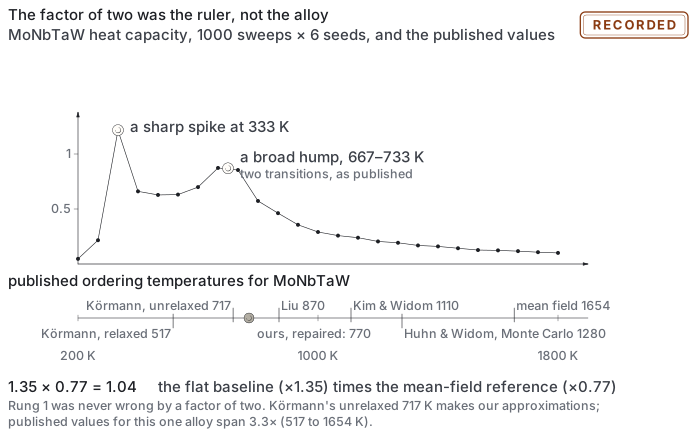
Is the published reference we compared against itself biased high?
Yes. It is a mean-field estimate that runs about 1.3 times high; with our baseline fixed too, the factor of two shrinks to 1.04.
In the log: The reference is mean-field, and the published spread is a factor of three
recordedDate not stated in the log; it was written between the commit of 2026-09-13 08:16 and the first commit that contains it, 2026-09-16 02:04unclassified0 predictions · 0 result paragraphsEXPERIMENTS.md lines 6470–6515
What E111 did and how it came out, drawn from this record and the files it names (book/assets/diagrams/exp/E111.svg).
Results
No result paragraph for this entry was found in the log.
The full record
EXPERIMENTS.md · lines 6470–6515
E111 — The reference is mean-field, and the published spread is a factor of three
E108's "0.54 of the published scale on 74 of 75 compositions" was read as a defect in rung 1.
Before repairing anything further, what the reference actually is.
LTVC is a mean-field treatment.ltvc_check.py says so in its own docstring - "an AFLOW
cluster expansion under a mean-field treatment" - and mean field overestimates an
order-disorder temperature by a known amount. For B2 ordering on bcc, which is the
nearest-neighbour Ising model on a bipartite lattice with z = 8, Bragg-Williams gives
k_B T_c = 8J against the Monte Carlo 6.354J: mean field runs 1.26 times high from the
approximation alone.
That is not a textbook argument here, because somebody has measured it on this exact alloy.
Huhn & Widom (JOM65, 1772, 2013) computed both from the same Hamiltonian:
mean field 1654 K, Monte Carlo 1280 K. The ratio is 0.774, against the 0.79 the
lattice model predicts.
And the published first-principles values for MoNbTaW span a factor of 3.3:
study
method
T_c (K)
Huhn & Widom 2013
mean field
1654
Huhn & Widom 2013
Monte Carlo, same Hamiltonian
1280
Kim & Widom, PRM7, 063803 (2023)
replica-exchange MC
1110
Liu et al., arXiv 2011.00698 (2020)
replica-exchange MC, EPI
870
Ruban, GPM + MC (via Körmann)
static lattice
~750
Körmann & Sluiter, Entropy18, 403 (2016)
DFT unrelaxed + config. entropy
717
Widom et al. 2013
hybrid MC/MD
"600-1200"
del Grosso et al. 2012
empirical
600-800
Körmann & Sluiter 2016
DFT relaxed
517
Two rows matter for us. Körmann's 717 K is the calculation whose approximations are ours -
a static ideal lattice, no relaxation, configurational entropy only - and their relaxed number
is 517 K, so relaxation costs 30 per cent of the ordering temperature. Our expansion is
fitted to unrelaxed MACE on a fixed lattice, so it belongs against 717, not against 1110
and not against a mean-field 1654.
Their enthalpies line up with E109 too. Körmann's unrelaxed A2-B2 enthalpy is 42.8 meV/atom;
E109 measured MACE at 50 and our expansion at 65 on the same quantity. Their two rows
are exactly proportional - 717/517 = 1.387 against 42.8/30.9 = 1.385 - so in their treatment
T_ord tracks the enthalpy linearly, which is the mean-field signature.
Consequence: E108's 0.54 is not one number about rung 1. It factorises into roughly 0.77
for the reference being mean-field and roughly 0.70 for everything else, and that 0.70 sits
inside a published spread that is itself 3.3 wide. The task "fix rung 1's factor-of-two scale
error" was chasing a defect that is at most partly ours.
Related entries
E108 — Rung 1 against 75 published transition temperatures, extracted a week ago and never used
E109 — Why rung 1 halves every ordering temperature: energies or sampling?