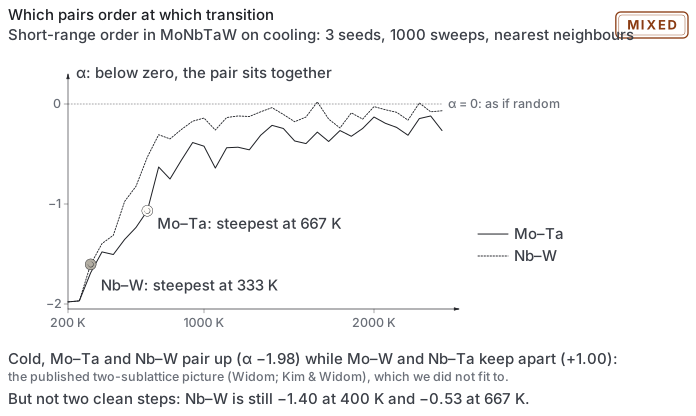
Do different pairs of elements drive the two ordering transitions, as published?
Partly. Nb–W orders at the colder transition (333 K) and Mo–Ta at the warmer (667 K), but their ranges overlap.
In the log: Which elements order at which transition
mixedDate not stated in the log; it was written between the commit of 2026-09-13 08:16 and the first commit that contains it, 2026-09-16 02:04rung 1 · ordering0 predictions · 1 result paragraphEXPERIMENTS.md lines 6554–6580, lines 6621–6659
What E112 did and how it came out, drawn from this record and the files it names (book/assets/diagrams/exp/E112.svg).
Results
EXPERIMENTS.md · line 6621
E112 result: the two-transition claim survives; prediction 2 falsified as worded.
Three seeds, 1000 sweeps per site, 34 rungs, Warren-Cowley in both bcc shells.
The low-temperature structure is the published one, and both shells say so independently.
At 200 K, first shell: Mo-Ta -1.979 and Nb-W -1.979 (together), Mo-W +1.000 and
Nb-Ta +1.000 (avoiding), Mo-Nb and Ta-W -0.021 (neutral). Second shell, where bcc
neighbours are the same sublattice: Mo-W -0.361 and Nb-Ta -0.333 together,
everything else +1.000.
Read together those give sublattice A = {Mo, W} and B = {Nb, Ta}, with a further Mo-Ta and
Nb-W pairing inside that. This is Widom et al.'s "cesium-chloride ordering between mixed
(Nb,Ta) sites and mixed (Mo,W) sites" plus Kim & Widom's low-temperature decomposition into
MoTa and NbW. We did not fit to any of it.
The two pairs do not order at the same temperature, which was the stated falsification
condition. Steepest change in the first shell:
Mo-Ta   667 K    -1.979 (200 K)  ->  -0.266 (2400 K)
Nb-W    333 K    -1.979 (200 K)  ->  -0.068 (2400 K)
Mo-Ta disorders through the 667-733 K hump and Nb-W through the 333 K spike, which is the
assignment Liu et al. make - T1 from Nb and W, T2 from the others. The 333 K peak is a real
second transition and E110's two-transition reading stands.
Prediction 1 confirmed. Mo-Ta is strongly negative cold and relaxes through the 733 K
hump, essentially gone by 933 K.
Prediction 2 falsified as worded. It said alpha(Nb-W) "stays near zero above 400 K". It
does not: Nb-W is -1.396 at 400 K and still -0.531 at 667 K. The two pairs disorder over
overlapping ranges with different midpoints, not in two separated steps. The
discriminating half of the prediction - different temperatures - holds; the picture of a
clean separation does not, and any later claim that these are two independent transitions
should say "overlapping" instead.
Prediction 3 confirmed above 300 K, where Mo-Ta is the largest parameter throughout,
matching the Mo-Ta > Mo-Nb > Ta-W > Nb-W bond hierarchy Huhn & Widom measured at -186, -103,
-110 and -53 meV/atom. At 200 and 267 K it is exactly tied with Nb-W rather than largest,
which is what a fully decomposed two-phase state should give.
The full record
This entry is written in 2 separate places in the log, shown here in log order.
EXPERIMENTS.md · lines 6554–6580
E112 — Which elements order at which transition
Two peaks at roughly the right temperatures could be coincidence. The literature makes a
sharper claim than temperature: it says which pairs drive each one. Liu et al. find T1 "is
due to an order-disorder transition of Nb and W" and T2 "due to the other elements", and note
that "the Nb-W SRO parameter indeed quickly drops to zero as temperature increases". Kim &
Widom find "the dominant ordering occurs between Mo and Ta", with Nb following Ta and W
following Mo, and the low-temperature state a two-phase mixture of B2 MoTa and B32 NbW.
forager.order.warren_cowley already computes exactly this quantity and has never been run
across a temperature ladder. alpha_ij negative means i and j sit together more often than
chance.
Predicted:
alpha(Mo-Ta) is strongly negative at low temperature and relaxes towards zero through the
733 K hump, because Mo-Ta is the strong pair and T2 is its transition.
alpha(Nb-W) stays near zero above 400 K and only becomes negative below the 333 K spike,
because Nb-W is the weak pair and T1 is its transition. This is the discriminating one: if
both pairs order at the same temperature there is one transition and the second peak is an
artefact.
alpha(Mo-Ta) is the largest off-diagonal parameter at every temperature where anything is
ordered, following the bond-strength hierarchy Mo-Ta > Mo-Nb > Ta-W > Nb-W that Huhn &
Widom measured at -186, -103, -110 and -53 meV/atom.
Falsified if the two pairs order together, in which case the 333 K spike is not a second
transition and the estimator must be made to refuse it on other grounds than the A/T^2 tail.
EXPERIMENTS.md · lines 6621–6659
E112 result: the two-transition claim survives; prediction 2 falsified as worded.
Three seeds, 1000 sweeps per site, 34 rungs, Warren-Cowley in both bcc shells.
The low-temperature structure is the published one, and both shells say so independently.
At 200 K, first shell: Mo-Ta -1.979 and Nb-W -1.979 (together), Mo-W +1.000 and
Nb-Ta +1.000 (avoiding), Mo-Nb and Ta-W -0.021 (neutral). Second shell, where bcc
neighbours are the same sublattice: Mo-W -0.361 and Nb-Ta -0.333 together,
everything else +1.000.
Read together those give sublattice A = {Mo, W} and B = {Nb, Ta}, with a further Mo-Ta and
Nb-W pairing inside that. This is Widom et al.'s "cesium-chloride ordering between mixed
(Nb,Ta) sites and mixed (Mo,W) sites" plus Kim & Widom's low-temperature decomposition into
MoTa and NbW. We did not fit to any of it.
The two pairs do not order at the same temperature, which was the stated falsification
condition. Steepest change in the first shell:
Mo-Ta   667 K    -1.979 (200 K)  ->  -0.266 (2400 K)
Nb-W    333 K    -1.979 (200 K)  ->  -0.068 (2400 K)
Mo-Ta disorders through the 667-733 K hump and Nb-W through the 333 K spike, which is the
assignment Liu et al. make - T1 from Nb and W, T2 from the others. The 333 K peak is a real
second transition and E110's two-transition reading stands.
Prediction 1 confirmed. Mo-Ta is strongly negative cold and relaxes through the 733 K
hump, essentially gone by 933 K.
Prediction 2 falsified as worded. It said alpha(Nb-W) "stays near zero above 400 K". It
does not: Nb-W is -1.396 at 400 K and still -0.531 at 667 K. The two pairs disorder over
overlapping ranges with different midpoints, not in two separated steps. The
discriminating half of the prediction - different temperatures - holds; the picture of a
clean separation does not, and any later claim that these are two independent transitions
should say "overlapping" instead.
Prediction 3 confirmed above 300 K, where Mo-Ta is the largest parameter throughout,
matching the Mo-Ta > Mo-Nb > Ta-W > Nb-W bond hierarchy Huhn & Widom measured at -186, -103,
-110 and -53 meV/atom. At 200 and 267 K it is exactly tied with Nb-W rather than largest,
which is what a fully decomposed two-phase state should give.