Is the energy model to blame for ordering temperatures coming out half the published values?
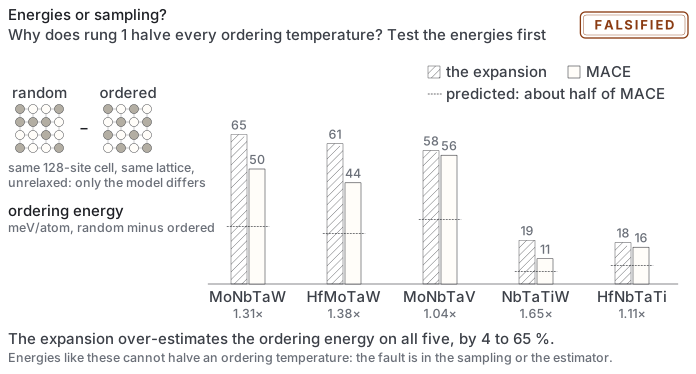
No. It overestimates ordering energies by 4 to 65 per cent on five alloys, so the fault lies in the sampling.
In the log: Why rung 1 halves every ordering temperature: energies or sampling?
falsifiedDate not stated in the log; it was written between the commit of 2026-09-13 08:16 and the first commit that contains it, 2026-09-16 02:04rung 1 · ordering0 predictions · 1 result paragraphEXPERIMENTS.md lines 6383–6431
What E109 did and how it came out, drawn from this record and the files it names (book/assets/diagrams/exp/E109.svg).
Results
EXPERIMENTS.md · line 6414
Result: prediction 1 is FALSIFIED, and in the opposite direction. Five compositions, the
same 128-site cell, same ideal lattice, unrelaxed, E(random) - E(ordered) in meV/atom:
The full record
EXPERIMENTS.md · lines 6383–6431
E109 — Why rung 1 halves every ordering temperature: energies or sampling?
E108 measured rung 1 at 0.54 of the published scale on 74 of 75 compositions, with Kim &
Widom's replica-exchange Monte Carlo agreeing with the published scale on MoNbTaW where we
report half. The fault lies in one of two places and they are separable:
The energies. If the expansion compresses ordering energies, every transition
temperature follows down roughly in proportion. A truncated cluster basis - pairs to 6 A,
triplets to 4.5 A - does exactly this, because the neglected longer-range and higher-order
terms contribute to ordering and not to the random-limit average.
The sampling. 128 sites, 90 sweeps, a 200 K temperature grid and a centre-of-mass
estimator on the excess heat capacity could each pull a transition low.
The test separates them cleanly and needs no new convention. For a composition, build the
random occupation and the B2-ordered occupation of the same 128-site cell at the same
ideal lattice constant, unrelaxed, and take the ordering energy E(random) - E(ordered) from
the expansion and from MACE directly. Everything cancels in the difference: same lattice,
same references, same relaxation state. Whatever disagreement remains is the expansion's.
Predicted:
The expansion underestimates the ordering energy against MACE on the same structures.
By roughly the factor needed to explain the temperature gap - a ratio near 0.5, since
an ordering temperature tracks the ordering energy close to linearly.
If instead the two agree to within 20 per cent, the energies are sound and the fault
is in the Monte Carlo or the transition estimator, which is a different repair entirely.
Falsified if the expansion and MACE agree, in which case prediction 1 is wrong and the
next thing to test is the sampling - sweeps, cell size, grid spacing, and the centre-of-mass
estimator against a peak-position estimator.
Result: prediction 1 is FALSIFIED, and in the opposite direction. Five compositions, the
same 128-site cell, same ideal lattice, unrelaxed, E(random) - E(ordered) in meV/atom:
alloy
CE
MACE
CE/MACE
MoNbTaW
65
50
1.31
HfMoTaW
61
44
1.38
MoNbTaV
58
56
1.04
NbTaTiW
19
11
1.65
HfNbTaTi
18
16
1.11
The expansion overestimates the ordering energy on every one of the five, by 4 to 65 per
cent. Nothing here can halve a transition temperature; if anything these energies should push
it up. The prior-art note already said the expansion runs about 30 per cent high because it
was fitted to unrelaxed MACE, and this measures the same thing from the other side.
Prediction 3's branch is therefore the live one: the fault is in the sampling or the
estimator, not the energies.
Related entries
E108 — Rung 1 against 75 published transition temperatures, extracted a week ago and never used