EXPERIMENTS.md · lines 5920–5985E101 — Is there a barrier between the basins, or did the search simply not look?
E100 found competitive compositions the generator never reports - Cr0.64Ni0.36 at -82
meV/atom against its own best of -88. Two explanations need separating before any fix is
chosen, and they call for different fixes:
- A barrier. The landscape is genuinely multi-modal and the path between W-Ta and Cr-Ni
climbs through bad compositions. A hill-climber cannot cross it, and the fix is restarts,
niching or an archive.
- No barrier. The path is passable and the generator simply stopped moving once it found
something good. The fix is in the reward or the stopping behaviour, not the topology.
Measured by walking the straight line in composition space between the two and screening
every point. Thirty-one steps, the same screen the generator learns from.
Predicted: there is a barrier, and a large one. The midpoint of that line is roughly
W0.37 Ta0.12 Cr0.32 Ni0.18, which mixes refractory metals with late transition metals - the
combination the databases say forms deep intermetallics (E84 measured NiTi, NiNb, NiTa and
NiV compounds 98 to 220 meV/atom below any solid solution). The hull should reject the middle
of the path hard.
Falsified if the ridge is under about 50 meV/atom above both ends, in which case the
landscape is effectively connected at the scale the generator moves on, and the failure is
that it stopped looking rather than that it could not get there.
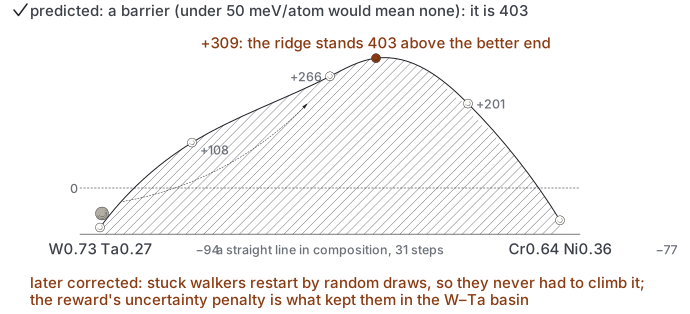
Outcome. The barrier is 403 meV/atom. This is topology, not a reward or a stopping rule.
Walking the straight line from W0.73 Ta0.27 to Cr0.64 Ni0.36, screening every step:
Both ends are good and everything between them is catastrophic. The ridge stands 403
meV/atom above the better end against a prediction of fifty. Mixing refractory metals with
late transition metals is exactly what the databases said would form deep intermetallics
(E84), and the hull duly rejects the whole middle of the path.
A hill-climber cannot cross this and was never going to. No reward shaping, diversity
bonus or stopping rule moves a walker over a 400 meV/atom ridge. The generator was not
failing to look; it was structurally unable to arrive.
And the basins are not the same size. Of 4000 random compositions, 218 are promoted, and
they divide:
Seventeen per cent of everything that passes involves Cr, Co, Cu or Ni - 37 compositions
of 218 - and the generator has never reported one. The refractory basin is five times larger,
so random starts favour it, and a population that shares a learned readout then collapses
onto whatever the first successes were.
So the fix is an archive or an island model, not a better reward. Restarts alone are
weak: with six seeds and a basin ratio of five to one, landing at least one seed in the late
basin is likely but reporting from it requires that the run not be summarised by its single
best, which is how every report in this file has been written.