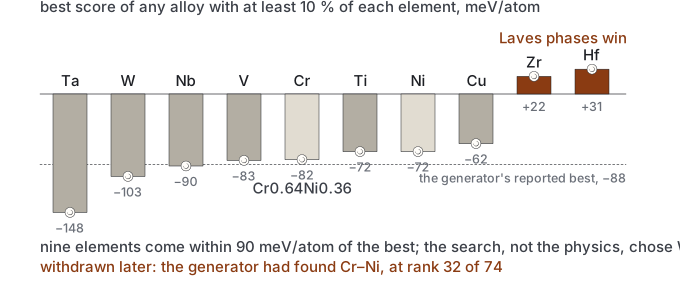
Does the generator return only tantalum–tungsten alloys because the other elements are genuinely worse?
Withdrawn. Other elements do score well (Cr0.64Ni0.36 at −82 meV/atom), but the generator had found Cr–Ni; the report showed only the top eight.
In the log: Why only tantalum and tungsten: the search, not the physics
withdrawnDate not stated in the log; it was written between the commit of 2026-09-13 08:16 and the first commit that contains it, 2026-09-16 02:04rung 3 · kinetics0 predictions · 1 result paragraphEXPERIMENTS.md lines 5870–5918, lines 6044–6061
What E100 did and how it came out, drawn from this record and the files it names (book/assets/diagrams/exp/E100.svg).
Results
EXPERIMENTS.md · line 6044
E100's claim that the generator "never reported" Cr-Ni is withdrawn. It found it, at an L1
distance of 0.04 from the brute-force optimum, and I never looked past the top eight rows.
Every report in this file has quoted the single best row of a 74-row file.
And I quoted the wrong quantity. "The generator's best was -88" was the best reward.
The best drive in the same campaign is Mo0.62 Nb0.38 at -108 - better physics than
anything W-Ta - demoted to rank 20-something by a 44 meV/atom ordering penalty from the gate
E99 showed under-predicts by two to three times.
So the mechanism is not the barrier.E101's 403 meV/atom ridge between W-Ta and Cr-Ni is
a real property of the landscape and is not why the generator converged: the walkers relocate
by Dirichlet draw on stall, so they do not have to cross it. The convergence is in the
reward.sigma = hypot(24.5*sqrt(h/0.17), 18.9) roughly doubles between the refractory
corner and the late transition metals, because those four are sparse in the expansion's
training set, and reward = drive + sigma therefore ranks by training-set density. The
squash makes it worse: 2/(1+exp(d/25))-1 gives 0.90 at -73 and 0.97 at -108, so below about
-75 meV/atom the fly cannot separate basins by drive at all while a 20 meV sigma difference
moves the reward by 0.4.
The full record
This entry is written in 2 separate places in the log, shown here in log order.
EXPERIMENTS.md · lines 5870–5918
E100 — Why only tantalum and tungsten: the search, not the physics
Asked why every campaign returns Ta-W. Two candidate explanations: the fixed lattice
structurally favours elements near 3.2935 A, or those elements genuinely win. Both were
tested.
The lattice bias is real but partial. Correlation between an element's shared-lattice
anchor and how often the generator uses it is -0.516, and four elements appear in none of
the 74 compositions found:
element
lattice A
anchor meV/atom
used in 74
Nb, Ta
3.317, 3.319
4, 6
29, 47
W
3.175
184
65
Mo
3.152
226
3
Hf, Zr, Cu, Co
3.56, 3.60, 2.89, 2.81
388-1100
0
But the physics does not reject them. Scanning 400 random compositions containing at
least ten per cent of each element:
element
best gated
composition
Ta
-148
Mo0.55 Ta0.45
W
-103
W0.60 Ta0.27 Mo0.14
Nb
-90
W0.70 Ta0.21 Nb0.10
V
-83
V0.53 Mo0.47
Cr
-82
Cr0.64 Ni0.36
Ti
-72
Mo0.71 Ti0.29
Ni
-72
Cr0.77 Ni0.23
Cu
-62
Cr0.60 Ni0.31 Cu0.09
Zr
+22
-
Hf
+31
-
Cr-Ni scores -82 against the generator's own best of -88, and Cr0.64Ni0.36 is
essentially nichrome. V-Mo is -83. Neither was ever reported, though the generator did
propose chromium in six of 74 compositions and nickel in five - it reached the
neighbourhood and converged elsewhere before finding the floor of it.
So the answer is convergence, not chemistry. Only hafnium and zirconium are genuinely
rejected, and for the reason E56 established: they form C15 Laves phases that beat any bcc
solid solution. The other nine elements all support a composition within 90 meV/atom of the
best found.
The fault is mine twice over. The generator is an elitist hill-climber with a learned
readout and no mechanism that requires it to report more than one basin, and every report I
have written quoted its single best. Nothing in the pipeline ever asked "what is the best
composition containing element X", which is one line of screening and answers the question
the operator asked in under a minute. A search that returns one answer, reported by someone
who never asks for a second, produces exactly this.
EXPERIMENTS.md · lines 6044–6061
E100's claim that the generator "never reported" Cr-Ni is withdrawn. It found it, at an L1
distance of 0.04 from the brute-force optimum, and I never looked past the top eight rows.
Every report in this file has quoted the single best row of a 74-row file.
And I quoted the wrong quantity. "The generator's best was -88" was the best reward.
The best drive in the same campaign is Mo0.62 Nb0.38 at -108 - better physics than
anything W-Ta - demoted to rank 20-something by a 44 meV/atom ordering penalty from the gate
E99 showed under-predicts by two to three times.
So the mechanism is not the barrier.E101's 403 meV/atom ridge between W-Ta and Cr-Ni is
a real property of the landscape and is not why the generator converged: the walkers relocate
by Dirichlet draw on stall, so they do not have to cross it. The convergence is in the
reward.sigma = hypot(24.5*sqrt(h/0.17), 18.9) roughly doubles between the refractory
corner and the late transition metals, because those four are sparse in the expansion's
training set, and reward = drive + sigma therefore ranks by training-set density. The
squash makes it worse: 2/(1+exp(d/25))-1 gives 0.90 at -73 and 0.97 at -108, so below about
-75 meV/atom the fly cannot separate basins by drive at all while a 20 meV sigma difference
moves the reward by 0.4.
Related entries
E56 — The survey inverts: every composition it rated highest is unstable off the lattice, and…
E99 — Checking rung 0's ordering gate against rung 1, on the fly's own finds
E101 — Is there a barrier between the basins, or did the search simply not look?