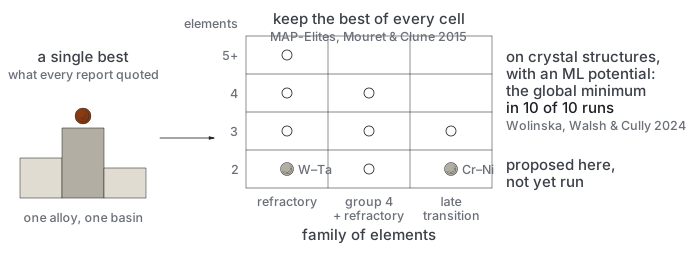
Is there a published search method that keeps every good family of alloys, not just one?
Yes. MAP-Elites (2015) keeps the best alloy in each cell of a feature grid and has found crystal structures, but it was not run here.
In the log: The fix is a known algorithm, and it was published for this exact problem
recordedDate not stated in the log; it was written between the commit of 2026-09-13 08:16 and the first commit that contains it, 2026-09-16 02:04generator · fly brain0 predictions · 0 result paragraphsEXPERIMENTS.md lines 5987–6031, lines 6063–6066
What E102 did and how it came out, drawn from this record and the files it names (book/assets/diagrams/exp/E102.svg).
Pre-registration
The pre-registration, as written
E102 stands but for a different reason. An archive is still the right answer - not
because the fly cannot reach the other basins, but because a run that finds them and a report
that shows one of them is a reporting failure, and the archive is what makes the report the
whole run.
Results
No result paragraph for this entry was found in the log.
The full record
This entry is written in 2 separate places in the log, shown here in log order.
EXPERIMENTS.md · lines 5987–6031
E102 — The fix is a known algorithm, and it was published for this exact problem
E101 established the landscape is multi-basin with a 403 meV/atom ridge, so the repair is an
archive rather than a reward. The literature has this, and closer to home than expected.
Quality-Diversity, and MAP-Elites in particular (Mouret & Clune 2015). The search keeps a
grid over user-chosen feature dimensions and stores the best solution found in each cell,
rather than a single global best. Every basin that occupies a distinct cell is retained by
construction. The property that matters here is stated in the original paper: because it
explores more of the space, it also tends to find a better single solution than a direct
optimiser. The archive is not a tax on optimisation.
It has already been done on crystal structure prediction with an ML surrogate, which is
our situation almost exactly - Wolinska, Walsh & Cully, Illuminating the property space in
crystal structure prediction using Quality-Diversity algorithms, Digital Discovery 2024.
They use a machine-learned interatomic potential precisely because MAP-Elites needs many
cheap evaluations, and report finding the global minimum in 10 of 10 runs plus about ten
other distinct structures per run. Code is open, adaptive-intelligent-robotics/QD4CSP.
And on composition space directly: DiSCoVeR (Baird, Diep & Sparks, Digital Discovery
2022) screens for compositions that are both high-performing and chemically distinct, using
Element Mover's Distance with density-aware clustering to keep families separate. That is the
same objective as reporting Cr-Ni alongside W-Ta.
What this means concretely for this project. The generator already produces thousands of
cheap evaluations, which is the expensive prerequisite QD usually has to argue for. The
missing piece is only the archive and a feature space to spread it over, and E101 measured
what the features should be: the family split (refractory / group-4 / late transition)
separates the basins, and the scan of E95 showed the promoted region is narrow in size
misfit and element count while being wide in melting point. Those are two or three
descriptors, which is the regime MAP-Elites was designed for; CVT-MAP-Elites (Vassiliades &
Mouret 2017) covers the case where more are wanted.
The honest reading of the last several days. The convergence was diagnosed, then
attributed to the reward, then to the uncertainty term, then to the acquisition function,
then to the gate - four attempted repairs, each a reward modification, against a problem the
field solved with an archive in 2015 and demonstrated on this exact kind of surrogate-driven
materials search in 2024. Searching the literature first would have cost ten minutes.
E102 stands but for a different reason. An archive is still the right answer - not
because the fly cannot reach the other basins, but because a run that finds them and a report
that shows one of them is a reporting failure, and the archive is what makes the report the
whole run.
Related entries
E101 — Is there a barrier between the basins, or did the search simply not look?
E95 — Where the screen actually asks for an activation energy