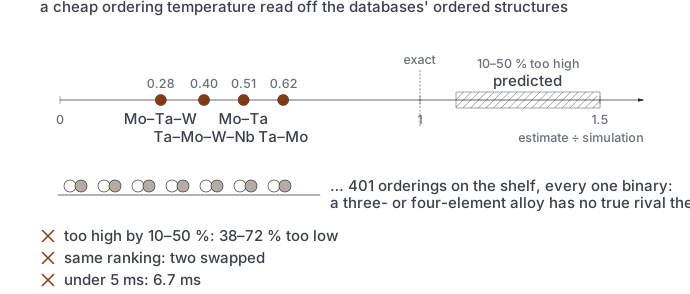
EXPERIMENTS.md · lines 5633–5700E97 — An ordering temperature the screen can afford: prediction
E96 showed rung 0 rewards the ordering hazard because the on-lattice ground states were taken
out of its hull. The repair is to give rung 0 the ordering question, and it is nearly free:
the 401 bcc orderings excluded in E86 are already relaxed with MACE and on disk, and the
driving force is linear in temperature (E95, departure 0.000 meV/atom). So the temperature at
which the random alloy stops beating its own ordered competitor is one division, not a
Monte Carlo.
T_cross = T_lo - d(T_lo) * (T_hi - T_lo) / (d(T_hi) - d(T_lo))
where d is the driving force against the hull WITH the orderings in it. Below T_cross the
ordered state is lower and the alloy is not a random solid solution. This is a mean-field
quantity in the sense that it compares two fixed states rather than sampling configurations,
but it is built on measured MACE energies rather than a Bragg-Williams estimate from the
ECIs.
Validated before deployment against the four ordering temperatures rung 1 measured in
E82 - the only four in this project measured under the current expansion.
Predicted:
- It overestimates the Monte Carlo T_od, because comparing the random state against a
single fully ordered state ignores the partial order that a real transition passes
through, and because mean-field treatments of bcc ordering run high by roughly a quarter.
Expect +10 to +50 per cent.
- It ranks the four correctly. This is the part that matters: rung 0 is a gate and a
ranking, and a quantity that is uniformly high but correctly ordered is usable where one
that scrambles the order is not.
- It costs under 5 ms, since the two hull queries it needs are already made.
Falsified as a gate if the ranking is wrong. If it cannot order four compositions whose
true answers are known, it cannot be trusted to gate thousands that are not, and rung 0 must
instead carry the cost of a short Monte Carlo or the ordering question stays at rung 1 with
the generator blind to it.
Outcome. All three predictions falsified, and the reason is that I substituted my own idea
for the advice I was given.
It underestimates by 38 to 72 per cent where an overestimate was predicted, the ranking
of the middle two is wrong, and it costs 6.7 ms rather than under 5.
Cause, and it is decisive: all 401 bcc orderings in the hull are binary. Not one is
ternary or higher. A three- or four-element solid solution can therefore only be compared
against mixtures of binary orderings, which are a strictly worse competitor than its own
ternary ground state, so its crossover comes out low - and the error grows with element
count, which is exactly the ratio column. Two-element compositions score 0.51 and 0.62; the
three-element one scores 0.28.
The databases hold binary superstructures because binaries are what people compute and
observe. They will not hold the multi-element ones, and no amount of fetching will change
that.
This is the mistake worth recording. Fable's suggestion was a Bragg-Williams spinodal
computed from the expansion's own ECIs - enumerate two-sublattice partitions at the
composition, evaluate each analytically, take the lowest. I substituted a hull of measured
structures, reasoning that real MACE energies beat a mean-field estimate. They do, for
structures that exist. The expansion knows every composition continuously and the database
knows only the ones somebody has made, and that is precisely the property this problem
needs. The advice was better than my improvement on it, for the reason that decided the
result.