EXPERIMENTS.md · lines 5371–5482E94 — Thirty-five activation energies across the disorder range, and a proxy fitted properly
E93 found Q strongly predictable from composition and refused to deploy the fit: three
parameters on five points whose element counts were 3, 3, 7, 7 and 8, which is two clusters
wearing a correlation. This measures Q across a designed range instead.
Thirty more compositions, stratified by element count from two to twelve, drawn from all
twelve elements rather than the refractory corner, joining the five already measured. Both
terms are sampled harder than before, because E93 showed five barriers is thin and that
vacancy formation carries two thirds of the signal: sixteen vacancy sites rather than
eight, six migration bands rather than five.
Predicted:
- Q falls monotonically with element count across the whole range, not merely between
two clusters - this is what five points could not test.
- Vacancy formation stays the dominant term at every element count, carrying more than
half the variation in Q.
- A fit on melting point and one disorder descriptor reaches a leave-one-out error below
0.5 eV. It will be worse than the 0.35 eV that three parameters achieved on five points,
because that number was not cross-validated; 0.4 to 0.7 is the honest expectation.
- The residual grows with element count, since the high-disorder end is where the
effective quantity is furthest from its mean and where sampling is thinnest.
Falsified if leave-one-out exceeds 1.0 eV, in which case there is no four-millisecond
activation energy for this system at any element count, the kinetic term stays out of the
screen for good, and multi-element candidates are promoted on thermodynamics with their
kinetics measured one at a time.
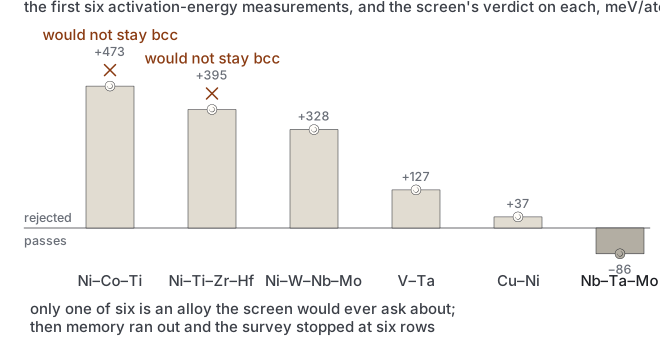
Interim, before the set is complete: two of the first six compositions failed, and the
failures are not noise.
Ni0.41 Co0.35 Ti0.24 and Ni0.45 Ti0.22 Zr0.20 Hf0.13 both stopped with "the perfect cell
did not reach the force tolerance". The kinetics are computed in a bcc supercell, and these
compositions will not hold one - they are fcc and hcp formers. That is an answer rather
than a fault, but it scopes what the fit can ever be: a cheap Q can only be fitted on
compositions that are bcc solid solutions in the first place.
Predicted, and testable without waiting for the survey: every composition whose kinetics
fail is already rejected by the screen on thermodynamics. If so the gap costs nothing,
because Q is only ever asked for compositions that have already survived the hull. If
instead some failing composition screens as stable, there is a hole - a candidate the screen
promotes and the kinetics cannot judge - and the screen needs a bcc-stability guard of its
own.
Outcome of the interim prediction: it holds, and it exposes a flaw in the sampling design.
Both failures are compositions the screen rejects outright, so no candidate is promoted that
the kinetics cannot judge. The hole predicted as the bad case does not exist here.
But five of the first six are rejected, and Q is only ever asked about the ones that are
not. The stratified design samples the space evenly by element count and the screen does
not - it promotes a narrow region, and a proxy fitted on a set that is five parts
irrelevant will be accurate mostly where it is never used. Fitting on compositions spanning
Q from 0.63 to 5.34 eV gives the fit a range to stand on, which was the point and is still
worth having; but its error must be reported on the promoted subset separately, and that
subset will be small.
This is the same mistake as E89 in mirror image. There, the training set was not where the
search goes and the model was rightly unsure; here, the calibration set is not where the
screen asks and the fit will be confidently wrong in the place that matters. The honest
fix is to sample both - a range wide enough to constrain the form, and enough promoted
compositions to measure the error where it is used - and the survey as designed has the
first and not the second.
Operational note: six workers ran the machine out of memory, and the checkpoint held.
Raising the survey from three workers to six for throughput drove free memory to 1.1 GB with
11 GB in the compressor - the machine was thrashing, and the harness killed two monitoring
tasks for memory before anything else broke. Six MACE processes at about 640 MB each is what
did it.
Nothing measured was lost. The survey appends each composition the moment it finishes and
skips by label on restart, so dropping back to three workers cost only the in-flight work.
That is the rule from the 136-relaxation OOM working as intended, on the first occasion it
has actually been tested.
The throughput was not there anyway. Six workers ran at 155 per cent CPU each against
190 for three - 9.3 cores against 5.7, a 60 per cent gain in exchange for doubling the memory
- and the load average stood at 19.9 on twelve cores. Three workers is both safer and close
to as fast. The parallelism was raised on an assumption about cores and should have been
checked against memory first.
Correction to the operational note above: the memory was not mine, and the churn was the
real cost.
Dropping back to three workers did not restore the machine - free memory returned to 0.1 GB
within minutes. The largest consumer is not the survey but a 54-atom Quantum ESPRESSO run
at 2.75 GB, the finite-size study listed as running in OVERNIGHT.md, which moved from
16-atom to 54-atom cells once the k-point series finished. It is alive and progressing, and
it was there first, so the survey yields to it: two workers, 1.0 GB free.
The churn cost more than the parallelism gained. The survey has been restarted three
times in an hour - three workers to six, back to three, then to two - and each restart
discards whatever was in flight, about twenty minutes per worker. Six rows exist now and six
existed at the start of the hour. Tuning the configuration three times on a job whose unit
of work is twenty minutes is how to make no progress at all; the right move after the first
memory warning was to drop to two and leave it alone.
One thing to flag for the operator rather than act on. The 54-atom run is at a 2x2x2
k-point grid, and E87 measured that grid at 55.8 meV/atom from 3x3x3 on the 16-atom cell.
For a finite-size comparison at fixed grid the error partly cancels, which may be the
intention. It is worth confirming before the number is used.