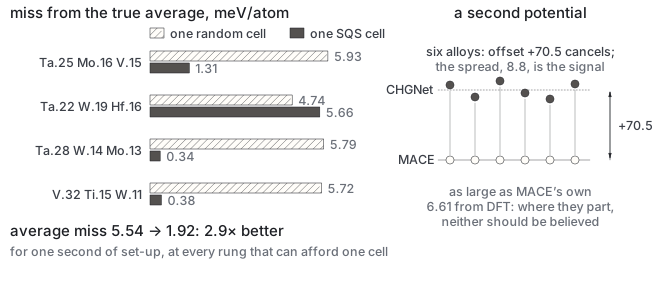
Is one carefully arranged cell more accurate than one random arrangement of atoms?
Yes. It misses the true average by 1.92 meV/atom against 5.54, 2.9 times better; a second potential disagreed with a spread of 8.8.
In the log: Two more rung heights, measured: SQS is worth 2.9x, CHGNet disagrees by 8.8
recordedDate 2026-09-12, as written in the logrung 2 · hull, MACE0 predictions · 0 result paragraphsEXPERIMENTS.md lines 1907–1954
What E38 did and how it came out, drawn from this record and the files it names (book/assets/diagrams/exp/E38.svg).
Results
No result paragraph for this entry was found in the log.
The full record
EXPERIMENTS.md · lines 1907–1954
E38 — Two more rung heights, measured: SQS is worth 2.9x, CHGNet disagrees by 8.8
Date 2026-09-12 · Question Before building a ladder on SQS and a second potential,
what is each actually worth? · Provenance…/rung_heights.py,
forager/design.py, forager/ladder.py
SQS is a fidelity of structure, not of energy. A special quasirandom cell reproduces
the pair and triplet correlations of an infinite random alloy where a random occupancy only
does so on average. That matters most where fewest samples are affordable - at the DFT rung
one structure is the budget, not sixteen.
composition
random mean
occupancy scatter
one SQS cell
SQS error
Ta.25 Mo.16 V.15
-149.3
5.93
-150.6
1.31
Ta.22 W.19 Hf.16
-127.0
4.74
-132.7
5.66
Ta.28 W.14 Mo.13
-137.3
5.79
-137.0
0.34
V.32 Ti.15 W.11
-165.2
5.72
-165.5
0.38
meV/atom. One random occupancy misses the true mean by 5.54 on average; one SQS cell by
1.92. A 2.9-fold improvement for one second of generation, and it applies at every
rung where only one structure can be afforded.
CHGNet is a second opinion, not a better energy. Independently trained, so where it and
MACE disagree is where neither should be believed. Across six compositions the difference is
+70.5 meV/atom with a spread of 8.8. The offset is the two codes' reference conventions
and cancels in any comparison; the 8.8 spread is the signal - comparable to the
potential's own 6.61 against DFT (E18), so a candidate where they diverge much beyond that
is outside both models' support.
The design space is now bounded (forager/design.py): eight elements, each 5-35%, at
least four above 10%. The simplex contains a great deal that is not a high-entropy alloy,
and the expansion's ensemble already reports roughly three times the uncertainty on a
four-to-one binary (E25) - searching there spends budget confirming the model does not know.
Projection onto that space is exact rather than iterative: there is a single shift tau with
sum_i clip(x_i - tau, lo_i, hi) = 1, found by bisection. Clipping and renormalising in turn
does not converge, and renormalising after clipping breaks the bounds clipping just imposed
both of which the first implementation did.
The ladder (forager/ladder.py) weights a verdict by the inverse variance of the rung
that issued it, so a candidate confirmed high up teaches more than one that merely cleared
a screen. The weights are measured errors, not choices, and the ladder refuses a dearer rung
that is no more accurate.
What is not yet measured, and is the next requirement. Cell size is a fidelity axis of
its own and has been treated as fixed at 54 atoms. DFT at 128 atoms wanted 23.45 GB against
15.6 available locally, which is why it has never been done here - it needs the cloud, not
more patience. And the whole environment is calibrated at one temperature, 1500 K;
a model of this system across a temperature range is not yet built.
Related entries
E18 — MACE-MPA-0 validated on 300 independent DFT structures
E25 — The thermodynamics wired in as a generator objective