Can the free energy steer the alloy search, and does it say anything new?
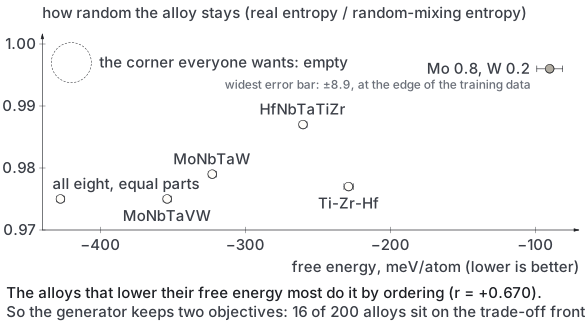
Yes. It runs at 100–125 alloys per second and shows low free energy comes from ordering, a trade-off (correlation +0.670).
In the log: The thermodynamics wired in as a generator objective
recordedDate 2026-09-12, as written in the logunclassified0 predictions · 1 result paragraphEXPERIMENTS.md lines 1150–1197
What E25 did and how it came out, drawn from this record and the files it names (book/assets/diagrams/exp/E25.svg).
Results
EXPERIMENTS.md · line 1168
Result. 1500 K, 64 occupancy samples, calibrated on 40 compositions:
The full record
EXPERIMENTS.md · lines 1150–1197
E25 — The thermodynamics wired in as a generator objective
Date 2026-09-12 · Question Does the free energy actually work as a search
objective, and does it say anything a cheap descriptor would not? · Provenancealloy_mogfn/surrogates/thermo.py (registered as ce_thermo),
…/surrogate_test.py
Method.CEThermoSurrogate satisfies the existing Surrogate protocol, so the
generator reaches it by name with no other change. It emits two objectives:
free_energy at the calibration temperature, and solid_solution - the real
configurational entropy as a fraction of the ideal value. The second is normally
assumed to be 1; here it is measured, and it is not 1.
fit() is a deliberate no-op. A cluster expansion learns from energies of resolved
occupancies; composition-level feedback carries no information about arrangement and
cannot update it. Fitting a composition-level offset would leave every ranking
unchanged while narrowing the reported uncertainty - worse than doing nothing.
Result. 1500 K, 64 occupancy samples, calibrated on 40 compositions:
alloy
F (meV/atom)
S/S_ideal
MoNbTaW equiatomic
-322.8 +/- 2.8
0.979
MoNbTaVW
-353.9 +/- 2.8
0.975
HfNbTaTiZr
-260.2 +/- 2.7
0.987
all eight, equiatomic
-427.5 +/- 2.8
0.975
Ti-Zr-Hf (one column)
-228.8 +/- 3.2
0.977
Mo(0.8)W(0.2)
-90.1 +/- 8.9
0.996
The last row is the ensemble earning its place: the training structures were drawn
near-equiatomic within whichever subset was chosen, so a 4:1 split sits at the edge of
the sampled region and the bootstrap members disagree about it - a three-fold wider
uncertainty, reported rather than discovered later. 100-125 compositions/s, with a
cache that makes the generator's inevitable revisits free.
The two objectives are in tension, which is the finding. Over 200 compositions the
correlation between free energy and entropy ratio is +0.670: since one is minimised
and the other maximised, the alloys that lower their free energy most do it by
ordering, which is exactly what stops them being random solid solutions. 16 of 200
sit on the Pareto front. A scalarised objective picks one of those 16 and never
reports that the other 15 exist - which is the case for a multi-objective generator
rather than a weighted sum, made on measurement instead of assertion.
Caveats. Two objectives is not yet a materials-design problem - nothing here says
anything about strength, ductility or oxidation. It is the thermodynamic floor those
would sit on. The design space's elements must be a subset of the expansion's; the
adapter refuses otherwise rather than extrapolating to a species the expansion has no
parameters for.