No result paragraph for this entry was found in the log.
EXPERIMENTS.md · lines 1626–1679E33 — A Gaussian process beats the fly, and the reason is architectural
Date 2026-09-12 · Question The fly beats random sampling. Does it beat the
instrument people actually use? · Provenance …/{bench_gp,gp_on_code}.py
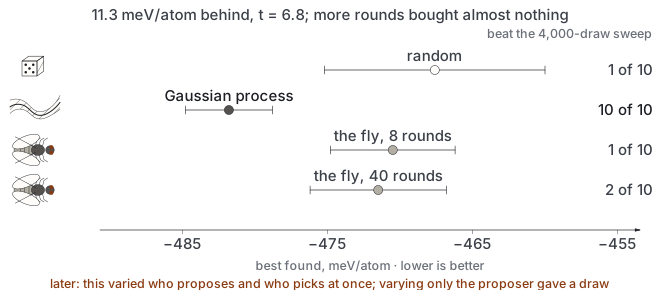
No. Sixty evaluations, ten seeds, the process given a 4,000-candidate pool each round -
far more than the fly ever proposes - a Matern kernel with learned length scales and
fitted noise:
11.3 meV/atom behind, t = 6.8. The process beats a sweep sixty-six times its size on
every seed; the fly manages one in ten. More rounds buy almost nothing.
The representation does not rescue it. The same process over the Kenyon-cell code
instead of the composition vector, identical acquisition, pool and budget:
Why, and it is not a tuning problem. A mushroom body is a discrimination engine: a
sparse random expansion into 4,064 cells exists to make thousands of chemically unrelated
odours linearly separable - patterns with no smooth structure to exploit. This objective is
a smooth function of eight continuous variables, the textbook best case for a kernel
method, where sixty points model the whole landscape. An expansion helps a linear readout,
which needs features (ridge on the code reaches Spearman 0.928 against 0.561 on raw
composition, E28), and hurts a kernel method, which already handles nonlinearity and pays
for every dimension. Both results follow from one fact.
Compounding it, the process wins by knowing what it does not know, and E29 established the
circuit's error is bias, not variance - so it cannot hold an uncertainty of that kind
even in principle. It searches blind against an instrument that searches informed.
No amount of tuning closes an architecture mismatch. Grinding might reach -474; it
would still lose, and the grinding would be fitting noise.
Open, and flagged rather than buried. The random baseline came out at -456.8 in E30-E32
and -467.6 here on a different seed set - an 11 meV/atom shift, about three sigma, not
explained. E30's claim that the fly beats random at t = 4.6 is not safe until it is,
since against this baseline the same margin is t = 1.0.
Where the architecture would suit the problem. Occupancy space - which arrangement, not
which composition - is combinatorial (of order 10^7 for a 16-site quaternary), has no smooth
metric for a kernel to exploit, and carries more of the prize: short-range order is worth
12.5 meV/atom (E21) against the ~5 meV/atom separating the compositions being contested.
A testable redirection, not a consolation.