EXPERIMENTS.md · lines 1684–1743E34 — Smearing smooths this landscape most where the chemistry differs most
Date 2026-09-12 · Question (operator) Smearing occupation numbers is what DFT does
to make a discontinuous function differentiable. Does the same trick smooth a discrete
occupancy landscape here? · Provenance …/{smearing,smearing2}.py
Background. Interpolating between chemical elements to turn discrete ordering into a
continuous surface is a published method - Kaappa, Larsen and Jacobsen, Phys. Rev. Lett.
127, 166001 (2021) - which solves systems with over 10^6 orderings in tens of energy
calculations where the non-interpolating variant fails. It was demonstrated on Au-Cu and
Cu-Ni: periodic-table neighbours, where a half-and-half atom is a reasonable thing to
imagine. These eight elements span groups 4 to 6, and the open question was whether the
trick survives chemistry that different.
Method. Walk from an arrangement to its exchange, swapping j sites each way so the
composition never changes, and average over which sites are swapped - the ensemble of all
ways to be j swaps along. That isolates the ordering degree of freedom. A smooth
interpolation gives a path with one turning point; a rugged one wanders.
A first attempt was wrong and is recorded as such. Letting each site draw its element
independently does not preserve composition - at the midpoint it averaged over
configurations holding anywhere from none to all of one element - and since mixing energy
depends far more on composition than on arrangement, the path measured composition
fluctuation. It returned deviations of thousands of meV/atom, which is what a broken
measurement of a ten-meV quantity looks like.
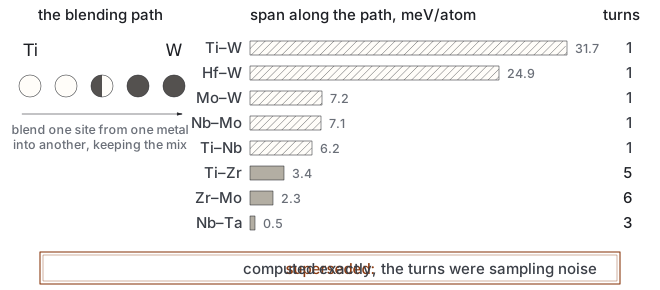
Result, 16 sites, composition fixed:
meV/atom. The pairs whose chemistry differs most give the smoothest paths and the largest
signal - a single turning point over spans of 25 to 32 meV/atom. The prediction on record
before this ran was the opposite, that interpolating Hf into W would be too unphysical to
smooth anything.
Why, in hindsight. Ti-W and Hf-W carry large mismatches in size and electronegativity,
so ordering is strongly driven and the landscape has one deep basin. Nb-Ta are nearly
interchangeable, the alloy is close to ideal, and the landscape is flat - the wandering in
those rows sits at 0.5 to 3 meV/atom, a scale at which it hardly matters what shape it is.
Ruggedness and weak chemistry arrive together, and so do smoothness and strong chemistry.
Consequence. The concern raised against the operator's proposal does not hold, and the
continuous relaxation should work here - most reliably on exactly the strongly interacting
pairs that carry the prize. It also means the combinatorial problem is not a regime where
kernel methods are structurally weak, which was the premise of the redirection proposed in
E33 and withdrawn here.
Caveats. Two-element exchange paths in a 16-site cell, with all other sites fixed; the
full eight-element landscape is not this. Nine points per path makes "one turning point" a
coarse statement. And smoothness along a path between two arrangements is weaker evidence
than smoothness of the whole surface.