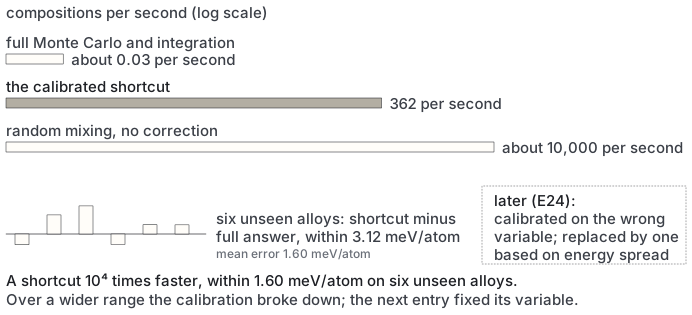
Can the slow free-energy calculation be replaced by a quick calibrated shortcut?
Withdrawn. It matched to 1.60 meV/atom, but was calibrated on the wrong variable; a correction based on energy scatter replaced it.
In the log: A composition-level free energy fast enough to be an objective
supersededDate 2026-09-12, as written in the logunclassified0 predictions · 1 result paragraphEXPERIMENTS.md lines 1026–1080
What E23 did and how it came out, drawn from this record and the files it names (book/assets/diagrams/exp/E23.svg).
Results
EXPERIMENTS.md · line 1049
Result. Both corrections are close to linear in S_ideal:
The full record
EXPERIMENTS.md · lines 1026–1080
E23 — A composition-level free energy fast enough to be an objective
Date 2026-09-12 · Question The generative search proposes compositions, not
occupancies, so it needs F(x, T) per composition — and it needs it thousands of times.
Monte Carlo costs ~30 s per composition. Can the short-range-order correction be
calibrated once and then applied for free? · Provenanceforager/thermo.py,
…/thermo_test.py
Method. Three tiers in one object (CEThermo), all on the 8-element CE of E16b:
Random limit — <E> over random occupancies at fixed composition, with
S = S_ideal. Exact at infinite temperature, ~10,000 compositions/s.
Reference — canonical Monte Carlo plus thermodynamic integration from that
random limit (the E21 procedure), ~30 s per composition.
Calibrated fast path — run tier 2 on a training set of compositions, regress
the corrections (energy lowering dE and entropy ratio S/S_ideal) on the ideal
entropy, then apply those corrections to tier 1.
Training compositions were drawn by Latin hypercube over the composition simplex,
not multinomially: a uniform draw on the simplex concentrates near the equiatomic
centroid and would leave the dilute corners unsampled. 20 training compositions at
1500 K, 54 sites; 6 held-out compositions for the test.
Result. Both corrections are close to linear in S_ideal:
MAE 1.60 meV/atom, max 3.12, against a reference that is itself only as good as the
CE (cross-validated RMSE 5.67) and the potential under it (6.61 against DFT). The
approximation is not the limiting error anywhere in the chain.
Speed. 2.76 ms per composition — 362 compositions/s, against ~0.03/s for the
full integration. Four orders of magnitude, for an error a quarter of the CE's own.
Why the linearity holds. S_ideal measures how much the composition is mixed at all.
A nearly-pure composition has little to order and little entropy to lose; an equiatomic
one has the most of both. The regression is picking up that single degree of freedom,
which is why 20 training points suffice — and why the residual scatter (3.15 meV/atom)
is the honest uncertainty on any one composition, not the fit quality.
Caveats. Calibrated at one temperature (1500 K) and one cell size (54 sites); both
would need re-fitting elsewhere. The correction is fitted across the whole simplex, so a
composition with unusual ordering chemistry — a strongly ordering binary pair in a
dilute matrix — is exactly where it would be worst. That is the case to check before
trusting a top-ranked candidate, and it is cheap to check: rerun tier 2 on the winners.
Related entries
E16b — The eight-element cluster expansion the rest of this log is built on
E21 — Configurational entropy computed, not assumed