On the new reward, does the fly brain beat simple searches that use no brain?
Withdrawn. Keep-the-best-and-mutate matched or beat the fly here, but that reading reversed once a distorting gate was removed from the reward.
In the log: the fly against the model-free arms on the real reward (2026-09-18 22:58, N1)
supersededDate 2026-09-18 22:58, as written in the logrung 4 · DFT2 predictions · 1 result paragraphEXPERIMENTS.md lines 12268–12282, lines 12284–12294, lines 12296–12309, lines 12311–12314, lines 12495–12527
What E195 did and how it came out, drawn from this record and the files it names (book/assets/diagrams/exp/E195.svg).
Pre-registration
(10)
the last inequality of prediction 2
("elitist < CEM") is falsified on the 12-element space; CEM's Dirichlet updates cannot
recover from a batch paid all zeros, elitist's mutation of a kept draw can. fly pending.
no verdict written against it
(27)
> cem
no verdict written against it
The pre-registration, as written
E195 — the fly against the model-free arms on the real reward (2026-09-18 22:58, N1)
Every fly-vs-CEM number in this record (E136 13.6 / 34.5; E167 25.9 / 71; E171b 40.0 / 82)
was earned on the flat icet reward, where every find scored ≈ −11 and the verdict could
not separate good from better. On FORAGER_RUNG0=ece the reward ranks (E193). So the
comparison is run again from scratch on the real reward: uniform (the null), sparse
(Dirichlet α 0.3 — the fly's geometry without the fly), elitist, CEM (the strongest
model-free arm), and the fly (E171b's head, MPS); 200 × 4 × 2 each, one process, tag e195.
Predictions. 1. The fly beats CEM on finds by more than one seed-sd (E193's 61 / 77
against CEM's number here); if it does not, the head's contribution on a reward that
ranks is null and every prior fly-vs-CEM claim is confined to the flat reward. 2. The
model-free order is uniform < sparse < elitist < CEM, as on the flat reward (E136).
3. The fly's finds have a lower mean v5 energy than CEM's (−10 meV or more): a live
gain field should find deeper minima, not only more of them. 4. Wall time: the CPU arms
~10 min each, the fly ~35 min; all five inside 1.5 h.
E195 confound, seen at its first two arms (23:05) and stated before the fly's number lands.
uniform: 0 finds; sparse: 0 finds, best 0. On the 12-element space nearly every Dirichlet
draw carries Co, Cu or Ni; the eCE has never seen them and the v5 screen refuses such
compositions outright (p = 0, ece_foreign_fraction). The fly's walkers can drive a
fraction to exactly zero (min_fraction 0) and so escape the refusal; a CEM or elitist arm
paid zero for everything cannot learn where to go. So E195 on the 12-element space would
give the fly a win it did not earn. E195b, queued behind it: the same five arms on the
eight-element refractory space (FORAGER_CE=ce_8element: Hf Mo Nb Ta Ti V W Zr — all
inside the eCE's nine, nothing refused), same predictions. E195's fly arm still stands as
the 12-element reference; its model-free arms are void by construction, and are recorded
as such, not as a result.
E195, third arm (23:07) — the confound note above was too strong. elitist:
AUC_Q 27.08 ± 5.12, distinct 57 ± 14, best −103 meV/atom. So a model-free arm that
learns does escape the foreign-element refusal (it keeps the rare all-refractory draws
and mutates around them); only the two non-learning arms (uniform, sparse) are void on the
12-element space. Prediction 2 ("uniform < sparse < elitist < CEM") so far reads
0 = 0 < 27 — the first inequality is a tie at zero, not an ordering. Predictions 1 and 3
still wait on cem and fly. E195b (8-element) remains the clean comparison and is queued.
Convention drift caught before launch (23:10). The eight E192 cells and E194 were
written with a 5×5×5 mesh; every validated 54-atom standard cell (E172b, E183, E187 — the
ones within 10 meV of v5, and the rows v6 will train on) is 60/720 Ry at 4×4×4
(36 irreducible k-points; 5×5×5 is 63, ~1.75× the time and ~20 GB scratch per cell).
All nine inputs corrected to 4×4×4 before pw.x reached them; nothing was restarted.
Rule restated: the 54-atom standard is 60/720, k 4×4×4, MV 0.02 Ry, local-TF β 0.1.
E195, fourth arm (23:12). cem: AUC_Q 10.15 ± 10.15, distinct 21 ± 21, best −56 —
one seed found nothing at all. elitist (27) > cem (10): the last inequality of prediction 2
("elitist < CEM") is falsified on the 12-element space; CEM's Dirichlet updates cannot
recover from a batch paid all zeros, elitist's mutation of a kept draw can. fly pending.
Results
EXPERIMENTS.md · line 12495
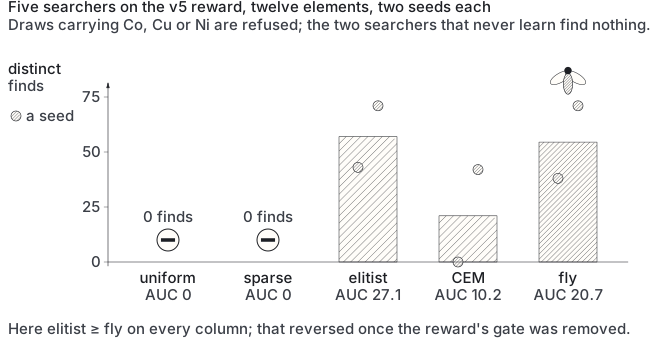
E195 result (23:51) — five arms on the v5 reward, 12-element space, 200 × 4 × 2 seeds.
arm
AUC_Q
distinct finds
best v5
mean v5 of finds
uniform
0.00
0
+83
—
sparse
0.00
0
0
—
elitist
27.08 ± 5.12
57 ± 14
−103.7
—
cem
10.15 ± 10.15
21 ± 21
−90.5
−70.3
fly
20.68 ± 8.38
54.5 ± 16.5
−102.4
−62.2
(± in the table = population sd of two seeds, as the log prints; score_arms.py uses
ddof = 1.) P1 confirmed as written (fly − cem = +33.5 finds > one seed-sd 29.7) but
void in substance — CEM was starved by the refusal confound. P2 falsified (elitist 57
cem 21). P3 falsified: the fly's finds are shallower than CEM's by 8 meV. P4
confirmed (all five in 53 min). The headline is the arm the confound did not touch:
elitist ≥ fly on every column (AUC 27.1 vs 20.7, finds 57 vs 54.5, best −104 vs −102).
On a reward that ranks, the whole-brain head with a live gain field does no better than
keep-the-best-and-mutate. E195b (eight elements, nothing refused) is the clean version and
is queued; if elitist ≥ fly holds there, the fly's advantage was a property of the flat
reward and the island surrogate, and the generator line's claim rests on nothing.
Search queue collapsed and rebuilt (23:56). Two crashes, both mine. (1) E173c
died at its first confirm: confirm() taught the "5ht" site by name on a head built
without one (StopIteration) — the run was the no-5-HT control, so the crash was the
design. Guarded: a head teaches the site only if it carries it; test added. (2) E195b,
then E198's two arms, died in build(): FORAGER_RUNG0=ece demanded that the expansion
contain every eCE element, so the eight-element space (no Cr) was refused although the
verifier projects by name. Relaxed to "shares at least one element" (ece_covers, tested).
Each crashed chain still wrote its done-marker, so the queue fell through in seconds and
E199 was killed before it could add a third. False markers removed, crashed logs parked in
runs/crashed_2309/, and the four searches relaunched as one chain
(runs/night_searches_chain.sh: E195b → E198 → E199 → E173c), one search at a time,
load-gated. Predictions for all four stand as written; the v6 chain waits on the last marker.
The full record
This entry is written in 5 separate places in the log, shown here in log order.
EXPERIMENTS.md · lines 12268–12282
E195 — the fly against the model-free arms on the real reward (2026-09-18 22:58, N1)
Every fly-vs-CEM number in this record (E136 13.6 / 34.5; E167 25.9 / 71; E171b 40.0 / 82)
was earned on the flat icet reward, where every find scored ≈ −11 and the verdict could
not separate good from better. On FORAGER_RUNG0=ece the reward ranks (E193). So the
comparison is run again from scratch on the real reward: uniform (the null), sparse
(Dirichlet α 0.3 — the fly's geometry without the fly), elitist, CEM (the strongest
model-free arm), and the fly (E171b's head, MPS); 200 × 4 × 2 each, one process, tag e195.
Predictions. 1. The fly beats CEM on finds by more than one seed-sd (E193's 61 / 77
against CEM's number here); if it does not, the head's contribution on a reward that
ranks is null and every prior fly-vs-CEM claim is confined to the flat reward. 2. The
model-free order is uniform < sparse < elitist < CEM, as on the flat reward (E136).
3. The fly's finds have a lower mean v5 energy than CEM's (−10 meV or more): a live
gain field should find deeper minima, not only more of them. 4. Wall time: the CPU arms
~10 min each, the fly ~35 min; all five inside 1.5 h.
EXPERIMENTS.md · lines 12284–12294
E195 confound, seen at its first two arms (23:05) and stated before the fly's number lands.
uniform: 0 finds; sparse: 0 finds, best 0. On the 12-element space nearly every Dirichlet
draw carries Co, Cu or Ni; the eCE has never seen them and the v5 screen refuses such
compositions outright (p = 0, ece_foreign_fraction). The fly's walkers can drive a
fraction to exactly zero (min_fraction 0) and so escape the refusal; a CEM or elitist arm
paid zero for everything cannot learn where to go. So E195 on the 12-element space would
give the fly a win it did not earn. E195b, queued behind it: the same five arms on the
eight-element refractory space (FORAGER_CE=ce_8element: Hf Mo Nb Ta Ti V W Zr — all
inside the eCE's nine, nothing refused), same predictions. E195's fly arm still stands as
the 12-element reference; its model-free arms are void by construction, and are recorded
as such, not as a result.
EXPERIMENTS.md · lines 12296–12309
E195, third arm (23:07) — the confound note above was too strong. elitist:
AUC_Q 27.08 ± 5.12, distinct 57 ± 14, best −103 meV/atom. So a model-free arm that
learns does escape the foreign-element refusal (it keeps the rare all-refractory draws
and mutates around them); only the two non-learning arms (uniform, sparse) are void on the
12-element space. Prediction 2 ("uniform < sparse < elitist < CEM") so far reads
0 = 0 < 27 — the first inequality is a tie at zero, not an ordering. Predictions 1 and 3
still wait on cem and fly. E195b (8-element) remains the clean comparison and is queued.
Convention drift caught before launch (23:10). The eight E192 cells and E194 were
written with a 5×5×5 mesh; every validated 54-atom standard cell (E172b, E183, E187 — the
ones within 10 meV of v5, and the rows v6 will train on) is 60/720 Ry at 4×4×4
(36 irreducible k-points; 5×5×5 is 63, ~1.75× the time and ~20 GB scratch per cell).
All nine inputs corrected to 4×4×4 before pw.x reached them; nothing was restarted.
Rule restated: the 54-atom standard is 60/720, k 4×4×4, MV 0.02 Ry, local-TF β 0.1.
EXPERIMENTS.md · lines 12311–12314
E195, fourth arm (23:12). cem: AUC_Q 10.15 ± 10.15, distinct 21 ± 21, best −56 —
one seed found nothing at all. elitist (27) > cem (10): the last inequality of prediction 2
("elitist < CEM") is falsified on the 12-element space; CEM's Dirichlet updates cannot
recover from a batch paid all zeros, elitist's mutation of a kept draw can. fly pending.
EXPERIMENTS.md · lines 12495–12527
E195 result (23:51) — five arms on the v5 reward, 12-element space, 200 × 4 × 2 seeds.
arm
AUC_Q
distinct finds
best v5
mean v5 of finds
uniform
0.00
0
+83
—
sparse
0.00
0
0
—
elitist
27.08 ± 5.12
57 ± 14
−103.7
—
cem
10.15 ± 10.15
21 ± 21
−90.5
−70.3
fly
20.68 ± 8.38
54.5 ± 16.5
−102.4
−62.2
(± in the table = population sd of two seeds, as the log prints; score_arms.py uses
ddof = 1.) P1 confirmed as written (fly − cem = +33.5 finds > one seed-sd 29.7) but
void in substance — CEM was starved by the refusal confound. P2 falsified (elitist 57
cem 21). P3 falsified: the fly's finds are shallower than CEM's by 8 meV. P4
confirmed (all five in 53 min). The headline is the arm the confound did not touch:
elitist ≥ fly on every column (AUC 27.1 vs 20.7, finds 57 vs 54.5, best −104 vs −102).
On a reward that ranks, the whole-brain head with a live gain field does no better than
keep-the-best-and-mutate. E195b (eight elements, nothing refused) is the clean version and
is queued; if elitist ≥ fly holds there, the fly's advantage was a property of the flat
reward and the island surrogate, and the generator line's claim rests on nothing.
Search queue collapsed and rebuilt (23:56). Two crashes, both mine. (1) E173c
died at its first confirm: confirm() taught the "5ht" site by name on a head built
without one (StopIteration) — the run was the no-5-HT control, so the crash was the
design. Guarded: a head teaches the site only if it carries it; test added. (2) E195b,
then E198's two arms, died in build(): FORAGER_RUNG0=ece demanded that the expansion
contain every eCE element, so the eight-element space (no Cr) was refused although the
verifier projects by name. Relaxed to "shares at least one element" (ece_covers, tested).
Each crashed chain still wrote its done-marker, so the queue fell through in seconds and
E199 was killed before it could add a third. False markers removed, crashed logs parked in
runs/crashed_2309/, and the four searches relaunched as one chain
(runs/night_searches_chain.sh: E195b → E198 → E199 → E173c), one search at a time,
load-gated. Predictions for all four stand as written; the v6 chain waits on the last marker.
Related entries
E136 — The fly has not been used, and nothing found so far is new
E167 — octopamine gain and serotonin persistence read from the head (task 0 step 4)