Experiments · E194
Does the search's best new alloy hold up in a full quantum calculation?
Yes. The quantum calculation gave −88.1 meV/atom against the energy model's −96.2, inside the 15 meV bar.
In the log: the flywheel check on the best find
Experiments · E194
Yes. The quantum calculation gave −88.1 meV/atom against the energy model's −96.2, inside the 15 meV bar.
In the log: the flywheel check on the best find
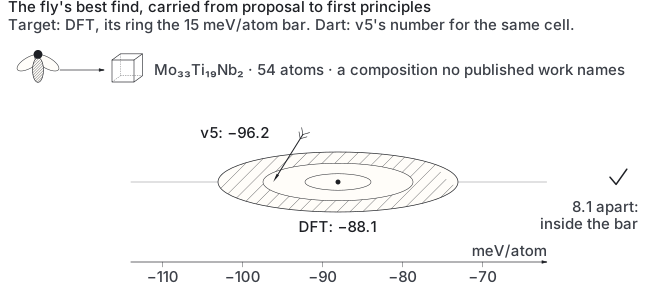
book/assets/diagrams/exp/E194.svg).E194 result (2026-09-20 04:56) — the generator's best find, verified at rung 4. Prediction confirmed.
Mo₃₃Ti₁₉Nb₂, the deepest of E193's finds, as a 54-atom cell at the standard (60/720 Ry,
k 4×4×4, MV 0.02, local-TF 0.1), against refs_v3_std: E_form(DFT) = −88.1 meV/atom
against v5's −96.2 → +8.1 meV, inside the 15 meV bar. So the cheap rung predicted
the first-principles formation energy of an alloy the fly invented, at a composition no
published work names, to 8 meV. Row stored as E194_Mo33Ti19Nb2.
What this does and does not say. It validates rung 0 as a formation-energy oracle on
the generator's own output — the flywheel's premise — and it is the first find to be carried
from proposal to first principles. It says nothing about the 90–1000 K requirement, which is
rung 1's question and rung 1 is not repaired. Mo–Ti is also where E192/E191 measured v5's
Mo-rich behaviour to be at its best, so this is the favourable corner, not a random test.
E196's two cells (Mo₃₅Ta₁₂Ti₇, Mo₃₆Nb₁₈) are the independent repeat and are queued behind this.
This entry is written in 2 separate places in the log, shown here in log order.
Mo₃₃Ti₁₉Nb₂ (54 atoms; Mo 0.61 Ti 0.35 Nb 0.04 — the rounding of E193's best), seed-0
decoration, Vegard a, the settings standard, references refs_v3_std. v5, before DFT:
−96.2 ± 5.8 meV/atom. Prediction (E193's #4): E_form(DFT) within 15 meV of −96.2
(v5's error on six cells: 3–10). Falsified beyond 15: v5's first miss at a search find, and
the cell goes to v6's training with the others. Literature for the Mo–Ti edge: ordered MoTi
−81 meV/atom (DFT, Zhang et al. 2022's table), so a random Mo-rich cell near −90 is
plausible. Queued behind E192's DFT.
E194 result (2026-09-20 04:56) — the generator's best find, verified at rung 4. Prediction confirmed.
Mo₃₃Ti₁₉Nb₂, the deepest of E193's finds, as a 54-atom cell at the standard (60/720 Ry,
k 4×4×4, MV 0.02, local-TF 0.1), against refs_v3_std: E_form(DFT) = −88.1 meV/atom
against v5's −96.2 → +8.1 meV, inside the 15 meV bar. So the cheap rung predicted
the first-principles formation energy of an alloy the fly invented, at a composition no
published work names, to 8 meV. Row stored as E194_Mo33Ti19Nb2.
What this does and does not say. It validates rung 0 as a formation-energy oracle on
the generator's own output — the flywheel's premise — and it is the first find to be carried
from proposal to first principles. It says nothing about the 90–1000 K requirement, which is
rung 1's question and rung 1 is not repaired. Mo–Ti is also where E192/E191 measured v5's
Mo-rich behaviour to be at its best, so this is the favourable corner, not a random test.
E196's two cells (Mo₃₅Ta₁₂Ti₇, Mo₃₆Nb₁₈) are the independent repeat and are queued behind this.
 Built with PRISMWebsite and visualizations made using Claude