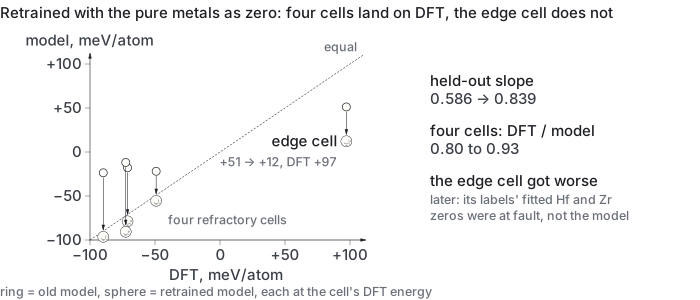
Does retraining the energy model on labels referenced to pure elements fix its DFT misses?
Partly. Four refractory cells now match DFT to about 10 %, but the hafnium–zirconium-rich cell got worse: +12 against +97 meV/atom.
In the log: retrain the eCE on pure-referenced labels (the flywheel's actual first turn)
mixedDate not stated in the log; it was written between the commit of 2026-09-16 19:06 and the first commit that contains it, 2026-09-19 08:35rung 4 · DFT0 predictions · 1 result paragraphEXPERIMENTS.md lines 11536–11546, lines 11560–11594
What E181 did and how it came out, drawn from this record and the files it names (book/assets/diagrams/exp/E181.svg).
Pre-registration
The pre-registration, as written
E181 — retrain the eCE on pure-referenced labels (the flywheel's actual first turn)
Same pipeline as v3b in every respect except the label file: _pureref. Composition-wise
split, same holdout compositions, same hyperparameters. Name: ece_v4_pureref.
Predictions.
The four QE cells' DFT/eCE ratios fall from 1.9 / 2.2 / 4.0 / (E180) to within
0.8–1.3 — the eCE re-predicts E172 near +97, E176 near −49, E177 near −71.
The composition-wise holdout slope rises from 0.586 to above 0.8; MAE may rise
(the label scale is larger) — MAE is not the metric.
If the ratios stay above 1.6, the references were not the whole story and the model's
own compression is real; that branch measures it against the pure-referenced holdout.
Results
EXPERIMENTS.md · line 11560
E181 result — predictions 1 (in part) and 2 confirmed; the edge is now the model's.ece_v4_pureref: train/valid/test loss 1.63e-4 / 2.99e-4 / 2.77e-4 eV²/atom² (test RMSE
16.6 meV/atom vs v3b's 14.2 — larger, as predicted). Composition-wise holdout:
model   pred = slope × true + b     r      MAE    true range
v3b     0.586 × true − 9.2        0.759   11.4   [−87, +18]
v4      0.839 × true − 1.4        0.850   15.0   [−112, +53]
Prediction 2 confirmed: slope 0.586 → 0.839. The five QE cells, re-mapped on v4:
Prediction 1 confirmed for the four refractory-centred cells (0.80–0.93, all inside
0.8–1.3): with labels whose zero is the elements, the eCE predicts DFT formation energies
of the search's basin to ~10%. Falsified for E172: at the Hf/Zr-rich edge v4 says +12
where DFT says +97 — the reference fix moved this cell the wrong way (v3b's +51 was
closer by accident of the compressed scale). That is the model's own extrapolation failure,
now visible because the references no longer hide it — and this cell is also the one whose
DFT carries the V-cutoff caveat (9 V atoms at ecutrho 400 < 645). Branch → E172b: the
same cell at the settings standard (60/720 Ry, k 4×4×4, refs_v3_std), which separates the
two. Prediction: E_form(E172b) within ±10 of +97.2 — the cutoff caveat is small
and the +97 stands, leaving the model's edge failure as real and E172 as the first cell
that must enter training (the flywheel's proper first turn, on v4). If E172b lands below
+70, the cutoff was the caveat and E172's DFT number is withdrawn.
refs_v3_std (60/720 Ry, k-spacing 0.16, 0.96/0.99/1.02): all eight minima bracketed;
a₀ = Hf 3.542, Mo 3.167, Nb 3.318, Ta 3.320, Ti 3.265, V 3.007, W 3.185, Zr 3.569 Å — the
hcp-formers' bcc constants sit 1–3% below RHEA's lowest-cell values, the refractories
within 0.7%. v4 is promoted to the eCE rung for the refractory-centred region; its edge
behaviour is the flywheel's first target.
The full record
This entry is written in 2 separate places in the log, shown here in log order.
EXPERIMENTS.md · lines 11536–11546
E181 — retrain the eCE on pure-referenced labels (the flywheel's actual first turn)
Same pipeline as v3b in every respect except the label file: _pureref. Composition-wise
split, same holdout compositions, same hyperparameters. Name: ece_v4_pureref.
Predictions.
The four QE cells' DFT/eCE ratios fall from 1.9 / 2.2 / 4.0 / (E180) to within
0.8–1.3 — the eCE re-predicts E172 near +97, E176 near −49, E177 near −71.
The composition-wise holdout slope rises from 0.586 to above 0.8; MAE may rise
(the label scale is larger) — MAE is not the metric.
If the ratios stay above 1.6, the references were not the whole story and the model's
own compression is real; that branch measures it against the pure-referenced holdout.
EXPERIMENTS.md · lines 11560–11594
E181 result — predictions 1 (in part) and 2 confirmed; the edge is now the model's.ece_v4_pureref: train/valid/test loss 1.63e-4 / 2.99e-4 / 2.77e-4 eV²/atom² (test RMSE
16.6 meV/atom vs v3b's 14.2 — larger, as predicted). Composition-wise holdout:
model   pred = slope × true + b     r      MAE    true range
v3b     0.586 × true − 9.2        0.759   11.4   [−87, +18]
v4      0.839 × true − 1.4        0.850   15.0   [−112, +53]
Prediction 2 confirmed: slope 0.586 → 0.839. The five QE cells, re-mapped on v4:
Prediction 1 confirmed for the four refractory-centred cells (0.80–0.93, all inside
0.8–1.3): with labels whose zero is the elements, the eCE predicts DFT formation energies
of the search's basin to ~10%. Falsified for E172: at the Hf/Zr-rich edge v4 says +12
where DFT says +97 — the reference fix moved this cell the wrong way (v3b's +51 was
closer by accident of the compressed scale). That is the model's own extrapolation failure,
now visible because the references no longer hide it — and this cell is also the one whose
DFT carries the V-cutoff caveat (9 V atoms at ecutrho 400 < 645). Branch → E172b: the
same cell at the settings standard (60/720 Ry, k 4×4×4, refs_v3_std), which separates the
two. Prediction: E_form(E172b) within ±10 of +97.2 — the cutoff caveat is small
and the +97 stands, leaving the model's edge failure as real and E172 as the first cell
that must enter training (the flywheel's proper first turn, on v4). If E172b lands below
+70, the cutoff was the caveat and E172's DFT number is withdrawn.
refs_v3_std (60/720 Ry, k-spacing 0.16, 0.96/0.99/1.02): all eight minima bracketed;
a₀ = Hf 3.542, Mo 3.167, Nb 3.318, Ta 3.320, Ti 3.265, V 3.007, W 3.185, Zr 3.569 Å — the
hcp-formers' bcc constants sit 1–3% below RHEA's lowest-cell values, the refractories
within 0.7%. v4 is promoted to the eCE rung for the refractory-centred region; its edge
behaviour is the flywheel's first target.
Related entries
E180 — Mo₂₇Ta₂₇: the basin against the literature, and a test of the labels themselves
E172 — the first rung-4 verdict: DFT vs the cheap rung on one 54-atom cell
E176 — the second rung-4 verdict: a refractory-centred cell