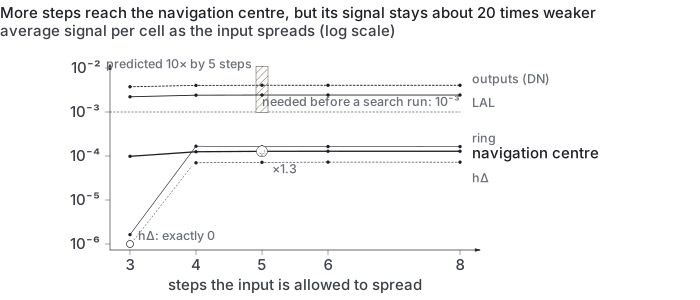
Does letting the input spread more steps wake up the brain's navigation centre?
No. A fourth step reached every navigation-centre cell, but their activity stayed about 20 times below other regions and did not rise.
In the log: how deep does the input go? (the branch E166 opened)
falsifiedDate not stated in the log; it was written between the commit of 2026-09-16 19:06 and the first commit that contains it, 2026-09-19 08:35rung 4 · DFT0 predictions · 1 result paragraphEXPERIMENTS.md lines 11040–11059, lines 11082–11150
What E171 did and how it came out, drawn from this record and the files it names (book/assets/diagrams/exp/E171.svg).
Results
EXPERIMENTS.md · line 11082
E171 diagnostic result (runs/e171_depth_state.json) — prediction 1 falsified. Mean
|pre| / fraction active:
Prediction 1 falsified: FB rises ×1.3 from 3 to 5 steps, not ≥ 10×. What the fourth
step does is reach — every central-complex cell is non-zero at 4 steps, hΔ from exactly
0 to 7e-5 — but the magnitude saturates at once, 20× below LAL, and does not move again
through 8 steps. That is the operator's damping (spectral radius 0.85): the input arrives
at the FB, attenuated by the synapses in between, and more steps add nothing.
Prediction 2 confirmed: LAL and DN change by ×1.1 (2.2→2.4e-3, 3.7→4.0e-3).
Prediction 3's branch fires: FB < 1e-3 at 8 steps. Depth is not the fix. The E171
search as specified ("smallest step count with FB ≥ 1e-3") has no valid step count and
is not launched.
Branch opened → E171b. The FB site's problem is lesson size, not reach: with steps = 4
every FB cell carries state, so the three-factor rule has an eligibility everywhere — just
20× smaller than at LAL. A site's learning rate is the one free parameter the rule has, and
the measured ratio fixes it: lr_fb = 0.1 × (2.4e-3 / 1.2e-4) = 2.0, so one FB lesson moves
a synapse as far as one LAL lesson does. Nothing else is tuned. E171b = E167's protocol with
FORAGER_STEPS=4 FORAGER_FB_LR=2.0, tag e171b, queued behind E169.
The FB site now moves: the seed dumps' fb |Δw| sum is > 1e-2 (E166's was ≤ 1e-4 by
E168's arithmetic). Below 1e-3 the scaling did not take and the mechanism is at fault.
The result is not identical to E167 on either seed (E166's null was identity to every
digit). Identity again means the FB→hΔ/vΔ synapses, however much they move, do not
reach the readout — a wiring statement, and it would send the site's output to PFL for
the readout in a further branch.
AUC_Q mean within E167's seed range (14–38); falsified downward if either seed is
below E163's 11.6 — an FB taught by the rung-0 ordering verdict then hurts the walk,
and the ordering verdict as the FB's reward is what gets withdrawn.
The fourth step changes the gains' inputs (LAL ×1.1): step and patience spans stay
within 20% of E167's (0.045, 5.8).
Rung-4 pw.x (n54_k3) — stalled, recorded as a measurement, not touched. 38 SCF
iterations in 88,567 s (~2,330 s each). Estimated scf accuracy (Ry): 1.3e-4 at iteration
32, then 6.2e-4, 2.1e-4, 2.7e-4, 3.8e-4, 6.3e-4, 2.5e-4 — six iterations on a plateau three
orders of magnitude above conv_thr = 1e-7, no downward trend. That is charge sloshing: a
54-atom, eight-species metallic cell with plain Broyden mixing at β = 0.3. Withdrawn from
the first version of this note: I wrote "MP smearing 0.1 eV" and proposed doubling
degauss with a re-referenced pure cell — the input actually uses Marzari-Vanderbilt
smearing at 0.02 Ry (0.27 eV), which is already wide enough; the smearing stays and no
re-referencing arises. Also found in the input: the job ran serial (no mpirun), which is
the 2,330 s/iteration. electron_maxstep = 200 would have left ≈ 105 h to an unconverged
stop. Operator's decision (morning of 2026-09-18): killed and rerun with the fix. Attempt
1 preserved at runs/rung4_n54_k3_attempt1/. Rerun at runs/rung4_n54_k3/ (out of /tmp,
per tier 4.3): identical cell, species, cutoffs, k-mesh 3×3×3 and smearing; only
mixing_beta = 0.1, mixing_mode = 'local-TF', mixing_ndim = 12, disk_io = 'low'
changed, under mpirun -np 8 (12 cores; 4 left to the two searches). The driver
rungs.py whose script had been deleted from /tmp was killed with it, so nothing launches
a further composition behind this one.
Prediction: converges to 1e-7 Ry within 60 iterations, and with 8 ranks at ≤ 500 s per
iteration — under 9 h. Falsified if it plateaus again above 1e-5: then the sloshing is not
the mixing's fault and the cell (a 54-atom random decoration) needs a smaller k-mesh error
or a different smearing, stated then.
Interim (first wake-up after relaunch): 11 iterations in 1,716 s — 156 s/iteration,
15× faster than attempt 1's 2,330 s (8 ranks, 2 pools, one thread each); the speed clause
is confirmed. SCF accuracy 10.65 → 6.07 → 1.45 → 0.78 → 0.31 → 0.14 → 0.12 → 0.053 → 0.014 →
0.0099 Ry: monotone, and at iteration 10 where attempt 1 sat at iteration 21. The
convergence clause (1e-7 within 60) is still open.
Result — both clauses confirmed. JOB DONE after 25 iterations (< 60), ~156 s each,
final scf accuracy 5e-8 Ry; total energy −22,850.45110333 Ry, Fermi level 16.97 eV.
The cell: Hf₁₀ Mo₁₅ Nb₂ Ta₅ Ti₂ V₉ W₁ Zr₁₀, 54 atoms on exactly ideal bcc sites (max
deviation 0.0000 a), a = 3.2935 Å, no stress requested. The stall was the mixing, as
predicted; local-TF at β 0.1 is now the setting for every rung-4 cell.
The full record
This entry is written in 2 separate places in the log, shown here in log order.
EXPERIMENTS.md · lines 11040–11059
E171 — how deep does the input go? (the branch E166 opened)
E168 measured that three recurrent steps carry the afferent broadcast to LAL (2.2e-3, 71%
active) and DN (3.8e-3) but leave the fan-shaped body at 1e-4 (13%), hΔ at exactly 0 and
ring neurons at 1.6e-6. The number of steps is the one parameter that sets how far the input
reaches. Diagnostic first (runs/e171_depth_state.json): the same head at 3, 4, 5, 6 and 8
steps, mean |pre| and active fraction for FB, hΔ, vΔ, ring, LAL, DN, KC, MBON.
Predictions, before the diagnostic.
FB mean |pre| rises by ≥ 10× from 3 to 5 steps and hΔ becomes non-zero by 5 steps —
the central complex is one to two synapses below the reach of three steps.
LAL and DN change by < 3× over the same range — they are already reached; more steps
redistribute rather than deliver.
If FB is still < 1e-3 at 8 steps the broadcast does not reach the central complex at any
practical depth on this operator (spectral radius 0.85 damps it) and the fix is an input
that lands there, not depth. That branch is stated now so it is not invented afterwards.
The search run that follows uses the smallest step count at which FB mean |pre| ≥ 1e-3
(E167's protocol plus that step count, tag e171); its own prediction is written when the
diagnostic has chosen the step count, and before it launches.
EXPERIMENTS.md · lines 11082–11150
E171 diagnostic result (runs/e171_depth_state.json) — prediction 1 falsified. Mean
|pre| / fraction active:
Prediction 1 falsified: FB rises ×1.3 from 3 to 5 steps, not ≥ 10×. What the fourth
step does is reach — every central-complex cell is non-zero at 4 steps, hΔ from exactly
0 to 7e-5 — but the magnitude saturates at once, 20× below LAL, and does not move again
through 8 steps. That is the operator's damping (spectral radius 0.85): the input arrives
at the FB, attenuated by the synapses in between, and more steps add nothing.
Prediction 2 confirmed: LAL and DN change by ×1.1 (2.2→2.4e-3, 3.7→4.0e-3).
Prediction 3's branch fires: FB < 1e-3 at 8 steps. Depth is not the fix. The E171
search as specified ("smallest step count with FB ≥ 1e-3") has no valid step count and
is not launched.
Branch opened → E171b. The FB site's problem is lesson size, not reach: with steps = 4
every FB cell carries state, so the three-factor rule has an eligibility everywhere — just
20× smaller than at LAL. A site's learning rate is the one free parameter the rule has, and
the measured ratio fixes it: lr_fb = 0.1 × (2.4e-3 / 1.2e-4) = 2.0, so one FB lesson moves
a synapse as far as one LAL lesson does. Nothing else is tuned. E171b = E167's protocol with
FORAGER_STEPS=4 FORAGER_FB_LR=2.0, tag e171b, queued behind E169.
The FB site now moves: the seed dumps' fb |Δw| sum is > 1e-2 (E166's was ≤ 1e-4 by
E168's arithmetic). Below 1e-3 the scaling did not take and the mechanism is at fault.
The result is not identical to E167 on either seed (E166's null was identity to every
digit). Identity again means the FB→hΔ/vΔ synapses, however much they move, do not
reach the readout — a wiring statement, and it would send the site's output to PFL for
the readout in a further branch.
AUC_Q mean within E167's seed range (14–38); falsified downward if either seed is
below E163's 11.6 — an FB taught by the rung-0 ordering verdict then hurts the walk,
and the ordering verdict as the FB's reward is what gets withdrawn.
The fourth step changes the gains' inputs (LAL ×1.1): step and patience spans stay
within 20% of E167's (0.045, 5.8).
Rung-4 pw.x (n54_k3) — stalled, recorded as a measurement, not touched. 38 SCF
iterations in 88,567 s (~2,330 s each). Estimated scf accuracy (Ry): 1.3e-4 at iteration
32, then 6.2e-4, 2.1e-4, 2.7e-4, 3.8e-4, 6.3e-4, 2.5e-4 — six iterations on a plateau three
orders of magnitude above conv_thr = 1e-7, no downward trend. That is charge sloshing: a
54-atom, eight-species metallic cell with plain Broyden mixing at β = 0.3. Withdrawn from
the first version of this note: I wrote "MP smearing 0.1 eV" and proposed doubling
degauss with a re-referenced pure cell — the input actually uses Marzari-Vanderbilt
smearing at 0.02 Ry (0.27 eV), which is already wide enough; the smearing stays and no
re-referencing arises. Also found in the input: the job ran serial (no mpirun), which is
the 2,330 s/iteration. electron_maxstep = 200 would have left ≈ 105 h to an unconverged
stop. Operator's decision (morning of 2026-09-18): killed and rerun with the fix. Attempt
1 preserved at runs/rung4_n54_k3_attempt1/. Rerun at runs/rung4_n54_k3/ (out of /tmp,
per tier 4.3): identical cell, species, cutoffs, k-mesh 3×3×3 and smearing; only
mixing_beta = 0.1, mixing_mode = 'local-TF', mixing_ndim = 12, disk_io = 'low'
changed, under mpirun -np 8 (12 cores; 4 left to the two searches). The driver
rungs.py whose script had been deleted from /tmp was killed with it, so nothing launches
a further composition behind this one.
Prediction: converges to 1e-7 Ry within 60 iterations, and with 8 ranks at ≤ 500 s per
iteration — under 9 h. Falsified if it plateaus again above 1e-5: then the sloshing is not
the mixing's fault and the cell (a 54-atom random decoration) needs a smaller k-mesh error
or a different smearing, stated then.
Interim (first wake-up after relaunch): 11 iterations in 1,716 s — 156 s/iteration,
15× faster than attempt 1's 2,330 s (8 ranks, 2 pools, one thread each); the speed clause
is confirmed. SCF accuracy 10.65 → 6.07 → 1.45 → 0.78 → 0.31 → 0.14 → 0.12 → 0.053 → 0.014 →
0.0099 Ry: monotone, and at iteration 10 where attempt 1 sat at iteration 21. The
convergence clause (1e-7 within 60) is still open.
Result — both clauses confirmed. JOB DONE after 25 iterations (< 60), ~156 s each,
final scf accuracy 5e-8 Ry; total energy −22,850.45110333 Ry, Fermi level 16.97 eV.
The cell: Hf₁₀ Mo₁₅ Nb₂ Ta₅ Ti₂ V₉ W₁ Zr₁₀, 54 atoms on exactly ideal bcc sites (max
deviation 0.0000 a), a = 3.2935 Å, no stress requested. The stall was the mixing, as
predicted; local-TF at β 0.1 is now the setting for every rung-4 cell.
Related entries
E166 — Task 0, step 3: a second plastic site, in the fan-shaped body
E168 — named in the log, no entry of its own
E167 — octopamine gain and serotonin persistence read from the head (task 0 step 4)